
Stress, sleep and energy for people who work too much: the complete guide
Updated September 2026
You already know the list. Sleep more, move more, breathe, put the phone in another room. The gap is not information. It is that the advice arrives as a dozen separate obligations aimed at someone already out of hours, so none of it survives a bad week, and a bad week is the only kind you have been having.
This guide is for people whose work is the thing producing the strain: founders, freelancers, anyone carrying a team or a household with no margin left over. It assumes almost no spare time and no interest in acquiring a wellness identity. It is not medical advice, and it is the wrong document if what you have needs a diagnosis: insomnia running for months, anxiety that does not track with events, exhaustion rest does not touch. Those are worth a doctor rather than an ebook. The Science of Stress Relief ends with a chapter called "When to Seek Professional Support", which is more restraint than this genre usually shows.
The map: five layers, and the order they fail in
Everything here sorts into five layers: the stress response, sleep, physical inputs, attention, and the demand side (how much is being asked of you before any of this starts). They are not independent, and they do not respond equally to effort.
The stress response goes first because it explains why the other four matter. Stress is not a mood; it is a hormonal cascade with a measurable shape, and knowing that shape stops you misreading normal signals as symptoms.
Sleep sits second, and this is the ordering claim most people get backwards: attention work, breathing practice and gym routines are all downstream of sleep, and none of them compensate for a chronic deficit. They make the deficit feel more manageable while it continues.
Food and movement come third: the cheapest reliable lever in the territory, not because either does anything dramatic, but because the effective dose is far smaller than the fitness industry has any incentive to tell you.
Attention comes fourth. It feels like it should be first, since inability to focus is usually the symptom that sends someone looking. But ten minutes of breathing does not offset four hours of sleep debt. It makes a rested person sharper and an exhausted person slightly calmer about being exhausted.
The demand side comes fifth and decides everything. Layers one to four are compensation; only the demand line changes what is coming in. Absorb 60 hours of obligation into 45 hours of capacity and you can optimise breathing protocols indefinitely without moving.
What stress is actually doing
Stress has a mechanism, and it is more specific than "cortisol bad".
The Science of Stress Relief opens on the HPA axis (hypothalamus, pituitary, adrenals) then walks through what sustained activation does to three brain regions: an amygdala that gets louder, a hippocampus that handles memory worse, and a prefrontal cortex it describes as going offline, which is a decent explanation for why your judgement is poor at 11pm on the fourth bad night. Its most useful chapter is on breath, on the grounds that the vagus nerve is the one lever here you can reach voluntarily and immediately. It gets specific about measurement too, discussing heart-rate variability and CO₂ tolerance rather than asking whether you feel calmer.
Break Free from the Cortisol Cycle handles the daily rhythm, and corrects a misreading almost everyone makes. Cortisol is not just a stress signal: it follows a 24-hour pattern set by the suprachiasmatic nucleus, and the sharpest feature of that pattern is the cortisol awakening response. The book cites research reported in Noise & Health showing cortisol rising roughly 75% in the first hour after waking in healthy people. That morning tightness in your chest is, in large part, the system working. Its method for changing anything is deliberately slow: assess your baseline, map your priorities, then build and iterate a habit stack, in that order, because a stack built before a baseline has nothing to be measured against.
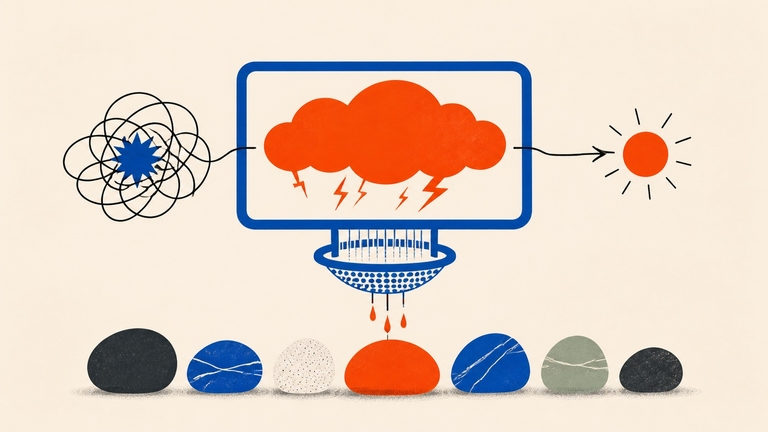
The Calm Beyond Anxiety handles the cognitive half, and its ABCD method is the most reproducible thing in the pack. Activating event: name the trigger precisely, including time and place. Beliefs: write down the automatic interpretation. Consequences: note what the belief did to your body and behaviour. Disputation: argue with the belief using evidence. Its worked example is a meeting invite with the subject line "Discussion needed": belief, "I must have made a serious mistake, my job is at risk"; consequences, racing heart and an urge to update your résumé; disputation, that previous unscheduled meetings have often been about new work. Written down, the gap between event and reaction becomes visible. Held in your head, it does not.
The mistake that costs most here is treating every unpleasant sensation as evidence of damage. The second is chasing calm before establishing a baseline, which leaves you unable to tell whether anything you changed did anything.
The physiology and the breathing protocols are covered in The Science Of Stress Relief; the daily cortisol rhythm and the baseline-first method in Break Free From The Cortisol Cycle; the cognitive work and boundary-setting in The Calm Beyond Anxiety.
Sleep, and the clock it runs on
Sleep has the worst ratio of importance to attention paid, and it is the layer where people buy things before adjusting anything free.
Sleep Smarter for a Better Life is direct about the order: fix the clock, then the room, then the routine. Light is the strongest cue for resetting the clock, and its "circadian light commandments" are a short, unglamorous list:
- See sunrise, or use a therapy lamp, within an hour of waking.
- Work near a bright window mid-morning.
- Take a daylight "booster shot" at lunch.
- Dim household lights after sunset.
- Use amber glasses or screen filtering after 8pm.
For the lamp it gets specific: 10,000 lux, 16 to 24 inches from your face at a 45-degree angle, 20 to 30 minutes within an hour of waking. It claims correct timing can advance sleep by up to 45 minutes, a modest number of the kind this genre rarely settles for. Its other transferable idea is the pre-sleep buffer zone: a defined stretch before bed that is not for work, arguments or screens, treated as part of the night rather than the end of the day.
The Power of Mindful Mornings takes the other end of the same 24 hours, and its most useful move is refusing the premise. It declines to argue for a 4am wake-up or membership of the 5am club, and builds around the first 90 minutes after you actually get up. It pairs a seven-step morning routine with an evening preparation protocol, which is the real insight: the morning is mostly decided the night before, by someone too tired to decide well. Laying out what tomorrow starts with is a two-minute job that removes the whole opening negotiation.
The mistake that costs most is spending money before adjusting light. The second is judging a new routine on how one morning felt rather than tracking it across a fortnight.
The circadian and environment work is covered in Sleep Smarter For A Better Life; the morning and evening routines in The Power Of Mindful Mornings.
Energy: what you eat, how you move
Here the advice is loudest and the effective dose is smallest.
The Science of Stress Relief is worth borrowing from here for its minimum effective dose argument: the smallest activity that produces a meaningful biochemical change, citing work in the British Journal of Sports Medicine. Its most quotable finding is that a single session of moderate activity can lower cortisol for up to 23 hours afterwards. Not a training programme. One walk.
Fitness Without Hustle names the opposing belief the hustle trap: the conviction that anything under an hour is not worth starting. Its 20-minute framework sorts sessions by time of day and purpose rather than muscle group: a morning energiser between 6 and 8am, an afternoon reset between noon and 2pm for the energy crash, an evening wind-down between 6 and 8pm aimed at releasing tension rather than building anything. The afternoon slot is the one most people skip and the one aimed squarely at the 3pm collapse. Its recovery chapter runs on a 3R structure: rest as deliberate energy preservation, reflect for clarity, reset for fast recovery under pressure.
Natural Energy Boost is the nutrition-side reference: cellular energy production, macronutrients and micronutrients, meal timing, and a chapter on balancing blood sugar for steady energy that is the practical core. Most self-diagnosed "afternoon energy problems" are a blood sugar shape produced by what happened at lunch. It also covers adaptogens and supplements, more carefully than most, which is still the section to read sceptically.
The 15-Minute Wellness Blueprint argues against the hours-required myth from the habit end: 15-minute meals, equipment-free routines, and a micro-habit approach designed to work without motivation, on the sensible grounds that motivation is the input least available to this reader.
The mistake that costs most is the all-or-nothing threshold: deciding a 15-minute walk does not count, and doing nothing for six weeks. The second is using energy tactics as a substitute for the sleep layer underneath.
Nutrition and the blood sugar mechanics are covered in Natural Energy Boost; the short-session training framework and the 3R recovery structure in Fitness Without Hustle; habit design at the 15-minute scale in The 15 Minute Wellness Blueprint.
Attention, which is what you are actually short of
Most people arrive here through attention. They cannot focus, so they look for a fix, and the fix is usually a blocker app installed before anyone established what is being blocked.
Digital Detox for Founders fixes the sequence with its attention audit system, and the framing is good: attention as a bank account, where every switch is a withdrawal, and most people have no idea how many they make before noon. The audit is three days of tracking without changing anything: for each switch away from your main task, record the time, what pulled you, and what you were doing. Three columns, three days, no judgement. Only then does the book move to environment design and its reset protocol. You cannot fix a leak you have not located, and almost nobody guesses their own pattern correctly.
Mindfulness at Work supplies the in-the-moment technique, and the STOP sequence is as simple as it looks: stop what you are doing, take a breath, observe your thoughts and surroundings, proceed deliberately. It recommends running it between 90-minute focus blocks rather than during them, plus 60-second transitions between tasks to clear what it calls attention residue: the part of your head still working on the last thing.
Mindfulness for Creators covers the case where the work itself is generative, and its central image earns its place: creative energy is a garden rather than a deep well, so the question is what conditions produce output rather than how hard you can pull. It maps block patterns before offering interventions, which matters because a block from fatigue and a block from fear need opposite responses.
The mistake that costs most is installing tools before auditing behaviour. The second is treating a creative block as a discipline failure, which reliably makes it last longer.
The audit method and environment design are covered in Digital Detox For Founders; the in-the-moment techniques and focus blocks in Mindfulness At Work; creative energy and block patterns in Mindfulness For Creators.
The demand side, which decides the rest
Everything above assumes the load is fixed and your job is to absorb it better. That assumption is where most wellness advice goes wrong.
Work-Life Balance for Ambitious Minds starts with detection rather than repair, cataloguing the early warning signs people miss in three groups (physical red flags, emotional indicators, cognitive fog) then asks you to build a personal warning system from the ones that apply. Its argument that energy beats time as a planning unit rests on separating energy into four types, beginning with the physical, on the observation that when physical energy is low nothing else is available either. Its most practical chapter is the strategic no: why yes is easier, how to decline without damaging the relationship, and the idea of being selectively available rather than perpetually reachable.
Mindfulness for Everyday Life handles the hours that are not work at all, and its micro-moments argument is the accessible entry point: presence practised in queues, commutes and meals rather than in a dedicated 20-minute block you will not schedule. Its kit includes a guide to the RAIN framework, the widely used four-step sequence for sitting with a difficult feeling rather than arguing with it.
The mistake that costs most is treating "no" as a character trait you either have or lack. It is a sentence, and the people who say it well have said it before, out loud, in advance. The second is waiting for a crisis to prompt a review: exactly what the warning-system chapter exists to prevent.
Burnout detection, boundaries and the strategic no are covered in Work Life Balance For Ambitious Minds; everyday practice and resilience in Mindfulness For Everyday Life.
How to start this week
Three things, no budget, in this order. None require finishing anything you have already started.
- Run the three-day attention audit. Time, trigger, and what you were doing, every time you switch away. Change nothing while you collect it. The pattern that comes out is almost never the one you would have predicted.
- Move your light. Daylight within an hour of waking, five mornings running; lights down after sunset; screens amber after 8pm. Free, and you will know inside a week whether it did anything.
- Write down your next three likely yeses, and the sentence you will use instead. Not a policy: three specific requests you can already see coming, and the exact words. Rehearsed declines are the only kind that survive the moment.
Then do the smallest thing available: a 20-minute walk this afternoon, at the hour you normally crash. The point is not the walk. It is finding out how small the effective dose is before you build anything larger on top of it.
Related guides
If the demand-side section landed hardest, the constraint is how the work is organised rather than how you recover from it: the focus and productivity guide covers that directly. And if you recognised the over-committing more than the tiredness it produces, the confidence and career guide deals with where that habit comes from.
Take the whole pack
Related reading
A structured way to argue with an anxious thought
A four-step method for testing an anxious thought against evidence, plus a plain note on when the problem needs more than a method.
Read more
A wellness routine sized to fifteen minutes, on purpose
A wellness routine sized to fifteen minutes, using a three-component meal formula and a two-minute habit rule.
Read more
Falling asleep starts with light, not the mattress
Falling asleep faster starts with morning light and room temperature, not a new mattress or more hours in bed.
Read more