
What your creative block is signaling
The blank page doesn't move, no matter how long you stare at it, and the standard advice (push through, set a timer, just start typing) treats the block like a discipline problem. Mindfulness for Creators argues that's usually wrong. A block is information about what's actually happening underneath the stuck feeling, and the fix depends on reading it correctly rather than muscling past it.
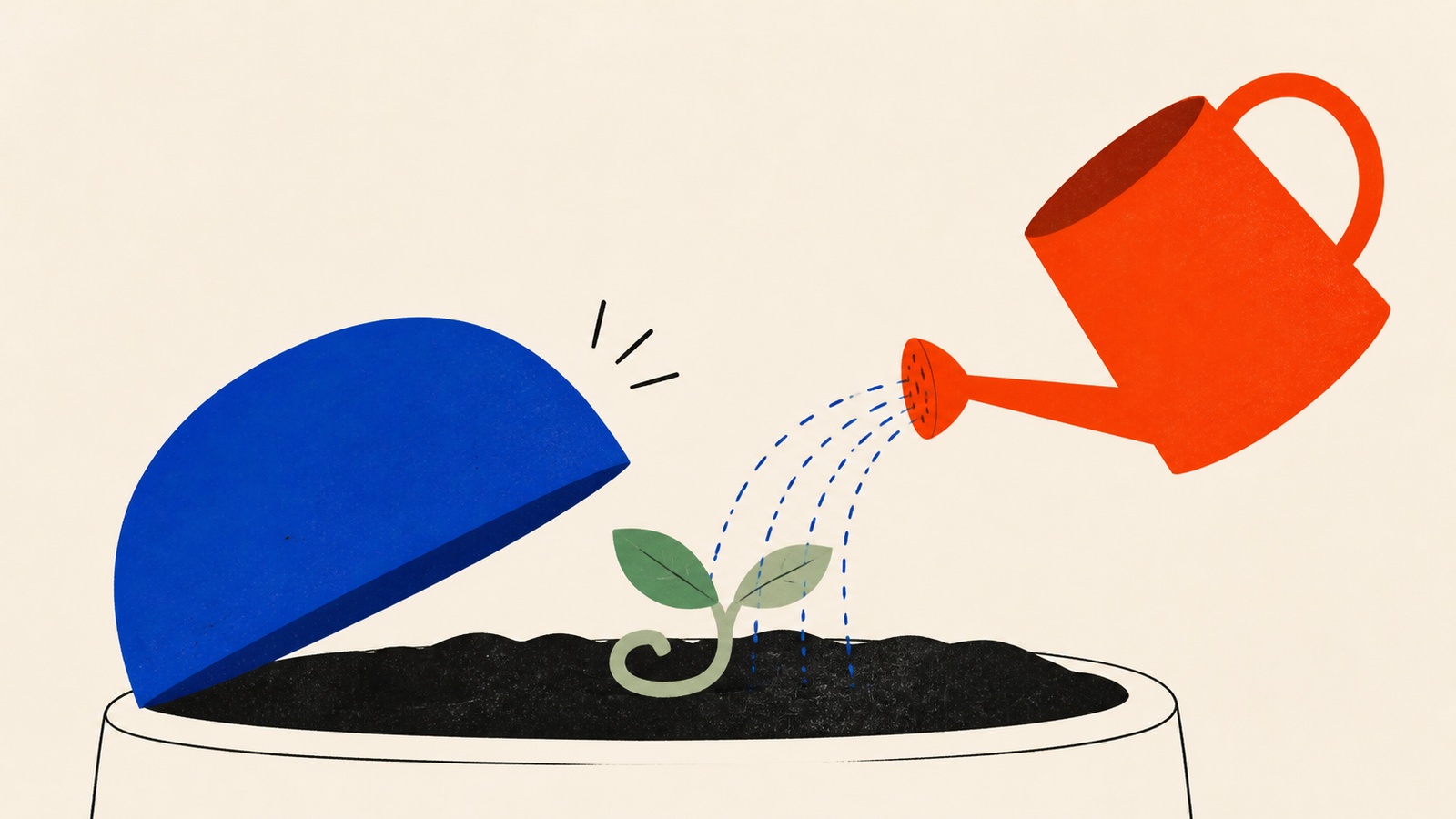
The book's central image reframes the whole problem: creative energy behaves like a garden, not a deep well you can draw from indefinitely if you just try harder. A well runs dry from overuse. A garden needs specific conditions (the right timing, the right recovery) to keep producing anything at all. Pushing through a block when the actual issue is depleted energy doesn't get you unstuck. It just produces worse work, more slowly, while making the depletion worse.
There's a mechanism behind why pushing through so often backfires. The book describes stress hormones like cortisol as dampening activity in the brain regions involved in decision-making and problem-solving: static interference on the creative signal, in its phrasing. It's not a reason to treat every stuck moment as a crisis. It's a reason to notice that forcing output during a stress spike is working against the same system you're trying to use. The book also points to mindful mind-wandering as a counterintuitive fix: a writer stuck on a scene who takes a walk, noticing sensations rather than forcing a solution, is more likely to have the idea arrive on its own than the writer who stays at the desk grinding against the same paragraph.
Reading the block instead of fighting it
The book maps three common block patterns, each with its own physical signature, its own default thought, and a mindful response that actually matches the mechanism instead of just papering over it.
| Block type | Physical signs | Common thought | Mindful response |
|---|---|---|---|
| Perfectionism | Shoulder tension, shallow breathing | "Never good enough" | Self-compassion practice |
| Imposter syndrome | Racing heart, nausea | "They'll know I'm fake" | Reality-testing |
| Analysis paralysis | Mental fatigue | "Need more research" | Action-oriented mindfulness |
The book traces one designer's recurring block (endless refinement of nearly finished work) back past the surface symptom to where it actually started: early creative criticism that had shaped a perfectionist reflex years before it showed up as a stalled project. The tactic that would have addressed the surface (a workspace change, a short break) wouldn't have touched that. The mindful response that does is self-compassion practice specifically, because the block isn't really about the work: it's about an old, automatic prediction of judgment attaching itself to new work.
Underneath block type sits a second layer: energy state, which the book treats as a separate axis worth tracking on its own.
| Energy state | Signs | Best matched to | Recovery |
|---|---|---|---|
| Peak flow | High inspiration, effortless focus | Complex creation | Light breaks |
| Steady state | Consistent output, good focus | Refinement work | Regular pauses |
| Low tide | Decreased motivation, scattered attention | Planning, admin | Active recovery |
| Depletion | Exhaustion, resistance | Essential only | Full reset |
A block during low tide or depletion isn't a creative problem at all: it's an energy problem wearing a creative-block costume, and no amount of technique fixes a mismatch between the task and the tank you're pulling it from. The book's answer is to apply RAIN directly to the block itself: recognize what's actually happening, allow the stuck feeling to be there without fighting it, investigate whether it's a block pattern or an energy state, then nurture yourself with whatever the diagnosis calls for rather than a generic fix.
For the moment a block hits and you need something immediate, the book offers sensory grounding, also known as 5-4-3-2-1:
- Notice five things you can see.
- Feel four different textures.
- Listen for three distinct sounds.
- Identify two scents.
- Name one taste.
It's a short-circuit for the spiral, not a solution to the underlying pattern, useful in the moment, but meant to buy the clarity to figure out what's actually going on, not to replace that work.
Where people go wrong
The first mistake is treating every block as a discipline failure and pushing through regardless, which sometimes produces output, but rarely good output, and reliably makes the next block worse.
The second is misreading which layer the problem is in: applying a block-pattern technique like self-compassion to what's really a depletion problem, or the reverse, reaching for a full reset when what was actually needed was ten minutes of grounding and a return to the page.
The third is collecting techniques without ever doing the underlying audit: trying a new mindfulness trick every time a block hits instead of tracking the pattern over a few weeks and noticing it's always perfectionism on Tuesdays after a feedback call. The book's own audit process is closer to a weekly habit than a one-time diagnosis: pause, without judgment, and note the physical sensations, the emotional state, and the thought pattern that showed up, rather than assuming this block is the same as the last one. How creative energy fits against sleep and the rest of what's drawing on the same reserves is covered in the full wellness guide.
Inside Mindfulness For Creators
Going deeper
- AudioThe Creator's Flow
- BookMindfulness for Creators
- ChecklistCreative Block-Breaking Action
- ChecklistMindful Project Planning
- GuideThe Creative Energy Management System
- Mini-CourseCreative Flow Switch
Mindfulness For Creators is one of 13 bundles in The Calm & Energy Pack, or take the whole pack for $29.
Related reading
Stress, sleep and energy for people who work too much: the complete guide
How stress, sleep, food, movement, attention and boundaries stack up for busy people, in dependency order, and what to fix before anything else works.
Read more
A structured way to argue with an anxious thought
A four-step method for testing an anxious thought against evidence, plus a plain note on when the problem needs more than a method.
Read more
A wellness routine sized to fifteen minutes, on purpose
A wellness routine sized to fifteen minutes, using a three-component meal formula and a two-minute habit rule.
Read more