
Brand building when nobody has heard of you: the complete guide
Updated September 2026

Everyone repeats that a brand is not a logo, and then spends the first weekend on the logo anyway. It is the most forgivable mistake in small business, because the logo is the only part of the job that looks like a finished thing at the end of an afternoon. Positioning does not. Voice does not. You can work on those for a week and have nothing to show anyone.
This guide is for people running a business small enough that they are the brand department: freelancers, consultants, one-person product businesses, teams of three or four selling to people who have never heard of them. If you have a brand strategist on retainer and an in-house design team, you already have opinions about the sequencing below, and should skip it. It is also the wrong guide if you have not sold anything yet: positioning is a claim about who you are useful to, and until someone has paid you, that claim is a guess. Sell something first, badly, to the wrong person. Then come back.
The map: five layers, and why the order matters
Brand work splits into five layers: positioning, story, voice, look, and reputation. They are not interchangeable, and almost everyone works them in reverse order.
Positioning comes first because every layer under it is a decision that needs a filter. What font, what tone in a refund email, whether to take a particular client: cheap decisions if a sentence settles them, exhausting ones if not. Positioning is not a slogan. It is the thing a slogan would have to be true to.
Story comes second because it is the evidence for the positioning claim. A positioning statement asserts you are the obvious choice for a particular kind of person; an origin story is why that assertion reads as believable rather than aspirational. Most small businesses skip this layer, assuming nobody cares why they started. People care, but only when the story is about the reader's problem and not the founder's feelings.
Voice comes third, and the ordering claim here is the one worth arguing. Voice work done before positioning produces the same result every time: "friendly, professional, approachable." Those three adjectives are the absence of a voice, and you get past them only once you know who you are not for.
Look comes fourth, which is the inversion most people make. Visual choices made before you have language for the brand are taste, not identity. The test is not whether you like the colour: it is whether you can tell someone else why it is wrong when they get it wrong. Without adjectives, you cannot, and you end up as the sole bottleneck on every design decision forever.
Reputation comes last in sequence and first in economics, and it is the only layer you do not control. It compounds in whichever direction the first four point it, because reviews and word of mouth are a distribution system for whatever experience already exists. Asking for reviews before the experience is designed simply publishes an average experience faster.
Positioning: the sentence everything else obeys
Most positioning exercises collapse into a document nobody reads again. The useful version ends in one sentence you use as a filter.
Build a Brand That Sells gives the template plainly: "For target audience, we are the type of offering or business that key benefit or solution because core reason or differentiator." The "because" clause is where nearly every draft falls apart. It asks for a differentiator, and most people write a quality claim there (because we care, because we are thorough) which does not differentiate when the alternative says it too. The book's own three-step method for finding the gap is deliberately mechanical: identify your main competitors, note their audience, benefits and personality, then spot the unmet need. Its example is two music apps: one sells songs, the other offers personalised playlists and social sharing. The second is not better; it answers a question the first ignores.
The same book argues the statement should govern product decisions too: a filter for what you build, not a caption for what you already built.
When you are the business, the problem changes shape. Personal Branding Expertise works that version: a unique value proposition built from your core strengths and a named target audience, then a content strategy that turns it into visible expertise rather than a claim on an about page. Its most useful chapter is the one on the obstacles to writing a UVP, because the real obstacle is rarely the formula. Naming a specific audience means turning down work, and most people drafting their first UVP cannot yet afford to.
The mistake that costs most here is writing the sentence and then never using it. A positioning statement that has not caused you to decline something is decoration.
The full positioning and brand-foundation work is covered in the Build A Brand That Sells post; the version where you are the product is in Personal Branding Expertise.
Story: the origin, and the launch
An origin story is not autobiography. It is the shortest piece of evidence that your positioning claim is not marketing.
The Founder's Story Formula is unusually strict about this, and its cleanest idea is the distinction it draws between emotion and ego. Vulnerability that serves the audience is the useful kind; vulnerability that serves the teller makes readers uncomfortable and leaves them with nothing. The practical tool is the 30-3-30 rule: adapt one core story into a 30-second version, a 3-minute version and a 30-minute version, without losing the essence. Most founders have only ever told the 30-minute version, to friends, and so freeze when a stranger asks what they do.
The book pairs that with a quarterly story-purpose audit, checking whether new offers still echo the original narrative, as a defence against what it calls narrative drift: the failure mode where a business slowly becomes something its own story no longer explains.
Launches are the same material under time pressure. Product Launch Storytelling Secrets structures a launch around a five-stage narrative arc:
- Status quo: establish the reality your audience currently lives in.
- Tension: name the growing pain or the missed opportunity.
- Big reveal: introduce the solution.
- Transformation: show the concrete before-and-after.
- Future vision: describe the reality now available.
What lifts this above a story template is that the book maps each stage to a different asset and a different reader: a blog post for the early-research reader at status quo, an email series for the problem-aware reader at tension, a case study for the sceptical evaluator. Launches fail when all five stages arrive on the same day, in one email, aimed at everyone.
The founder-narrative work is covered in The Founders Story Formula; the launch-sequence version in Product Launch Storytelling Secrets.
Voice: how you sound when you are not in the room
Voice is what stays constant. Tone is what moves. Conflating the two is why most style guides are useless: they either freeze the writer into one register or leave so much room that nothing is decided.
Brand Voice Breakthrough handles this with what it calls a tone playbook, and the mechanism is worth reproducing because it is concrete. You map two or three tone dimensions (formal to informal, enthusiastic to reassuring) then plot your actual recurring scenarios on them: a customer complaint, a product announcement, a crisis response. For each scenario you draft example phrases showing how the same voice adapts. Its worked example is a financial services firm whose voice is always knowledgeable and straightforward, shown adjusting for a market downturn without becoming either breezy or panicked.
That last part is the whole value. A guide made of adjectives can be applied only by its author; a guide made of example sentences for situations you will actually face can be handed to a contractor.
The sentence-level craft is a separate skill, and Writing That Sticks is the pack's kit for it. Its core idea is the curiosity gap, the tension between what a reader knows and what they want to know, maintained past the opening line rather than spent on it. It is also sensible about the unglamorous mechanics: copywork, a swipe file, active voice, and cutting the sentence you are proudest of when it is not carrying its weight.
The mistake that costs most is writing the voice document you wish were true. A voice guide is working when someone else can draft a sentence you would have approved. Until then it is a wish list.
Voice architecture and the tone playbook are covered in Brand Voice Breakthrough; the sentence-level craft in Writing That Sticks.
Look: the identity, and knowing when to change it
How to Build a Consistent Visual Identity opens on the problem correctly: a founder saying "I want it to pop" or "make it clean" is not giving instructions. Clean could mean the sterile white of a hospital or the warm minimalism of a tea house.
Its fix is a technique it calls the Cocktail Party Test. Imagine the brand as a person at a crowded event: how they dress, how they speak, and above all how the other guests describe them once they leave. If the answer is "they were nice," you have failed, because nice is forgettable. You want authoritative, or rebellious, or nurturing. From there you pick three to five core adjectives across three categories: emotional (how the customer should feel), descriptive (the nature of the service), stylistic (the personality).
Then comes the part most brand exercises omit, and the reason this one produces usable decisions: the anti-adjective. You define the neighbouring word you are not. A logistics company might be "fast" but not "rushed": fast implies competence and points toward sleek, slanted type, while rushed implies chaos. Defining the boundary is what stops a design drifting into adjacent territory that nobody can quite name as wrong.
It is also unromantic about logos, making the case for a simple wordmark over a bespoke symbol, and it has a chapter titled "The Hidden ROI of Boring Consistency": the correct register for this work. Consistency is not exciting, and it is most of the return.
Consistency does eventually become a constraint, and that is a real problem rather than a failure of nerve. The Brand Evolution System for Modern Creators is built for the point where the brand you carefully made no longer fits what you now do. It runs nine steps in three movements: clarify your core identity, audit the current brand, define the future vision; then reframe the message, refine the visual and verbal identity, reintroduce the brand; then re-engage the audience, realign the offers, rebuild visibility. Its listicle of thirteen signals that a brand needs a refresh is the diagnostic half, and the part to read first: the most common reason for a rebrand is boredom with your own work, which is not a signal.
The mistake that costs most runs in both directions: redesigning to avoid selling, and rebranding by deletion, quietly removing the old positioning instead of narrating the change to people who already knew you.
Visual identity from scratch is covered in How To Build A Consistent Visual Identity; the repositioning case in The Brand Evolution System For Modern Creators.
Reputation: the part you do not write
Reputation is the layer where you stop being the author. You influence it in two ways: by designing the moments people remember, and by responding well when something goes wrong.
The Psychology of 5-Star Google Reviews builds on the peak-end rule, Daniel Kahneman's finding that memory of an experience is dominated by its emotional peak and its final moments, while the middle fades. The consequence is specific: the end of an engagement is disproportionately what gets reviewed, and for most small businesses the end is the worst-designed part: a final invoice, a file transfer, silence. One deliberate closing moment costs almost nothing and moves the memory the review is drawn from. The kit's review request protocol handles the other half, timing the ask to land near the peak rather than a fortnight later.
Reviews are the calm-weather version. Build Positive Digital Presence covers the other one, with a crisis chapter built around what it calls the golden hour: acknowledge the issue quickly, gather the facts, convene whoever decides, and become the primary source of information about your own situation before someone else takes that role. It supplies a holding statement to adapt, which is the genuinely useful artefact: the first hour is not when anyone writes well.
Reputation Revolution is the standing-practice kit between the two: translating values into a specific tone, style and vocabulary, keeping that consistent across platforms, and writing the crisis communication plan before it is needed rather than during.
The mistake that costs most is treating a negative review as a dispute with the reviewer. It is a public reply, and the audience is every future customer reading it, most of whom will forgive the complaint and judge you on the response.
Review psychology and the timing of the ask are covered in The Psychology Of 5 Star Google Reviews; crisis response and the wider digital footprint in Build Positive Digital Presence; the ongoing reputation practice in Reputation Revolution.
How to start this week
Two hours, no budget, in this order:
- Write the positioning sentence. "For audience, we are the offering that benefit because differentiator." If the because clause is a quality claim your competitors could also make, you have found the actual problem, and that is progress rather than failure.
- Choose three to five adjectives and one anti-adjective. One emotional, one descriptive, one stylistic, then the neighbouring word you are not. Fast, not rushed. Keep them where you will see them next time you brief a designer.
- Record the 30-second version of your story. Out loud, on your phone, once. The 3-minute version can wait. Most people discover on the first attempt that they have been telling the middle and never the beginning.
Then do the smallest thing on the list: ask one customer from the last month for a review, timed within a day of whatever their best moment with you was. Not the invoice. The moment before it.
Related guides
Once voice and positioning are settled, the next constraint is usually publishing volume rather than clarity: the Content & Creator guide covers turning one idea into a working publishing habit. And if the positioning section made you suspect the underlying offer is the real problem, the Business Foundations guide deals with that directly.
Take the whole pack
Related reading
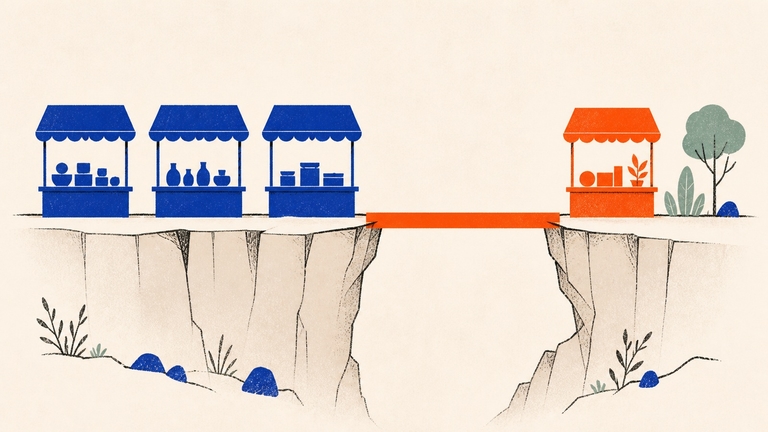
A brand is a system, not a logo
A one-sentence positioning template and a three-step process for finding what actually separates you from competitors, worked through with a real example.
Read more
Brand evolution without losing the audience you already have
A nine-step framework for changing your content or niche without the audience-loss creators fear, built around what stays fixed and what's allowed to move.
Read moreBrand voice consistency: why your company sounds like three businesses
How to translate your core values into one recognizable brand voice, so your Instagram and your invoices don't sound like different companies.
Read more