
A brand is a system, not a logo
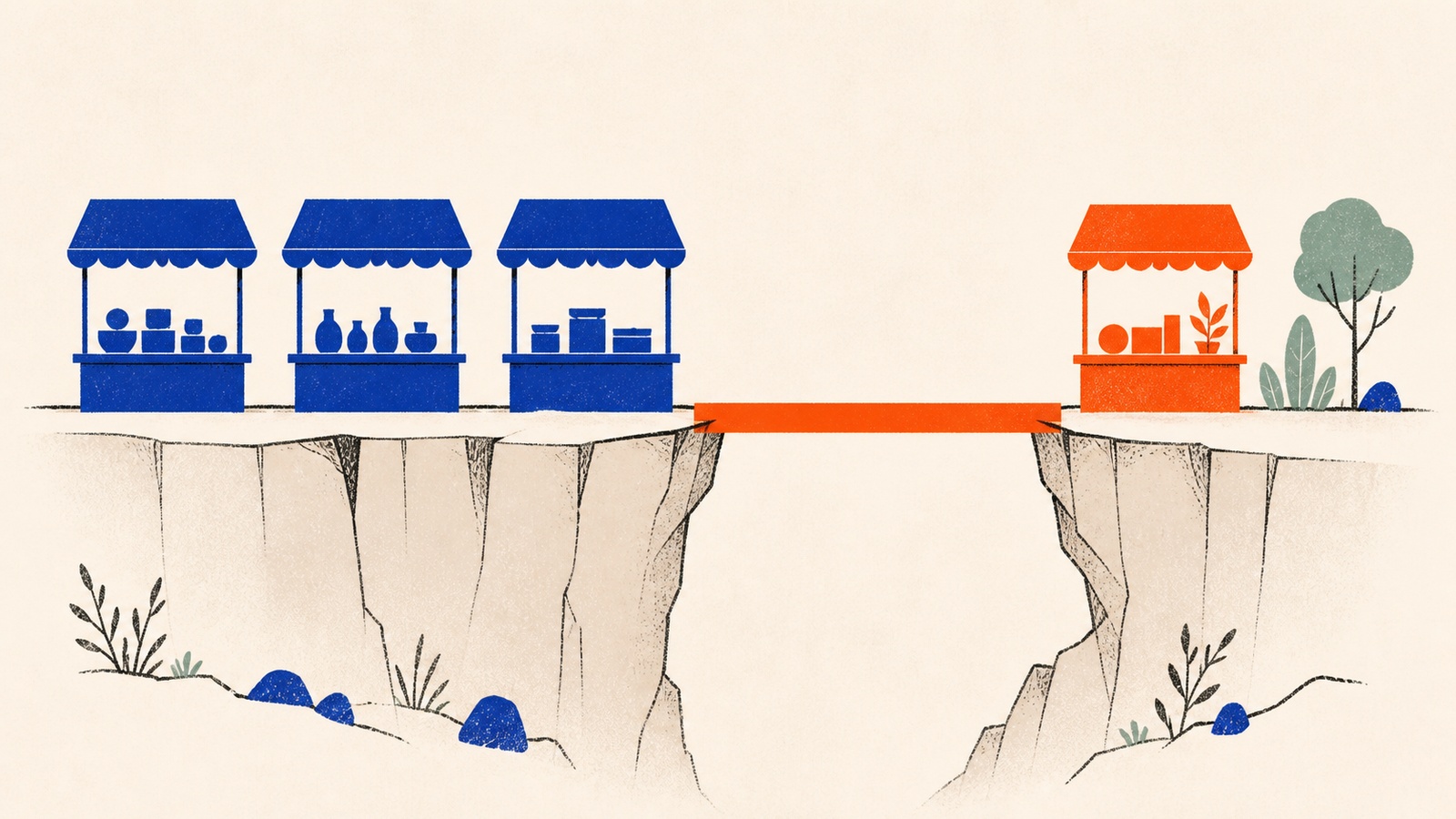
A founder hires a designer, gets a logo, a color palette and a font pairing back within a week, and feels like the brand work is done. Then a prospective customer asks what makes the business different from the three others they're also considering, and the founder reaches for adjectives (quality, reliability, care) that every competitor in the room would also claim.
The logo was never the hard part. It's also not the part that determines whether a stranger chooses you. Research the book cites from CEB puts a number on it: 64% of consumers say they choose a brand primarily because of shared values, not features or price, which makes a vague positioning claim a measurable liability, not just weak copy.
Build A Brand That Sells starts somewhere less visual: a single sentence that has to be true before any color gets picked, and a method for finding the one claim in it that a competitor genuinely couldn't make.
The positioning sentence, and the gap it has to name
Before the sentence, the book asks two earlier questions, because positioning without them tends to drift: what specific problem does your work solve, and what would genuinely disappear if your business closed tomorrow. The answers become a one-sentence mission: plain, jargon-free, specific enough to filter out the wrong clients along with the right ones.
The book's template for the sentence itself: "For target audience, we are the type of offering or business that key benefit or solution because core reason or differentiator."
Almost every draft falls apart at the last clause. People write a quality claim there (because we care, because we're thorough), and a quality claim isn't a differentiator, because the competitor down the street would sign their name to the same sentence. The "because" has to name something the alternative can't say, or the whole sentence is decoration dressed as strategy.
To find that gap, the book gives a three-step process rather than asking you to intuit it:
- Identify your main competitors.
- Note their audience, their stated benefits, and their personality.
- Spot the unmet need or the clear gap none of them are naming.
Its worked example is two small music apps. One sells songs. The other offers personalized playlists and social sharing built around the same catalog. The second app isn't objectively better: it's answering a question the first one never asked, which is what makes its positioning defensible instead of interchangeable. A good positioning statement names what the alternative is quietly failing to do, not what you happen to be proud of.
The book pushes this further than most branding guides: a positioning statement worth having should be able to guide product decisions, not just marketing copy. If a proposed feature doesn't serve the "because" clause, that's useful information about the feature, not the sentence.
Before treating a draft as final, the book asks you to share it with actual customers and watch for a "so what?" reaction: the tell that another pass is needed. It also asks for proof behind the claim: data, testimonials, or a documented method, because a differentiator with no evidence behind it reads as just another marketing line people have learned to tune out.
Where people go wrong
The first mistake is writing the sentence once, in a workshop, and never opening the document again. A positioning statement that hasn't caused you to turn down a client or cut a feature is a wall poster, not a working filter.
The second is skipping the competitor research entirely and guessing at the gap from memory. Most founders overestimate how differentiated their offering already sounds to someone who hasn't spent eighteen months living inside it: the three-step process exists specifically to correct for that blind spot.
The third is confusing personality with positioning. "Bold" and "friendly" describe how you sound; they don't answer why a stranger with three options should pick the one from your business. Values only become a differentiator once they're observable in behavior rather than listed in a mission statement: the book's own comparison is two coffee shops that both claim "community," where one hosts weekly events and knows regulars by name and the other just has the word in its bio. Customers can tell the difference without being told which is which.
The full sequence (where positioning sits relative to story, voice, look and reputation, and why the order matters) is in the brand-building guide.
Inside Build A Brand That Sells
Going deeper
- AudioThe Identity Advantage
- BookBuild a Brand That Sells
- ChecklistBrand Consistency System
- ChecklistDefining Your Brand Foundation
- GuideThe Core Brand Canvas
- GuideThe Core-to-Micro Method
- Mini-CourseBoost Your Branding in 6 Days
- Prompt PackStrategic Brand Building
- ToolstackPower Up Your Brand
Build A Brand That Sells is one of 11 bundles in The Brand & Story Pack, or take the whole pack for $29.
Related reading
Brand building when nobody has heard of you: the complete guide
Positioning, story, voice, visual identity and reputation, in the order they actually depend on each other, and what to do first with no budget.
Read more
Brand evolution without losing the audience you already have
A nine-step framework for changing your content or niche without the audience-loss creators fear, built around what stays fixed and what's allowed to move.
Read moreBrand voice consistency: why your company sounds like three businesses
How to translate your core values into one recognizable brand voice, so your Instagram and your invoices don't sound like different companies.
Read more