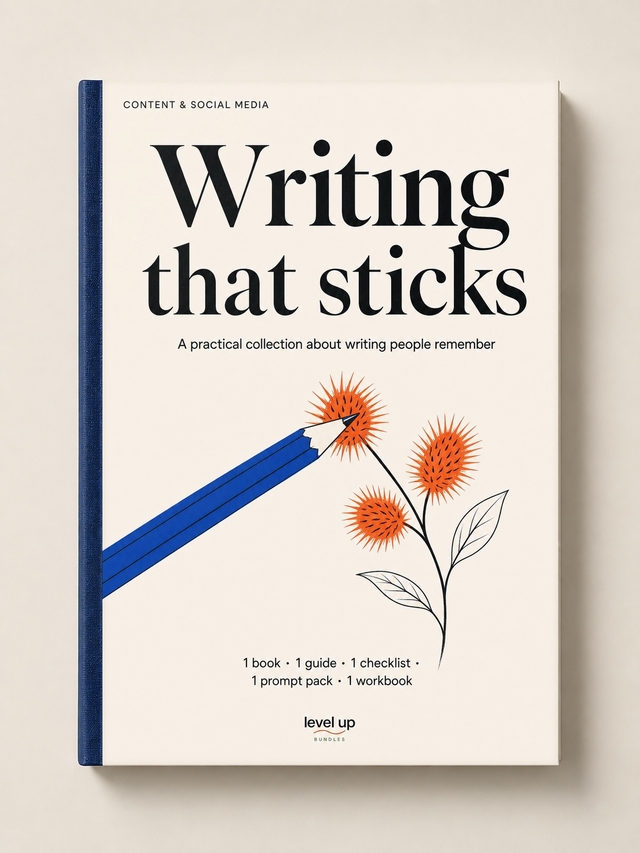
Writing That Sticks Ebook
Most writing is forgettable on contact. The reader gets through it, can't remember what was said by the next morning, and certainly can't repeat the line that mattered. Writing that sticks, the kind that gets quoted, screenshotted, repeated in meetings, uses a small, learnable set of techniques that almost no business writer was ever taught.
The kit covers stickiness as a craft. The ebook lays out the framework, a guide walks through the practical moves (concrete imagery, surprise, structure, story shape), a checklist gates whether what you've written has the elements that survive memory, a workbook turns the framework into your own writing-rebuild plan, and a prompt pack handles the AI-assisted draft work that finally produces lines worth keeping.
Built for the writer or founder whose writing reads as professional and isn't being remembered, and ready to be both.
Contents
In this bundle
5 items, in reading order.
 Book
BookWriting That Sticks - Ebook
Most writing falls flat because the writer skipped the structural work that distinguishes memorable copy from forgettable copy, then blamed audience attention spans. The work that makes writing stick is teachable, and most of it isn’t about talent. This ebook is the long-form treatment: the purpose-and-audience definition that anchors every piece around what it’s actually for, the hook craft that earns the first paragraph (with the specific patterns that work versus the ones that read as clickbait), the flow-and-rhythm work that prevents the meandering middle, the active-voice and sentence-variation discipline that makes prose readable, the jargon-and-simplification pass that handles complex ideas without dumbing them down, the emotional-engagement and persuasion work that turns information into action, and the field-tested examples that show what writing-that-sticks actually looks like in practice. Built for the writer ready to stop publishing forgettable content.
 Checklist
Writing That Sticks - Checklist
Most writing falls flat because the operator wrote without a clear purpose, and the reader could feel the meandering even if they couldn't name it. The structure that produces writing that sticks is more disciplined than people expect. This checklist sequences the writing pass: the purpose definition that decides what the piece is actually for (versus the vague "share thoughts"), the audience-and-context pass that catches the implicit assumptions about the reader, the hook design that earns the first paragraph, the structure decisions that prevent the meandering middle, the emotional-engagement check that catches the dry stretches, the call-to-action that converts attention into next-step, and the post-publish review that surfaces what worked. Pair with the writing-that-sticks guide for the strategic frame; this checklist is the per-piece writing pass.
 Guide
GuideWriting That Sticks - Guide
Most writing fails at one of four predictable layers: unclear purpose, weak hook, broken flow, or zero emotional engagement. The writing that sticks runs all four well. This guide installs the practice: the purpose-definition work that anchors every piece around what it's actually for, the hook-techniques that earn the first paragraph (with the specific patterns that work versus the ones that read as clickbait), the flow-and-transition work that prevents the meandering-middle problem, the emotional-engagement moves that turn information into something readers care about, the persuasion-checklist that catches the gaps in argument, and the implementation framework that turns the principles into reflexive writing skill. Pair with the writing-checklist for the per-piece pre-flight; this guide is the strategic writing-quality framework.
 Prompt Pack
Writing That Sticks - Prompts
Writing work eats time in the structured drafting jobs: the next blog post, the email, the social caption, the case study. The pack moves those jobs to AI-assisted starting points: purpose-and-message prompts that decide what the piece is actually trying to do before drafting starts, hook-and-headline prompts that produce variants worth testing instead of one safe opener, flow-and-transition prompts that catch the structural breaks in drafts, emotional-and-persuasion prompts that lift writing past the merely informative, and clarity-and-CTA prompts that handle the editing pass without homogenizing voice. Drop them into Claude or ChatGPT alongside the actual writing context. Pair with the writing-that-sticks guide for the strategic frame; the prompts are the working session that produces the next piece.
 Workbook
Writing That Sticks - Workbook
The Writing That Sticks ebook covers the principles and patterns; this workbook is where the writer does the actual work on their actual content. The pages walk through structured exercises: the purpose-definition work for the writer’s next piece (specific, not vague), the audience-connection mapping that grounds the writing in real reader concerns, the practical-writing techniques applied to the writer’s actual draft (active voice, sentence variation, jargon removal), the persuasion-and-engagement exercises that test whether the writing actually moves the reader, and the revision-and-iteration prompts that turn first drafts into pieces worth publishing. Each exercise produces real changes to the writer’s actual work. Pair with the writing ebook for the strategic frame; this workbook is the do-the-work layer that produces measurably better writing by the end.