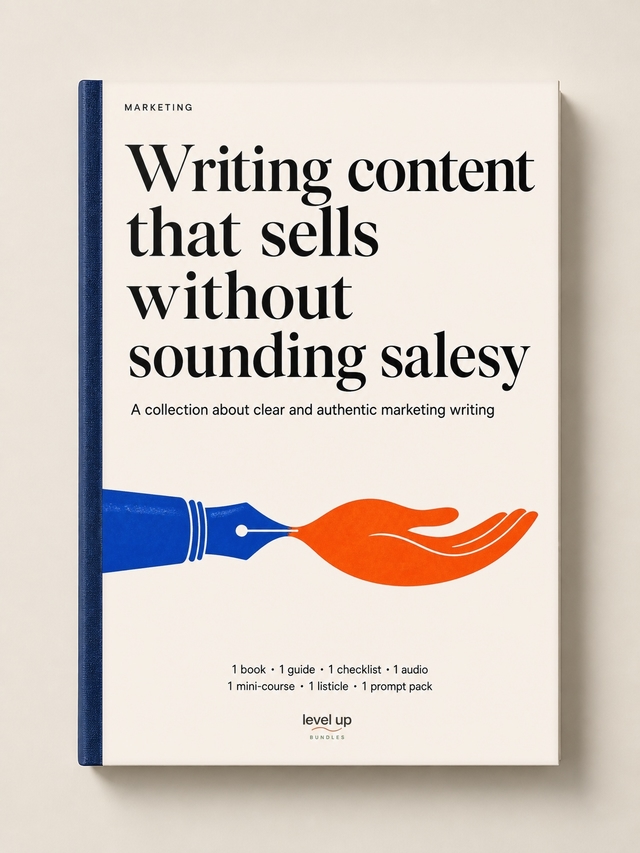
Writing Content That Sells Without Sounding Salesy
The selliest copy is usually the copy people respect least. Operators with a strong audience know it; the trade is short-term conversion against long-term trust, and the right answer is content that sells without performing the sale. The frameworks for this are well-known to professional copywriters and rarely shared with the rest of marketing.
The kit covers authentic-sells writing. The book lays out the framework, a customer language collector guide handles the upstream research that makes copy land, a "crafting narratives that sell naturally" checklist gates whether what you wrote is selling or just performing, a listicle surfaces the seven ways to sell without losing credibility, an 8-day "authentic marketing" mini-course turns the framework into a working week, and an authentic marketing prompt pack handles the AI-assisted drafting. The audio companion frames words-that-win thinking.
For the marketer or founder who's tired of writing copy they're embarrassed to have under their name and ready to write copy that sells anyway.
Contents
In this bundle
7 items, in reading order.
 Audio
AudioWords That Win
Most copywriting advice teaches manipulation tactics and produces copy that the buyer can smell from across the page. The actual high-converting copy is honest, specific, and built around what the customer actually says about the problem (not what the marketer wishes they'd say). The three-episode audio series covers the practice: episode one walks why authentic language outperforms hype every quarter, episode two installs the customer-language-collection practice that turns interview transcripts into copy that converts, episode three breaks the science of story-based selling and why it works at the brain-stem level. Each episode includes the moves to test in the next campaign. Made for commute listening. Pair with the ebook for the long-form treatment; the audio is the briefing version.
 Book
BookWriting Content That Sells Without Sounding Salesy
Most online sellers are caught between two failure modes: the manipulative copy that converts short-term and burns trust, and the timid copy that doesn't convert at all. The honest middle path is structured and learnable, and the operators running it consistently outperform both alternatives. This ebook is the long-form treatment: the customer-language collection that grounds copy in what the buyer actually says, the storytelling structure that earns attention without feeling forced, the value-presentation work that turns features into the outcomes the buyer cares about, the persuasion-without-manipulation principles that respect the buyer, the call-to-action craft that converts without yelling, the editing pass that catches the corporate-speak drift, and the testing approach that improves the copy across launches. Built for the operator whose product is good and whose copy is the bottleneck on conversion.
 Checklist
Crafting Narratives That Sell Naturally
Most marketing copy fails at storytelling because the operator wrote a feature list and called it a story. The structure that produces stories that actually move buyers is more disciplined than people expect. This checklist sequences the storytelling pass: the audience-language pass that grounds the story in real customer words, the conflict-and-tension setup that earns attention past the first paragraph, the specificity check that prevents the generic-story collapse, the deployment plan that places the story at the right point in the funnel, the social-proof integration that supports the narrative without interrupting it, and the editing pass that catches the over-polished moments that read as fake. Run it on every story-driven asset before it ships. Pair with the customer-language guide for the source material; this checklist is the per-asset storytelling pass.
 Guide
GuideThe Customer Language Collector
Most copy underperforms because the operator wrote in their own language, when the buyer makes purchase decisions in their own. The customer-language collection practice closes that gap. This guide installs the practice: the customer-language basics that explain why this is the highest-leverage research the marketer can do, the research methods that pull real language from interviews, support tickets, reviews, and forum mentions, the organization-of-insights work that turns raw quotes into a usable language bank, the writing practice that uses the bank without sounding like a quote-stitch, the field-tested examples that show before-and-after copy improvements, and the message-testing loop that catches what's actually landing. Pair with the storytelling checklist for the per-asset work; this guide is the upstream language-collection practice.
 Listicle
7 Ways to Sell Without Losing Credibility
Most "ethical sales" content is so timid it stops short of asking for the sale, and the operator who follows it converts at lower rates than the manipulative competitor they were trying to avoid. The honest middle path produces both credibility and conversion. This listicle catalogs seven specific moves: the explicit-trade-off conversation that earns trust by naming what the buyer gives up by buying, the qualification-up-front practice that prevents wasted sales calls, the price-transparency move that's harder to do and more effective than dancing around, the alternative-options acknowledgment that signals real expertise, the post-sale-honesty pattern that earns referrals, the no-pressure close that lets the prospect actually decide, and the follow-up-as-care practice that distinguishes from chasing. Each move has the diagnostic and the implementation. Made for desk reference. Pair with the customer-language guide for the upstream work; this listicle is the integrity-first sales menu.
 Mini-Course
8 Days to Authentic Marketing
Most "authentic marketing" courses are vibes-driven content that produces no behavior change, and most students finish with the same copy and the same conversion rates. This drip course runs the practical install across the working week: lesson one names why traditional marketing feels manipulative and what's structurally different, lesson two installs finding the operator's authentic voice across content, lesson three covers connecting through honesty, clarity, and relevance, lesson four lands aligning marketing with personal values and customer needs, lesson five handles storytelling that feels natural rather than performed, lesson six builds the trust-over-hype frame for long-term customer relationships, lesson seven sets the prompts and reflections that make marketing easier, lesson eight installs the daily-practice structure that holds without burning out. Built for the operator who wants the copy to convert and to be honest at the same time.
 Prompt Pack
Authentic Marketing Assistant
Authentic-marketing work eats time in the structured drafting jobs: the next email, the social post, the landing page, the customer story. The pack moves those jobs to AI-assisted starting points: audience-understanding prompts that produce real persona work from raw research, brand-voice prompts that hold tone consistent across writers and channels, story-and-narrative prompts that turn customer experiences into shareable stories without flattening them, persuasion-without-pressure prompts that handle the conversion moments respectfully, readability prompts that catch the corporate-speak drift, platform-adaptation prompts for the same message across Instagram, email, and LinkedIn, and feedback-and-improvement prompts that turn each piece into the next iteration. Drop them into Claude or ChatGPT alongside the actual brand context. Pair with the authentic-marketing course for the strategic frame; the prompts are the working session.