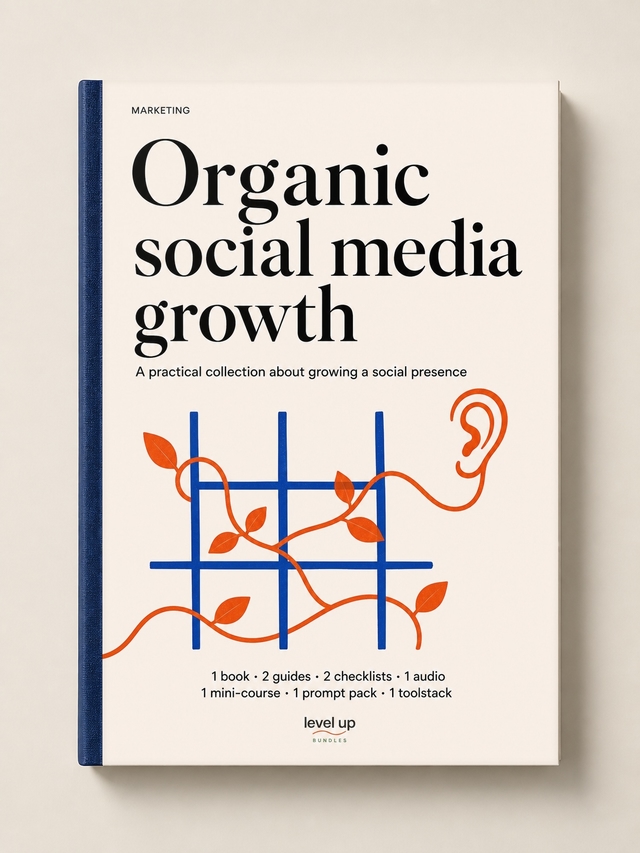
Organic Social Media Growth
Organic social is the channel everyone says is dead and most operators still need to make work. Reach is down, the algorithms favour ads, and a generic posting cadence produces a generic result. What still works at small scale is a value-first content strategy on the right platform for the audience, not all five platforms, not the algorithm-of-the-week, just the one or two where the math actually adds up.
The kit covers the disciplined-organic playbook. The book lays out the framework, two guides handle the upstream decisions (the ultimate platform selection strategy, the value-first content strategy implementation), two checklists cover community engagement and confident publishing, an organic social media success mini-course rebuilds the cadence, plus an organic growth engine prompt pack and a social media growth tool stack handle execution. The audio companion frames social-media-that-sticks thinking.
Aimed at the operator who's tired of "post more" advice and ready for the discipline that actually compounds.
Contents
In this bundle
9 items, in reading order.
 Audio
AudioSocial Media That Sticks
Most social-media growth advice runs on platform myth and survivor bias: a creator hits a million followers, writes a how-to, and the rest of the operators copy patterns that worked once for someone with a different audience. The five-episode audio series treats organic growth as a mechanic, not a magic trick: episode one breaks why organic still works in 2026 (and which platforms it works best on), episode two covers platform selection matched to audience and operator strengths instead of the founder’s hobby, episode three handles content patterns that earn engagement without engagement-bait, episode four installs the publishing rhythm that compounds without burning the operator out, episode five lands the community-building moves that turn followers into the marketing channel. Made for commute listening. Pair with the ebook for the long-form treatment; the audio is the briefing version.
 Book
BookOrganic Social Media Growth
Paid social got expensive enough that organic stopped being a backup channel and became the actual differentiator, and most operators are running the organic playbook from 2019 because nobody told them the rules changed. This ebook is the long-form treatment for the current era: the four pillars every organic strategy needs (clear positioning, platform-fit content, real distribution mechanics, community as compounding asset), the platform-by-platform breakdown of what actually rewards organic growth (versus the platforms that quietly throttle it), the content patterns that earn shares and saves rather than just impressions, the algorithm-friendly publishing rhythm that doesn’t require burning the operator out, the community work that turns engagement into trust, and the measurement frame that connects growth to revenue instead of vanity metrics. Built for the operator who’s done buying every algorithm hack and wants the system underneath them.
 Checklist
Engage and Grow Your Community
Most community-building checklists treat engagement as a goal in itself, when the actual outcome is whether the community produces real relationships, real word-of-mouth, and (eventually) real revenue. This checklist sequences community work for that outcome: the welcome routine for new members that signals "this is a real place" instead of "this is a list," the content cadence that gives members reasons to return without performing for the algorithm, the rituals (weekly prompt, member-of-the-week, monthly call) that compound participation, the moderation system that scales past the founder’s personal attention, the engagement metrics that catch decay before it becomes silence, and the activation moves for the lurkers who never post but quietly buy. Pair with the social-media growth book for the strategic frame; this is the community operations layer.
 Checklist
Publish Your Content with Confidence
Most social posts go out with a typo, the wrong link, or a thumbnail that doesn’t match the platform’s actual aspect ratio, and the engagement loss is invisible because nobody A/B tests their own mistakes. This checklist runs the pre-publish QA pass: the message-clarity check (one idea per post, named in the first line), the format-fit pass for each platform (the dimensions, the caption length, the link placement that actually works there), the visual-quality review (the thumbnail in the actual feed view, not the editor view), the brand-consistency check (color, voice, signature elements), the call-to-action audit (is there one, does it match the post’s intent), and the cross-device preview that catches the mobile-only break. Run before every publish. Pair with the value-first strategy guide for the upstream content work; this checklist is the per-post quality control.
 Guide
GuideThe Ultimate Platform Selection Strategy
Most operators pick social platforms based on where they personally hang out, then wonder why the audience isn’t there. The platform pick is the highest-leverage decision in the whole organic strategy, and most operators do it in five minutes. This guide installs a real selection pass: the audience-fit analysis that names where the actual buyer spends time (versus where the operator wishes they did), the content-capability assessment that matches the operator’s strengths to the platform’s format demands (long-form video versus short-form, written versus visual), the resource-planning math that sizes the time commitment honestly, the ROI evaluation framework that connects platform investment to actual revenue, and the field-tested challenge solutions for the real moments platform strategy breaks. Pair with the value-first content guide for the content layer; this guide is the upstream platform decision.
 Guide
GuideThe Value-First Content Strategy Implementation
Most operators publish promotional content at a 50/50 ratio with educational content and wonder why the audience tunes out by month two. The 80/20 frame (eighty percent value, twenty percent promotion) is the version that earns trust at scale, but most operators run it backwards. This guide installs the value-first strategy properly: the audience-research pass that names what the buyer actually wants to learn (versus what the founder wants to teach), the content-matrix build that maps eight value angles per topic, the publishing rhythm that holds the 80/20 split without slipping into vanity content, the quality checks that prevent value-content from becoming corporate-blog fluff, the engagement-and-growth tracking that proves the strategy is working, and the optimization loop that moves the ratio over time. Pair with the platform-selection guide for upstream picks; this guide is the content discipline.
 Mini-Course
Organic Social Media Success
Most "social media success" courses are a mix of platform-update-of-the-week and motivational quotes about consistency, and most students finish with the same follower count. This drip course runs the actual install: lesson one reframes why organic still beats paid for trust-building (and which platforms still reward it), lesson two installs the Four Pillars Framework (clear positioning, platform-fit content, distribution mechanics, community as compounding asset), lesson three covers content patterns that earn shares without engagement-bait, lesson four lands the conversation-and-social-proof moves that turn followers into buyers, lesson five sets the publishing rhythm and brand voice that survive a year, lesson six picks the platform mix matched to audience and operator strengths, lesson seven hands off to the conversion content that turns audience into revenue. Lessons drip across a working week. Built for the operator who’s done buying every algorithm hack.
 Prompt Pack
The Organic Growth Engine
Organic social media work eats time in the small drafting jobs: the next post draft, the comment-response template, the platform-by-platform repurpose, the weekly performance read. The pack moves those jobs to AI-assisted starting points: content-strategy prompts that turn a quarter goal into a usable editorial calendar, post-creation prompts tuned per platform (LinkedIn long-form, TikTok short, Instagram carousel, X thread), community-management prompts that produce useful comment responses without sounding canned, performance-analysis prompts that read raw engagement data and surface what to repeat, and profile-optimization prompts that audit the bio and link-in-bio against the actual conversion goal. Drop them into Claude or ChatGPT alongside the actual audience and offer context. Pair with the success course for strategy; the prompts are the working session.
 Toolstack
Social Media Marketing Growthstack
Social media tooling sprawls fast: a scheduler, an analytics layer, a graphic-design tool, a stock-asset library, a community moderation platform, a content-research suite. Most operators end up paying for ten when six would do the job at the audience size they have. The kit here is the curated short-list, organized by job: the scheduling and management platforms matched by team size (Buffer for solo, Later for small teams, dedicated tools at scale), the analytics tools split between platform-native (free) and the paid layers worth the money, the content-creation stack (Canva, CapCut, the lighter alternatives), the strategic-framework templates worth using, and the community-building tools that actually help versus the ones that just add notifications. Each pick has a one-line reason and a price tier. Pair with the success course for strategy; this list is the buy-list.