
Why fewer platforms grow faster than more
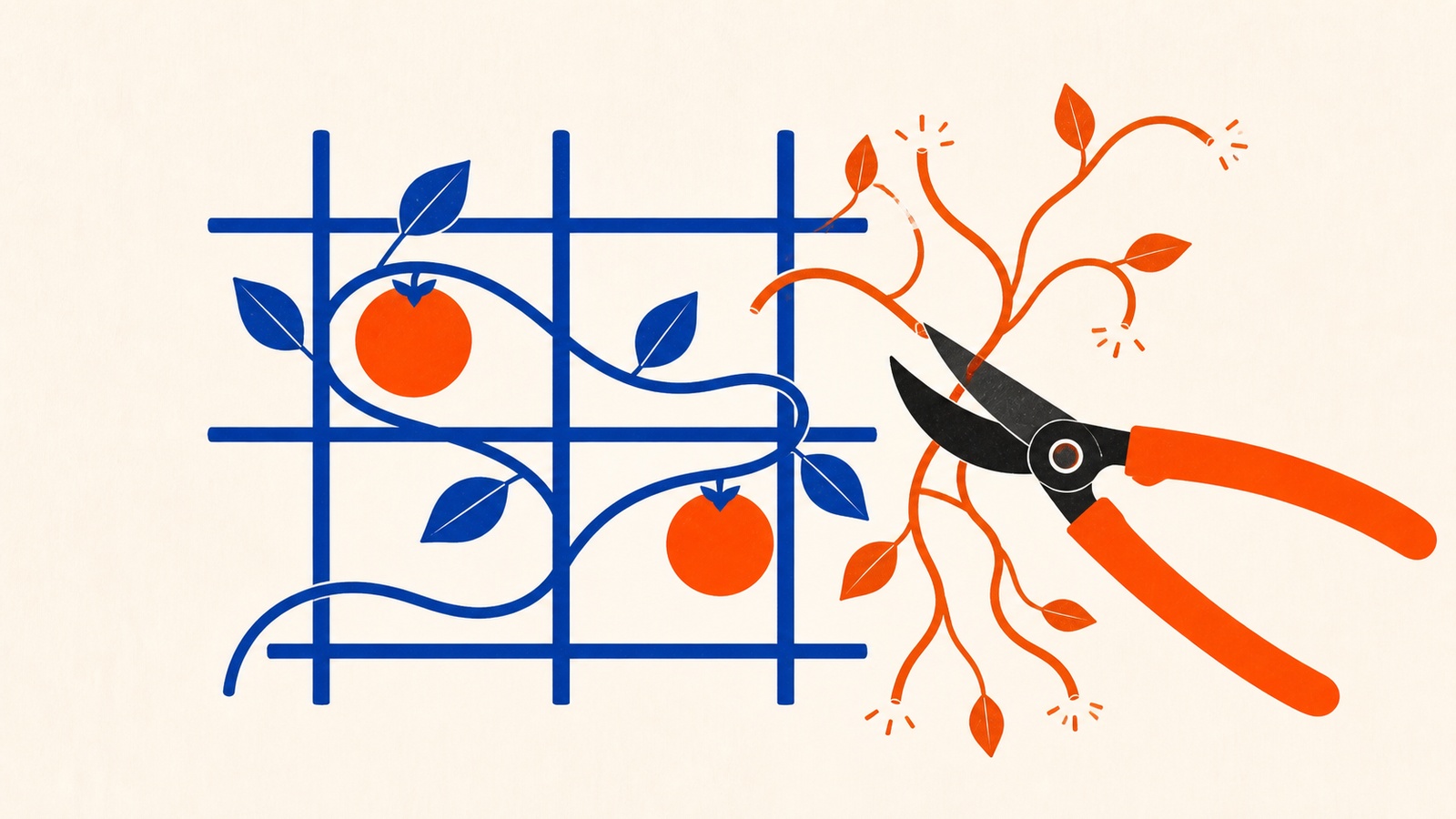
A wellness coaching business kept active profiles on six different social platforms and could not say what any single one of them was doing for the business. After applying a simple selection framework, it cut down to Instagram and LinkedIn, with Pinterest as a secondary channel, and saw a 300% increase in qualified leads within four months, while spending 60% less time on social media management.
Cutting five platforms to two produced more, not less. That runs against the instinct behind most social strategy, which treats presence everywhere as safety and absence anywhere as a missed opportunity.
The book in this bundle argues organic growth isn't a posting-frequency problem or a platform-coverage problem. It's a resource-allocation problem, and most accounts lose before they start because effort is split across four platforms instead of concentrated on two.
The four pillars, and the one that actually compounds
The book organizes organic growth around four pillars meant to reinforce each other: engagement (two-way communication that builds trust), consistency (a reliable posting rhythm and voice), content value (information that genuinely serves the audience's needs), and audience connection (relationship-building that turns followers into advocates). The claim is that each pillar strengthens the others: value content drives engagement, engagement builds connection, connection makes consistency easier to sustain because posts aren't going out into silence.
The book's own arithmetic for how this compounds is worth reading skeptically. It walks through a post reaching 100 followers, 10% sharing it to networks of 100 each, 1% of those new viewers converting and repeating the cycle: a chain that implies reach snowballs on its own. Treat that as the best case it obviously is, not a median outcome; most content is not shared by one in ten people who see it. What's durable in the framework isn't the arithmetic: it's that consistency is the only one of the four pillars a single person actually controls outright, since engagement, content resonance and audience connection all depend on how other people respond, and consistency doesn't.
The concrete tactic worth taking directly from the book is smaller than the framework: replace closed engagement prompts with open ones. "Do you like our new product" gets a thumbs-up and nothing else. "What's the hardest part about starting a side business" gets an answer you can build a future post around. The same logic applies to comment replies: a generic "thanks" adds nothing, while a reply that references the specific thing someone said extends the conversation and, over enough repetitions, turns a commenter into someone who checks for new posts.
Consistency gets a specific number attached to it rather than being left as advice to "post regularly": accounts posting four to seven times a week saw roughly two to three times more engagement than accounts posting sporadically, per the 2025 benchmark data the book cites. The number matters less than the shape of the finding: sporadic posting punishes an account more than a slightly-too-low but steady frequency does.
Where people go wrong
The first failure mode is maintaining presence on every platform instead of picking two based on format fit: a business that thinks in paragraphs loses a year to a short-video-first strategy chosen for its size, not its shape. The book's own selection framework runs on four questions before a single post goes out: where does the audience actually spend time, can the team sustain that platform's format, what will it cost in hours and tools, and what does the realistic organic reach look like there. Skipping straight to "we should be on TikTok" answers none of them.
The second is chasing posting frequency as the whole strategy. A strong rhythm applied to thin content underperforms a slower rhythm applied to posts that actually deliver something, and the 80/20 split the book recommends (80% of posts genuinely useful, 20% promotional) gets inverted by accounts under pressure to "stay visible," which is exactly the pressure that produces filler.
The third is treating comment replies as a formality: generic acknowledgments that close a conversation instead of the open questions that extend it, and quietly cost an account the audience-research value every comment thread represents. A related version of the same mistake is measuring community health by follower count alone, when the book's own benchmarks (active daily participants in the 5-10% range, a 65% new-member retention rate after 30 days) say far more about whether an audience will stick around.
The full content marketing guide covers where platform choice sits relative to the rest of a one-person content practice, including why it comes before, not after, a production system gets built.
Inside Organic Social Media Growth
Going deeper
- AudioSocial Media That Sticks
- BookOrganic Social Media Growth
- ChecklistEngage and Grow Your Community
- ChecklistPublish Your Content with Confidence
- GuideThe Ultimate Platform Selection Strategy
- GuideThe Value-First Content Strategy Implementation
- Mini-CourseOrganic Social Media Success
- Prompt PackThe Organic Growth Engine
- ToolstackSocial Media Marketing Growthstack
Organic Social Media Growth is one of 13 bundles in The Content & Creator Pack, or take the whole pack for $29.
Related reading

Content marketing for a team of one: the complete guide
How one person builds a content practice that lasts: message, production, distribution, search, proof and revenue, in the order they depend on each other.
Read more
Branding without a founder's face
How to build customer trust for a business with no public founder, using a mission statement, a value proposition, and a documented voice.
Read more
Building a content funnel backward from the sale
A six-step method for mapping content to TOFU, MOFU, and BOFU by working backward from a revenue target.
Read more