
Building a content funnel backward from the sale
The problem with content that doesn't add up
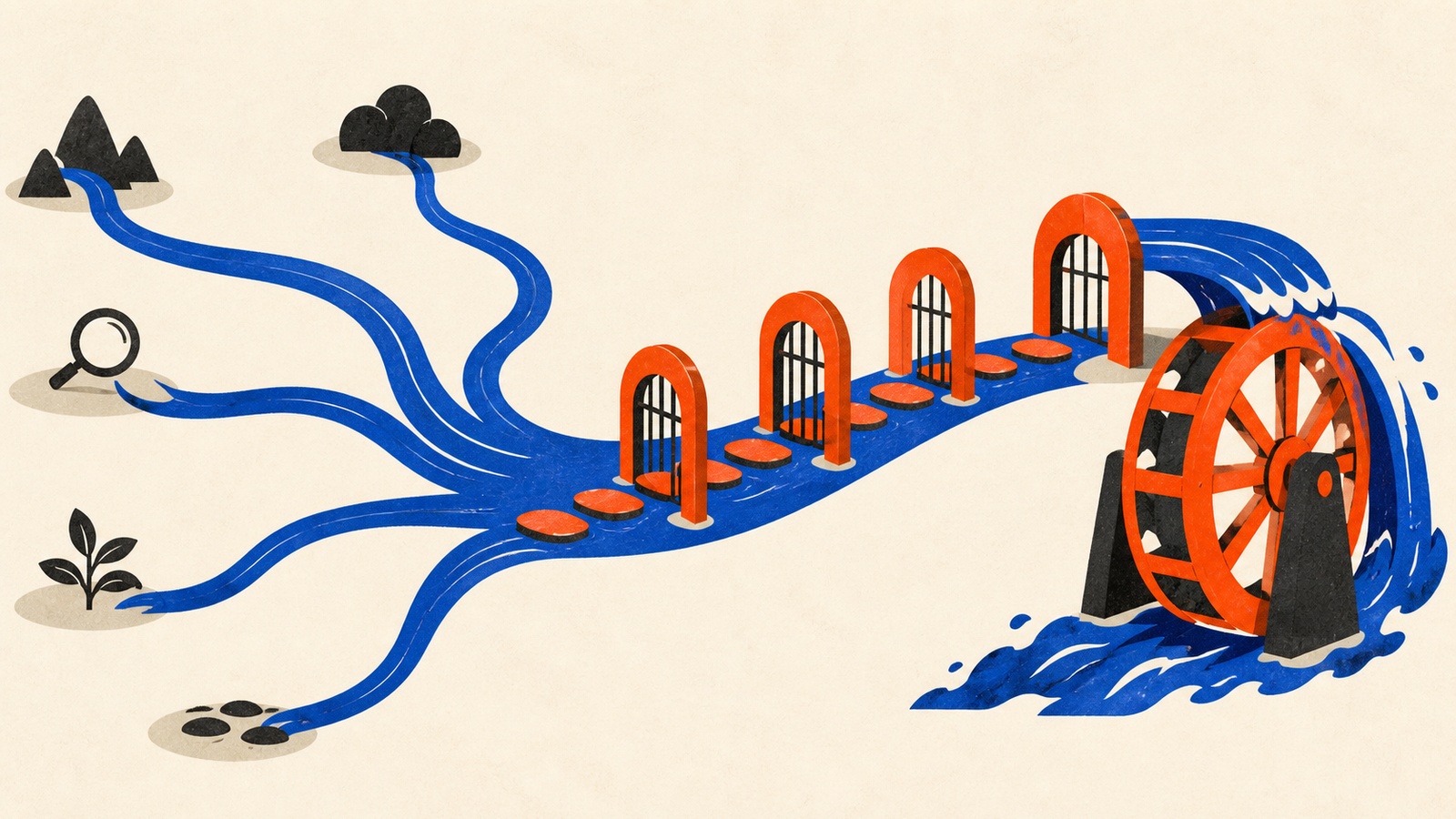
You've published blog posts, lead magnets, and emails for months. Traffic exists. None of it seems to add up to a sale. Every piece was fine on its own, but nothing hands the reader off to the next thing, so someone who reads three of your articles is no closer to buying than someone who read zero.
Converting Content Funnel treats this as a structural problem, not a content-quality problem: content without a deliberate path from first contact to purchase is just noise, however well-written any single piece is.
Most buyers aren't reading your content in the tidy sequence you'd like. They hop between stages, revisit old posts, and research across several channels before they ever talk to anyone on your team. The book's argument isn't that you need more content to catch them: it's that each piece needs a specific job in that journey, so a prospect moving from curious to convinced always has somewhere to go next.
Building the funnel backward from a revenue number
The book's core method inverts how most people plan content. Instead of starting with what to publish this month, it starts with a revenue target and works backward through six steps: set the revenue target and work out how many customers that requires, define the buyer persona, set KPIs for each funnel stage, inventory the content you already have and map it to a stage, find and prioritize the gaps, then build a production timeline starting with the highest-impact gaps first.
The inventory step is where most funnels reveal their real problem. The book names three recurring patterns: "traffic but no trust" (strong top-of-funnel content, nothing in the middle to build confidence), "trust but no trigger" (solid middle-funnel material with nothing pushing toward a decision), and "all blog, no conversion" (heavy investment in awareness, nothing built for someone ready to buy). Naming which pattern applies tells you exactly what to build next, instead of publishing more of what you already have plenty of.
The three stages themselves (TOFU, MOFU, BOFU) map to a buyer's actual questions rather than to marketing jargon. Top-of-funnel content answers "do I have a problem," and should teach without pitching. Middle-funnel content answers "what solutions exist," through comparisons, guides, and webinars. Bottom-funnel content answers "which option is best, and how do I justify it," through demos, case studies, and ROI calculators. One example from the book: a software company's pricing-page visitors converted to sales calls at 23 percent, while blog readers converted at 0.8 percent. The gap between those numbers is the argument for building bottom-funnel content on purpose instead of hoping blog traffic eventually converts by itself.
Where people go wrong
The most common failure is building top-of-funnel content indefinitely because it's the easiest to produce and measure, while the part that actually closes deals stays thin. Traffic keeps climbing while revenue doesn't move.
The second is treating funnel stages as a straight line customers walk down in order, then wondering why a demo request comes from someone who never opened a single blog post. A rigid, one-path funnel misses most of the real journey, and a funnel designed only for the tidy path leaves gaps at every stage someone might actually enter from.
The third is writing from assumptions about what buyers care about instead of from real customer language. The book describes a company whose messaging focused entirely on reducing costs, but interviews revealed the real driver was reducing downtime. Reframing content around actual customer language tripled conversion within weeks. That persona work, and the broader system for building an audience-first content operation, gets more room in the Content & Creator guide.
A fourth, quieter failure: a handoff from marketing to sales that loses all the context a prospect built up. Someone who read four articles and downloaded a comparison guide shouldn't get a cold, generic first sales email: the funnel's whole point collapses if the content stage and the sales stage don't share what they've each learned about the same person.
Inside Converting Content Funnel
Going deeper
- AudioThe Funnel That Sells
- BookConverting Content Funnel
- ChecklistComplete Content Funnel Mapping
- GuideEngineer BOFU Pages that Convert
- GuideFunnel Mapping Blueprint
- Mini-CourseCreate Your Content Funnel
- Prompt PackContent Funnel Builder
Converting Content Funnel is one of 13 bundles in The Content & Creator Pack, or take the whole pack for $29.
Related reading
Content marketing for a team of one: the complete guide
How one person builds a content practice that lasts: message, production, distribution, search, proof and revenue, in the order they depend on each other.
Read moreFinding the story your brand already has
A twelve-beat framework for turning a founder's actual history into a brand story, distilled to the five elements worth actually writing down.
Read more
Getting AI to draft content that still sounds like you
A five-part prompt structure for AI content drafts that keep your brand's voice instead of defaulting to generic copy.
Read more