
The four-question test for merchandise people actually keep
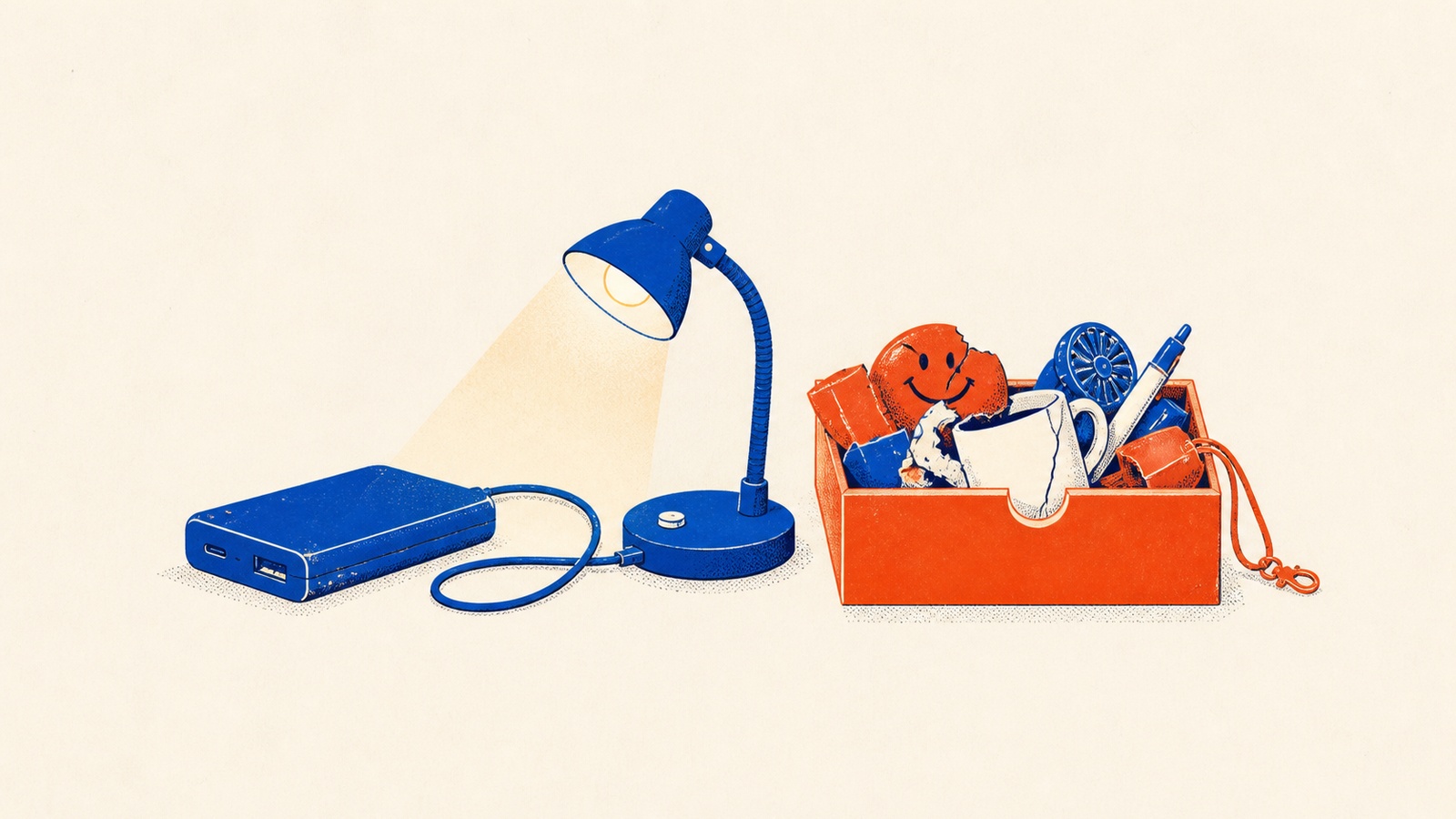
A desk drawer in any office is a graveyard of company-branded pens, stress balls, and phone stands, most with logos too faded to read. Somebody ordered five thousand of them, spent real budget on the print run, and here they sit, unused, waiting for the drawer to get cleaned out and go in the trash.
Cheap merchandise doesn't fail because the item itself was bad. It fails because "cheap" was the entire strategy: buy the lowest bid, print the logo as large as it fits, distribute widely, and hope volume compensates for the fact that nobody wanted the thing in the first place. Meanwhile, a study cited in Merch That Sticks found 85% of people remember the advertiser who gave them a promotional item, and 79% say they're more likely to do business with that brand afterward: numbers that only pay off if the item survives long enough to be remembered.
The gap between merchandise that works and merchandise that becomes landfill isn't budget. It's whether the item passes a specific test before it's ever ordered.
The four-pillar test for a merchandise idea
Merch That Sticks runs every merchandise idea through four questions before it goes anywhere near a supplier.
Utility asks whether the item solves a real problem in someone's existing routine, not a problem invented for the sake of having a product. A mug keeps a drink warm. A tote carries things. Neither is exciting on a whiteboard, and both work because people were already going to use something like them.
Quality is where most promotional budgets quietly fail. An Advertising Specialty Institute study the book cites found 63% of people keep branded drinkware for at least a year, conditional on the item actually being good. A water bottle that cracks in a week doesn't create a neutral impression; it creates a negative one, and a negative association from cheap merchandise is harder to undo than the goodwill from having given nothing at all.
Uniqueness doesn't mean strange. It means choosing the notebook when every competitor at the trade show is handing out pens, or the insulated travel cup when everyone else defaults to a basic mug. The differentiation has to add value, not just novelty for its own sake: a weird item that doesn't work is still a bad item.
Brand alignment is the pillar most companies skip, because it requires starting from identity instead of catalog. The book's test for whether alignment is real: would a customer recognize the item as yours with the logo worn off? A well-chosen product for a tech brand communicates the brand through material and design before anyone reads a name on it.
Run those four questions against a real pair of options and the difference gets concrete fast. A branded power bank for a tech company clears all four: useful for a device-dependent audience, built to survive daily carry, distinct from the sea of generic promotional items, and a natural fit for the brand. A branded stress ball for the same company clears none of them: cheap to produce, forgettable, indistinguishable from a thousand other trade-show giveaways, and unrelated to what the company actually does.
The book also uses two well-known failures as a caution against chasing trends instead of running this test. Google Glass had genuine innovation behind it and still failed on design and practical value. Crystal Pepsi departed too far from what customers already expected. Both cases make the same point from different directions: novelty without utility, or utility without brand fit, fails the same four-pillar test, just at different pillars.
Where people go wrong
The first failure is chasing whatever's trending instead of running the book's five-year test: will customers still find this useful in five years? A branded notebook passes; a branded fidget spinner doesn't, and by the time the bulk order of the trendy item arrives, the trend has usually already passed.
The second is picking a supplier on price alone. The book's own example is a founder who lost $15,000 across three suppliers in a row (a batch that arrived broken, a batch that was three weeks late, then a supplier who disappeared entirely) before learning that the cheapest bid is rarely the most reliable one.
The third is ordering a full production run on enthusiasm rather than a test batch. Fifty to a hundred units, sent to your best customers, tells you whether the quality holds up and whether people actually use the thing before you commit real budget to it. Skipping that step is how the $15,000 mistake and a warehouse full of the wrong trend both happen at the same company: nobody paused long enough to test either one. That same test-first discipline applies to store decisions generally, and the e-commerce guide covers it as part of the whole system.
Inside Merch That Sticks
Going deeper
- AudioThe Smart Merch System
- BookMerch That Sticks
- ChecklistBrand DNA Alignment
- ChecklistThe Merchandise Evaluation Framework
- GuideMerchandise Supplier Vetting System
- GuideThe 90-Day Merchandise Launch Plan
- Listicle12 Merchandise Secrets That Break the Rules and Win Big
- Listicle7 Branding Errors Hidden in Your Company Merchandise
- Mini-CourseStrategic Merchandise Mastery
- Prompt PackStrategic Merchandise Planning
Merch That Sticks is one of 5 bundles in The E-commerce Pack, or take the whole pack for $29.
Related reading
Running an online store on margin, not revenue: the complete guide
What decides whether a small online store makes money: product research, store clarity, pricing and margin, and the five numbers worth tracking.
Read more
Why adding a pricier option sells more of the cheaper one
How price anchoring and tiered pricing menus work, with the underlying margin math that determines whether the psychology actually pays off.
Read more
Why your checkout is losing sales you already won
The checkout friction that causes cart abandonment (forced account creation, unnecessary form fields, and hidden shipping costs) and the fixes.
Read more