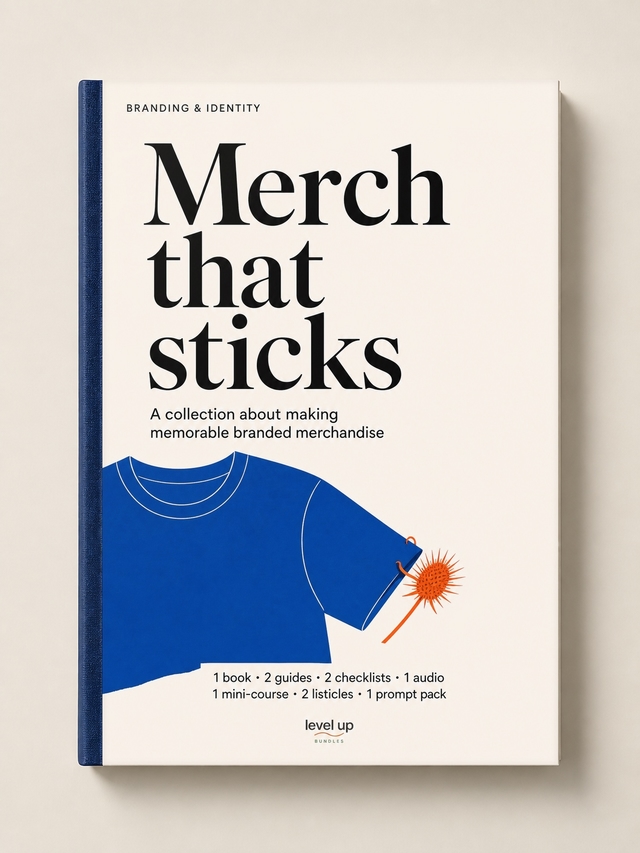
Merch That Sticks
Most company merch is a sad t-shirt nobody wears. The logo is too big, the cotton is too cheap, and it ends up in a drawer next to three other unworn freebies. Merch that actually gets worn is brand work, same standards as the website or the deck, and the operators who treat it that way build the kind of recall a $50K ad campaign can't buy.
The kit covers merch as brand strategy. The book lays out the framework, two guides handle the heavy lifting (a 90-day merchandise launch plan, a supplier vetting system), two checklists cover brand DNA alignment and the merchandise evaluation framework, two listicles surface the seven branding errors hidden in most company merch and the twelve secrets that break the rules and win, a strategic merchandise mastery mini-course turns the framework into a working program, and a strategic planning prompt pack handles concept and copy work. The audio companion frames the smart merch system.
For the founder or brand lead who's done printing logos on cotton and ready to make merch the audience actually wears.
Contents
In this bundle
10 items, in reading order.
 Audio
AudioThe Smart Merch System
Most company merch ends up in a closet within ninety days because the operator chose between two bad options: cheap branded swag that nobody wears, or premium gear that nobody buys. The five-episode audio series covers the third path: episode one breaks why smart merch is a brand-building lever instead of a logo-on-stuff exercise, episode two walks the design principles that make merch people actually keep, episode three covers supplier-vetting (and the red flags that show up before the bad order does), episode four lands the products worth investing in versus the ones that drag, episode five installs the Brand DNA system that makes the merch line recognizable without the logo. Made for commute listening. Pair with the ebook for the long-form treatment; the audio is the briefing version.
 Book
BookMerch That Sticks
Branded merchandise is one of the most-attempted and least-thought-through marketing channels in small business, and the closet of unworn t-shirts is the proof. The operators whose merch actually moves treat the line as a product business, not an afterthought, and their economics look completely different. This ebook is the long-form treatment: the strategy frame that decides whether merch is a community asset, a revenue line, or a marketing channel (and the design implications of each), the product-selection logic that picks items the audience actually wears versus items the founder thinks are cool, the supplier-vetting work that prevents the production disaster, the pricing-and-bundling math that runs profitable instead of break-even, the launch playbook that earns demand instead of begging for it, and the operations layer that runs without the founder’s daily attention. Built for the operator who wants merch to compound the brand, not embarrass it.
 Checklist
Brand DNA Alignment
Brand-aligned merch isn’t merch with the logo on it; it’s merch the audience would buy without the logo. Most operators skip the alignment work and end up with products that read as random because nothing connects them to the brand. This checklist runs the alignment audit: the values-to-product translation (does the item express the brand’s actual position), the audience-fit test (would the buyer actually wear or use this), the visual-system consistency (color, typography, material that match the rest of the brand), the voice-on-product check (the copy on the tag, the package, the thank-you card), the unboxing experience that extends the brand, and the post-purchase touch that earns the photo on Instagram. Sibling to the merchandise-evaluation framework; this one handles the brand-alignment layer.
 Checklist
The Merchandise Evaluation Framework
Picking merch by gut feeling produces closets full of unsold inventory. The operators who pick well run a real evaluation pass before placing the production order, and their reorder rates show it. This checklist is the framework: the utility test (does the item earn its place in the audience’s daily life), the uniqueness check (does it look different from everything competitors are running), the perceived-quality assessment (does it pass the in-hand test), the brand-fit score (does it belong in the lineup), the price-elasticity estimate (will the audience actually pay), and the inventory-risk math (small batch first, then scale). Each item gets scored before the order goes in. Sibling to the brand-DNA alignment checklist; this one is the product-evaluation pass that decides what gets made.
 Guide
GuideMerchandise Supplier Vetting System
The supplier picks the operator made in a hurry are the suppliers who deliver late, send the wrong color, and refuse to honor the spec. The vetting work that prevents this takes a week upfront and saves a quarter of fire-fighting later. This guide is the vetting system: the research pass that finds suppliers beyond the first page of Alibaba, the outreach template that filters serious vendors from the ones that ghost, the evaluation framework that weighs price, lead time, quality, and reliability against each other instead of optimizing one, the sample-testing protocol that catches quality issues before the production order, the red-flag checklist for conversations that should kill a deal early, and the relationship-management cadence that keeps the supplier prioritizing the account. For the operator who’s been burned once and doesn’t want to repeat it.
 Guide
GuideThe 90-Day Merchandise Launch Plan
Most merch lines launch with no plan past the production order, then sell the first thirty units and stall. The launches that compound have a ninety-day plan that treats the launch as a product launch instead of an inventory drop. This guide is that plan: days one through thirty cover product selection, supplier vetting, and the sample-and-iterate loop that prevents the production disaster, days thirty-one through sixty handle pricing and bundling decisions, the marketing assets, and the pre-launch list-building that earns demand before opening, days sixty-one through ninety run the launch sequence (waitlist, soft open, full launch, post-launch retention) and the iteration loop that turns the launch into the next launch. Sibling to the supplier-vetting guide for the production layer; this one is the end-to-end launch playbook.
 Listicle
12 Merchandise Secrets That Break the Rules and Win Big
Most merch advice is the same five rules repeated forever: clean design, quality material, brand-aligned colors, etc. The brands that actually move merch break those rules on purpose and the wins come from the contrarian moves. This listicle catalogs twelve: the deliberately ugly drop that goes viral, the misprint that becomes the limited edition, the tier of "not for everyone" merch that builds cult before scale, the limited-color-palette move that makes the lineup more recognizable than a logo could, the no-promotion launch that earns the email-list activation, and seven more, each with a real example and the strategic logic underneath. Made for scanning, not for note-taking. Sibling to the branding-errors listicle (mistakes to avoid); this one is the contrarian moves to consider.
 Listicle
7 Branding Errors Hidden in Your Company Merchandise
Most company merch fails the brand quietly: the colors are slightly off, the logo is the dominant visual, the material is the cheapest option that still meets the spec, and the result reads as corporate giveaway instead of brand asset. This listicle names the seven specific errors hiding in most existing merch lines: the logo-as-design crutch that produces forgettable items, the brand-color-misuse that drifts the visual identity, the cheap-fabric tell that signals "this is free" instead of "this is wanted," the typography mismatch with the rest of the brand, the package-design afterthought that wastes the unboxing moment, the tag-and-care-label oversight that breaks brand voice, and the lack of a second touchpoint after the first wear. Each entry has the diagnostic and the fix. Sibling to the rule-breaking listicle; this one is the errors to remove first.
 Mini-Course
Strategic Merchandise Mastery
Most merch programs run as a side project that produces side-project results. The brands whose merch actually compounds treat it as a product business and run it like one. This drip course installs that operator frame across a week of emails: lesson one aligns the merch program to a real strategic position (community asset, revenue line, marketing channel, or some defensible mix), lesson two covers product-selection by audience fit instead of founder taste, lesson three lands the design principles that make merch people actually wear, lesson four sequences the rollout for demand-building instead of inventory-dumping, lesson five handles supplier and operational scale, lesson six covers measurement and iteration that turns each launch into the next launch. Built for the operator who’s done watching merch eat capital and produce closets of unworn shirts.
 Prompt Pack
Strategic Merchandise Planning
Merch planning eats time in the small drafting jobs: the product brief, the supplier outreach email, the launch announcement, the post-mortem after the drop. The pack collapses those into AI-assisted starting points: product-selection prompts that turn audience research into a defensible item shortlist, supplier-outreach prompts that get useful responses instead of templated ones, launch-strategy prompts that frame the rollout as a real product launch, design-brief prompts that translate brand attributes into spec the manufacturer can use, post-launch analysis prompts that pull lessons from the drop instead of just celebrating sell-through, and inventory-and-reorder prompts that handle the math before the second order. Drop them into Claude or ChatGPT alongside the actual brand and audience context. Pair with the launch-plan guide for strategy; the prompts are the working session.