
Running an online store on margin, not revenue: the complete guide
Updated September 2026
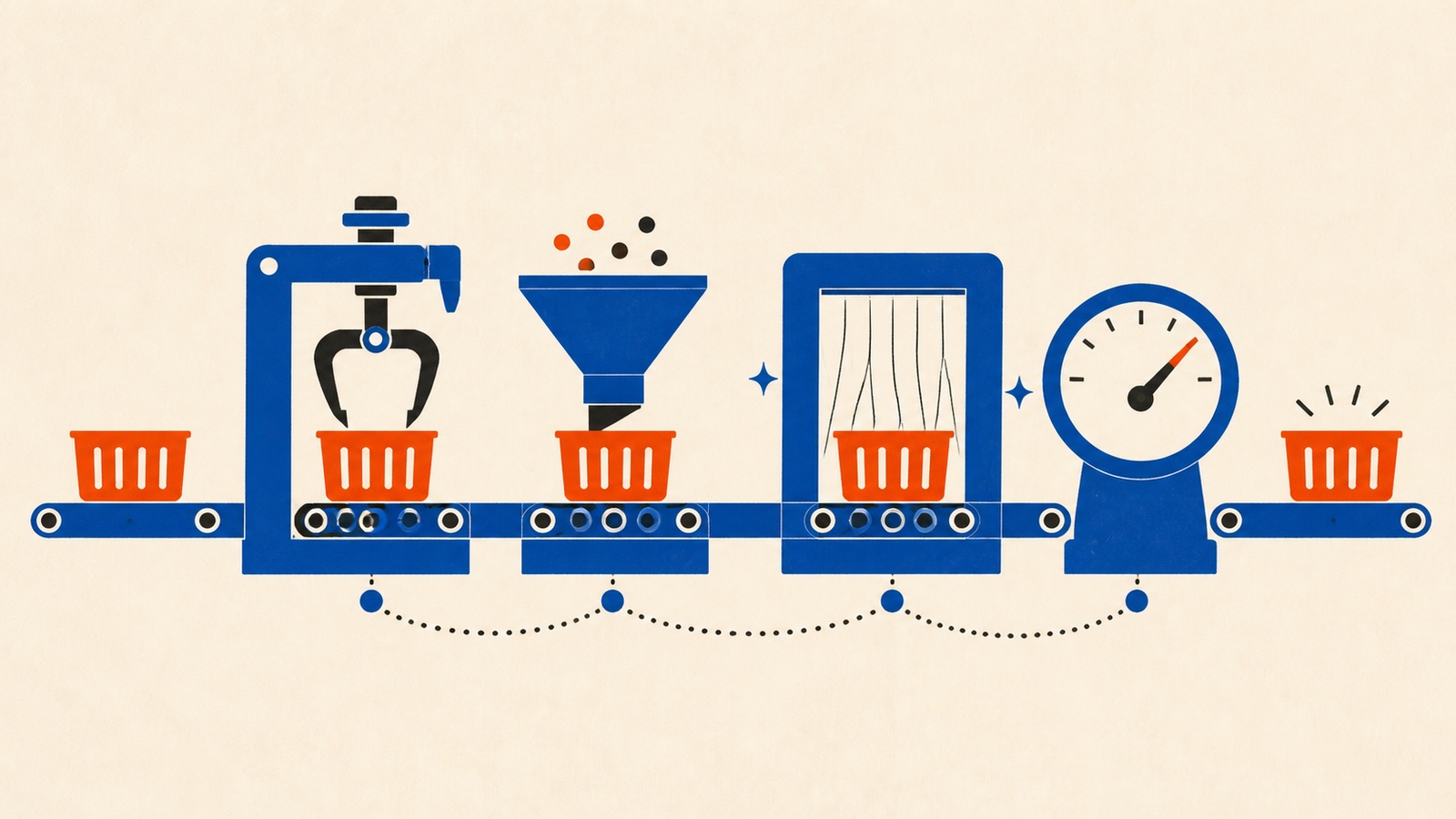
A store can grow revenue every month and still run out of cash. It happens constantly, and it is not a paradox: it is what a long cash conversion cycle and a thin gross margin look like from the inside. The dashboard says up and to the right. The bank balance says the inventory ate everything.
This guide is for people running a small online store, or about to open one: a few orders a day up to a few hundred a week, physical or hybrid, with nobody else looking at the numbers. It assumes you pick the products, write the product pages, set the prices, and pay the supplier invoice, and that these are all the same afternoon.
If you have a merchandising team and a finance function, skip it: your constraint is coordination, not knowledge. And if your "store" is one digital product with no inventory and no shipping, most of what follows will not apply to you either. No COGS means no margin problem, which means your problem is traffic and offer, not operations.
The map: four decisions, and which one binds first
Running a store is four decisions repeated: what you sell, how the store presents it, what you charge against what it costs, and what you look at to tell whether any of it is working. There is a fifth, optional one (a branded product line alongside the main catalogue), but it depends on the first four being solid.
The order is not arbitrary, and getting it wrong is the most expensive mistake in the whole sequence.
Product research binds first because everything downstream multiplies it. A fast, clear, beautifully-built store selling something nobody is looking for converts very efficiently into nothing. Winning Product Research opens on Clayton Christensen's figure that 95% of new products fail in their first year, and the honest reading of that number is not that products are hard: it is that most of them were never validated against a real buyer before the money went in.
Margin binds second, and this is the ordering claim people resist hardest. You cannot advertise your way out of a 15% gross margin. Paid traffic scales whatever unit economics you already have, in both directions. If the fifth sale loses money, the five-hundredth loses more, faster, and with a bigger card bill attached.
Store clarity binds third: before you spend on traffic, not after. Every ad click landing on a page where shipping cost is a mystery until step three of checkout is money spent demonstrating your own friction to strangers.
Measurement comes fourth in sequence only because you need orders before you have anything to measure. In importance it is not fourth at all. The moment you place a purchase order, the cash conversion cycle starts running whether you are watching it or not.
What you sell, decided before you build anything
Product research in this niche usually means scrolling a trend tool until something looks promising. That is browsing, not research, and it produces confident decisions built on nothing.
The method in Winning Product Research is duller and works better: state the belief, then go looking for the thing that would disprove it. The book asks you to write your assumption as a sentence concrete enough to be wrong: "small business owners will pay $50 monthly for an automated bookkeeping solution" is its example. A sentence with a buyer, a price and a behaviour in it can be tested. "There's demand for eco-friendly pet products" cannot.
From there it escalates in cost order. Conversations first, where the instruction is to listen rather than pitch: you are collecting how people describe the problem now, not reactions to your idea. Then a simple page describing the product, measured by email signups or pre-order commitments; the book points at Airbnb validating demand this way before the platform existed. Then rough prototypes, and only then a pre-sale with a stated minimum sales goal, which is the first test where someone's card is actually charged.
The mistake that costs most is confirmation bias, and the book names it directly. If you ask people who like you whether your idea is good, they will tell you it is good, and you will have bought a very expensive compliment. The fix is mechanical: decide the number that would make you walk away before you run the test.
The research and validation sequence, the market-gap work and the keyword-demand side of it are covered in the Winning Product Research post.
The store: clarity beats aesthetics
The instinct when opening a store is visual: logo, palette, a homepage that looks like a work of art. Build an Ecommerce Store That Sells calls this the Aesthetic Fallacy, and its comparison is the sharpest thing in the book: the conceptual boutique with mood lighting and hidden products versus the hardware store with harsh light, concrete floors and aisle markers that tell you exactly where the bolt is. The hardware store wins on sales, every time.
Its mechanism for why is the Confusion Tax. Every micro-decision your interface forces (is that text a link or a button, where is the menu, what will shipping cost) drains the shopper's attention, and the book grounds this in cognitive load, formalised by John Sweller in 1988 and built on Hick's work from 1952. The cumulative effect is decision fatigue, and a fatigued brain refuses the one decision you want.
The most reusable piece is its Three-Part Brand Story Framework for the About page: Origin, Mission, Expertise. The Origin is the human hook: the specific struggle that started the business, because people connect with struggles rather than success. Patagonia is the worked example, opening not on product specs but on Yvon Chouinard hand-forging climbing pitons because existing gear was destroying the rock he loved. The Mission aligns with the reader's values. The Expertise satisfies their logic. Emotion, identity, logic: three legs of a stool, and the book's point is that removing any one of them makes trust wobble.
The mistake that costs most is designing for your own taste and calling the result a brand. The store owner sees a gallery wall; the shopper is on a mission and cannot find the aisle.
Category pages, product-page structure, the checkout friction audit and the conversion killers hiding on product pages are covered in the Build An Ecommerce Store That Sells post.
Price and margin, set before you buy traffic
Most small stores price by cost-plus: take what it cost, add a markup that feels defensible, publish. Price and Profits of Online Stores treats that as the default failure, and it frames store finance as three pillars (revenue generation, cost management, profit optimisation) that have to be managed together rather than in sequence.
Its alternative is value-based pricing, which starts from what the customer is actually buying rather than what you paid. The worked example is a luggage company that launched a suitcase at $225 into a category priced at $80-120 and was told it was mad. Buyers were not purchasing a container for clothes; they were buying a lifetime warranty, a built-in charger and a statement about themselves. The book breaks the implementation into three components: customer value perception, market context, and value communication, the last being the one people skip, then wonder why the premium price gets no takers.
The mistake that costs most is reaching for a discount whenever sales slow. A discount is the fastest lever available and the most permanent in its effects: it moves volume this week, resets what customers believe the product is worth, and comes straight out of the gross margin you needed for everything else. Fix the value communication before touching the number.
Pricing models, margin optimisation and the operational automation that protects margin as volume grows are covered in the Price And Profits Of Online Stores post.
The five numbers that tell you whether it works
Most store dashboards track forty things and drive zero decisions. 5 Numbers Every E-Commerce CFO Must Know calls this the hidden cost of tracking everything, and reduces the whole picture to five:
- Gross margin: revenue minus cost of goods, over revenue. For e-commerce that means subtracting shipping and fulfilment, returns and refunds, platform and payment fees, and packaging, not just the product cost. The book puts healthy at 40-60%, and cares more about the trend than the number.
- Cash conversion cycle: days inventory outstanding plus days sales outstanding, minus days payables outstanding. DIO + DSO − DPO. How long your money sits inside stock before it comes back as cash.
- Marketing ROI, not ROAS: acquisition cost against lifetime value, per channel, by cohort, with overhead allocated. Not how much revenue marketing produced, but how much profitable revenue it produced over time.
- Inventory turnover: how many times stock sells and is replaced, tracked at SKU level. The book's healthy range is four to eight times a year.
- Net profit per order: every cost of fulfilling one order, including customer service, marketing attribution and the probability of a return.
Two of these will contradict your instincts on first calculation. Gross margin usually comes out lower than expected once returns and payment fees are in it, and net profit per order is where a bestseller sometimes turns out to be a loss leader nobody chose.
The mistake that costs most is measuring without thresholds. A number you look at but have not decided a trigger point for is decoration. The book's discipline is to define, for each metric, how it is calculated, where the data comes from, and what value makes you act.
Metric definitions, the reporting cadence and the order-level profitability audit are covered in the 5 Numbers Every E Commerce Cfo Must Know post.
Branded merchandise, as a second line
Merchandise is the most commonly botched extension in small e-commerce, because it gets treated as marketing spend rather than as a product decision with its own margin and its own inventory risk.
Merch That Sticks applies four pillars to any candidate item: utility, quality, uniqueness, brand alignment. Utility means it solves a real problem in someone's daily routine: the mug keeps drinks warm, the tote carries things. Quality is where the cost hides: the book cites an Advertising Specialty Institute study finding 63% of people keep branded drinkware for at least a year, conditional on it being good, and a bottle that cracks in a week buys you a negative association instead of a neutral one. Uniqueness means a better choice in the same category, notebooks where everyone else gives pens, rather than novelty for its own sake. Brand alignment means the item makes sense coming from you.
Its operational instruction is test small, scale smart, sequenced through a ninety-day launch plan. The mistake that costs most is a minimum order quantity decision made on enthusiasm: five hundred units of an untested item is not a marketing budget, it is inventory with a cash conversion cycle attached.
Item selection, supplier vetting and the ninety-day launch sequence are covered in the Merch That Sticks post.
How to start this week
Two hours, no budget, in this order:
- Calculate true gross margin on your best-selling product. Not price minus cost. Price minus product cost, shipping, packaging, payment fees, platform fees, and your return rate applied as a cost. If it lands under 40%, that is the finding, and it outranks everything else on your list this month.
- Write your riskiest current assumption as one sentence containing a number. Whatever you are about to spend money on: a new SKU, a supplier, a channel. Then write the result that would make you stop. Both sentences, in writing, before the spend.
- Run a fresh-eyes audit. Hand your phone to someone who has never seen your store, ask them to buy a specific item, and say nothing while they do it. Note every pause. Each pause is the Confusion Tax being charged in real time.
Then do the smallest thing: find where shipping cost first becomes visible on your site. If the answer is checkout, move it to the product page today. It is one of the cheapest conversion fixes available and it costs nothing but ten minutes.
Related guides
If the margin section landed and you suspect your prices are the underlying issue rather than your costs, the Money & Pricing guide works that ground directly. And once the store converts and the unit economics hold, buying traffic becomes reasonable rather than reckless: the Paid Ads & Landing Pages guide covers what to do with it.
Take the whole pack
Related reading
Testing a product idea before you spend a dollar building it
A cheap-to-expensive ladder for validating a product idea (conversations, a landing page, a prototype, a pre-sale) before committing real budget.
Read moreThe five numbers that tell you if your store is profitable
The five e-commerce metrics worth tracking daily to weekly: gross margin, cash conversion cycle, marketing ROI, turnover, net profit per order.
Read more
The four-question test for merchandise people actually keep
Before ordering branded merchandise, run it through utility, quality, uniqueness, and brand alignment: the framework behind items people keep.
Read more