
Cold email follow-ups that get replies
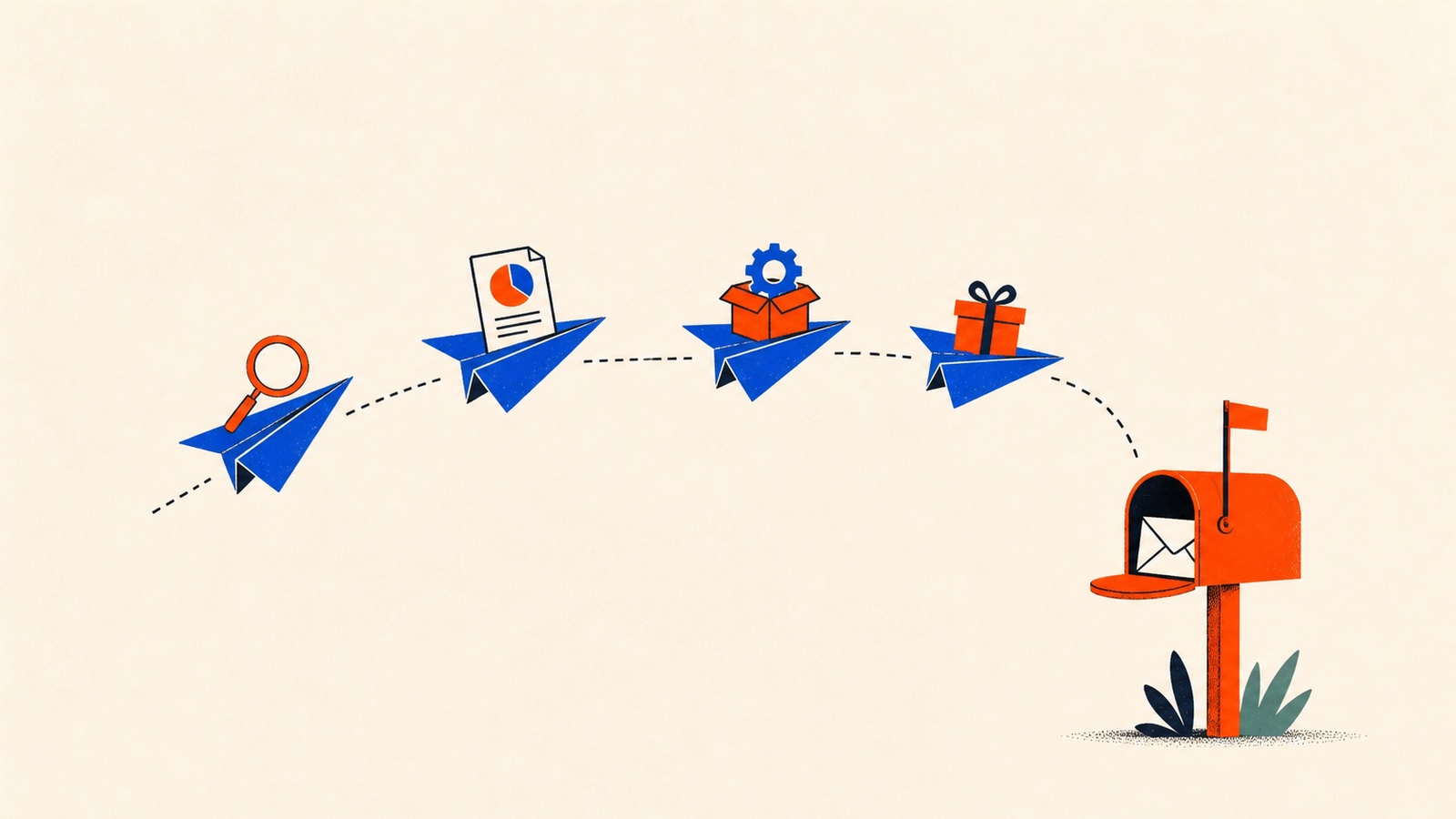
Most cold email advice stops at the first message: subject line, opening hook, one clear ask. Then the reply doesn't come, and the sender either gives up or sends the same email again with "just following up" tacked on top, which is the fastest way to signal that a message wasn't worth much the first time either, and prospects can tell within one glance that nothing new was worth writing.
The research behind this bundle points at a specific number worth knowing before any of that: 35 to 50 percent of sales go to whichever vendor responds first. Reply speed matters. But the bigger problem most senders have isn't speed: it's that they send one follow-up, maybe two, and never build the sequence that actually earns a response from someone who was busy, not uninterested.
Silence after a cold email is rarely a no. It's usually a maybe that never got prioritized against everything else in someone's inbox that week. Treating that silence as rejection (and stopping after one attempt) throws away most of the replies a sequence would have earned, because the person who didn't answer on day one is often the same person who would have answered on day seven, given a reason to, and a single unanswered email gives them no such reason to reconsider.
The four-touch sequence, and the email that closes it
Cold Email Marketing lays out a specific cadence rather than a vague instruction to "follow up more." The first message goes out, and if nothing comes back within 24 to 48 hours, the sequence starts:
| Follow-up | Timing | What it does |
|---|---|---|
| First | 24-48 hours after the initial email | Reiterate the main point, ask if clarification would help |
| Second | Day 7 | Share a relevant case study or success story |
| Third | Day 14 | Offer a resource or piece of content with no ask attached |
| Fourth | Day 30 | A clear call to action, or the break-up email |
The rule underneath the schedule is more useful than the schedule itself: every follow-up adds something new. Repeating the first email with different framing isn't a follow-up, it's a second attempt at the same pitch, and prospects notice. The book's example of a value-adding follow-up references an industry report tied specifically to the prospect's recent expansion into a new market: not a nudge, an actual reason to read further.
After five to seven attempts over two to three months with no response, the book's advice is to stop, and to stop with a specific email rather than silence. Its break-up email:
"Hi Name, I've reached out a few times about how Your Product/Service could help Company Name achieve Specific Goal. Since I haven't heard back, I assume this isn't a priority for you right now. I don't want to bother you with continued follow-ups, so I'll stop reaching out after this email. If your situation changes in the future, please don't hesitate to contact me. I'm always happy to help. All the best, Your Name"
The mechanism is straightforward: naming the end of contact removes the mild pressure a prospect feels from an open-ended sequence, and removing that pressure is often what gets the reply that four polite nudges didn't. When it doesn't, it leaves a clean final impression instead of a slow fade into being ignored.
Where people go wrong
The most common mistake is treating "follow-up" as a single email sent once, a week later, instead of a planned sequence with a distinct job for each message. A sender who gives up after one attempt is leaving replies on the table that would have come on attempt three, and the reply-speed statistic above cuts both ways: a fast first message still loses to a competitor who simply stayed in the inbox longer.
The second is repeating the pitch. A follow-up that just resends the original offer in different words reads as pressure, not value, and prospects who ignored the first version tend to ignore the repeat too: each message in the sequence needs its own reason to exist, whether that's a case study, a resource, or a genuinely new angle on the original ask.
The third is not knowing when to stop. Continuing to email someone who has shown no engagement across five or six attempts stops being persistence and starts costing you: both the time spent and, eventually, the sender's own reputation. Where this outbound sequence fits against list-building, compliance, and message anatomy more broadly is covered in the Email & SMS guide.
Inside Cold Email Marketing Ebook
Going deeper
- BookCold Email Marketing - Ebook
- ChecklistCold Email Marketing - Checklist
- GuideCold Email Marketing - Guide
- Prompt PackCold Email Marketing - Prompts
- ToolstackCold Email Marketing - Toolstack
- WorkbookCold Email Marketing - Workbook
Cold Email Marketing Ebook is one of 6 bundles in The Email & SMS Pack, or take the whole pack for $29.
Related reading
Email and SMS marketing for a small list: the complete guide
How email and SMS work for a small list: permission, segmentation, sequence, channel choice, and the numbers actually worth tracking.
Read more
Email segmentation that goes past a first name
A scoring system that segments an email list by behavior instead of demographics, plus the three mistakes that undo it.
Read more
Four email metrics worth checking weekly
The four core email formulas, and a before-and-after case study showing what changed when a retailer actually tracked them.
Read more