Deal Breaking Case Studies Creation
Case studies are the highest-converting marketing asset most B2B companies barely produce. The team knows there are great customer stories, they're trapped in a Slack DM with the customer-success lead, and the closer the prospect gets to the buying decision, the more they want to read one. The bottleneck is process: which story, what structure, what proof, written by whom.
The kit operationalises case studies. The book lays out the framework, a "select story winners that close deals" guide handles the curation work, a 1-to-10 repurposing system guide turns one win into ten assets, two checklists cover identifying winning customer stories and designing case studies people actually read, two listicles catalogue the thirteen psychological triggers that close and the seven case study frameworks for B2B, a "let customer stories do the selling" mini-course rehearses the process, and a persuasive business proof prompt pack handles writing. The audio companion frames turning proof into profit.
Built for the B2B founder or marketer sitting on customer wins they aren't using and ready to turn proof into close.
Contents
In this bundle
10 items, in reading order.
 Audio
AudioTurning Proof Into Profit
Three episodes on case studies as the highest-leverage marketing asset most B2B and services businesses systematically underbuild. Why most case studies don't move deals (they're testimonials, not stories with structure), the structural framework for case studies that actually do close work, and the production discipline that lets you build them at the cadence the sales team needs. Built for the marketing or sales lead at a B2B or services business where social proof matters and the current case study library is either thin, generic, or both.
 Book
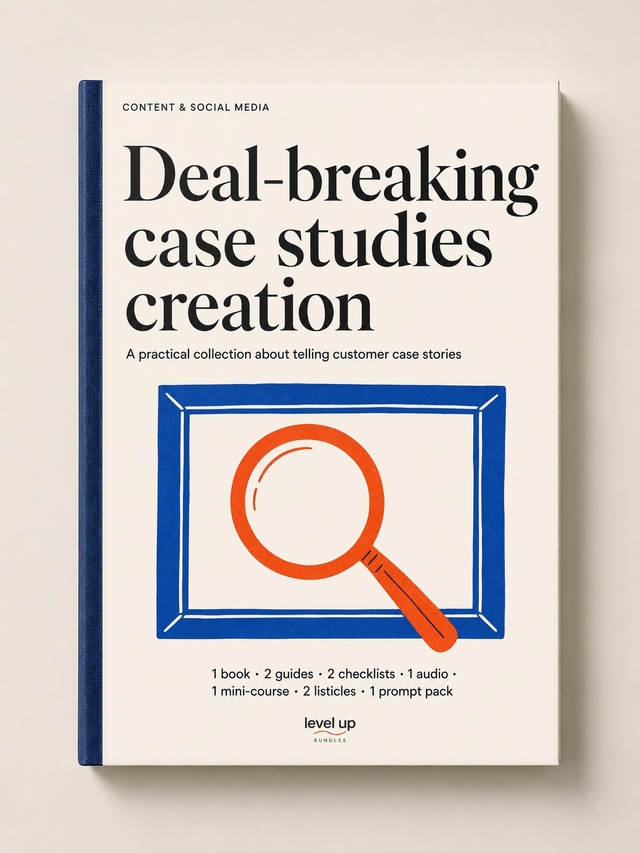
BookDeal-Breaking Case Studies Creation
The book on building case studies as deal-closing assets, not just marketing decoration. Covers the structural moves: the customer-selection rubric that identifies case-study-worthy stories (most aren't), the interview structure that surfaces the actual story (versus what the customer initially says), the narrative architecture that handles objection prevention without sounding defensive, and the distribution pattern that gets the case study in front of the buyer at the right point in the cycle. Built for the marketer ready to treat case studies as the sales tool they actually are.
 Checklist
Design Case Studies That People Actually Read
The structural check for any case study draft before it gets published. Walks through the hook test (does the headline earn the click for someone who doesn't already know your brand), the specificity check (does it have the concrete numbers and quotes that make it feel real), the objection-prevention layer (does it answer the questions a skeptical reader would ask before they ask them), and the next-step verification (does the reader know what to do after reading). Run on every case study draft. Most teams have at least one missing element on most case studies.
 Checklist
Identify Customer Winning Stories
The structured filter for spotting which customer relationships actually deserve case study production effort. Walks through the result-clarity check (is there a measurable outcome, not just 'they're happy'), the story-shape check (is there a before/middle/after with a turning point), the customer-cooperation check (will they actually be available for the interview and review), and the strategic-fit check (does this story serve a sales argument we're trying to build). Run on the customer list quarterly. Most teams discover three or four case-study-worthy stories they hadn't noticed.
 Guide
GuideSelect Story Winners That Close Deals
The detailed framework for selecting which case study to develop next based on which sales argument it strengthens. Covers the deal-loss analysis that surfaces the objections most often killing deals, the objection-to-case-study mapping (each objection deserves at least one case study that defuses it), the customer-fit decision for which existing relationship best demonstrates the relevant outcome, and the prioritisation framework for the case study production queue. Built for the marketing lead working alongside a sales team and ready to align case study production with actual deal mechanics.
 Guide
GuideThe 1-to-10 Case Study Repurposing System
The framework for getting ten distinct marketing assets out of one case study production effort. The full case study (the cornerstone). The two-page summary for sales decks. The 90-second video. The customer-quote graphic for social. The three social posts (one per main argument). The newsletter feature. The webinar talking points. Each derivative has structural rules: what gets included, what gets dropped, and the format-specific framing. Built for the small marketing team that needs to compound the value of each case study production.
 Listicle
13 Psychological Triggers for Deal-Closing Case Studies
Thirteen psychological mechanisms that make case studies more persuasive: most of them invisible to the writer who hasn't named them. The specificity premium (numbers and dates outperform adjectives by enormous multiples). The hero-customer framing that makes the reader project themselves into the story. The struggle acknowledgement that prevents the success from feeling sanitised. The unexpected detail that signals authenticity. Each gets a one-paragraph explanation and an implementation note. Read in fifteen minutes. The bundle's other resources turn the recognition into structural changes in production.
 Listicle
7 Case Study Frameworks for Closing More B2B Deals
Seven structural frameworks for case studies, each suited to a specific type of buying decision. The before-after-bridge for transformations. The problem-agitate-solve for buyers stuck on a specific pain. The hero's journey for stories with real struggle (and real recovery). The day-in-the-life for buyers trying to imagine using the product. The numbers-first format for analytical buyers. Each gets a one-paragraph framework, a use case, and an example. Read in twelve minutes. Most teams default to one framework for everything; matching the framework to the buyer is the unlock.
 Mini-Course
Let Customer Stories Do the Selling
Eight email lessons that walk through building a case study production practice, not just a one-off case study. By session three the recipient has identified the first three case-study-worthy stories and the sales arguments each one strengthens. Sessions four through six work the production sequence (interview, draft, review, publish). Sessions seven and eight handle distribution and the ongoing rhythm. Built for the marketing or sales-enablement lead inheriting a thin case study library and ready to build a real one.
 Prompt Pack
Creating Persuasive Business Proof
Working prompts for the AI-assisted parts of case study production: the customer-interview question generator (against a defined sales argument), the interview-transcript synthesiser that produces a structured story arc from raw notes, the case study draft generator (in your brand voice, against the structural framework), and the per-channel adaptation prompts for derivatives. Each prompt comes with input/output format. Tested across Claude and ChatGPT. The value is in compressing the production timeline from weeks to days while keeping editorial control.