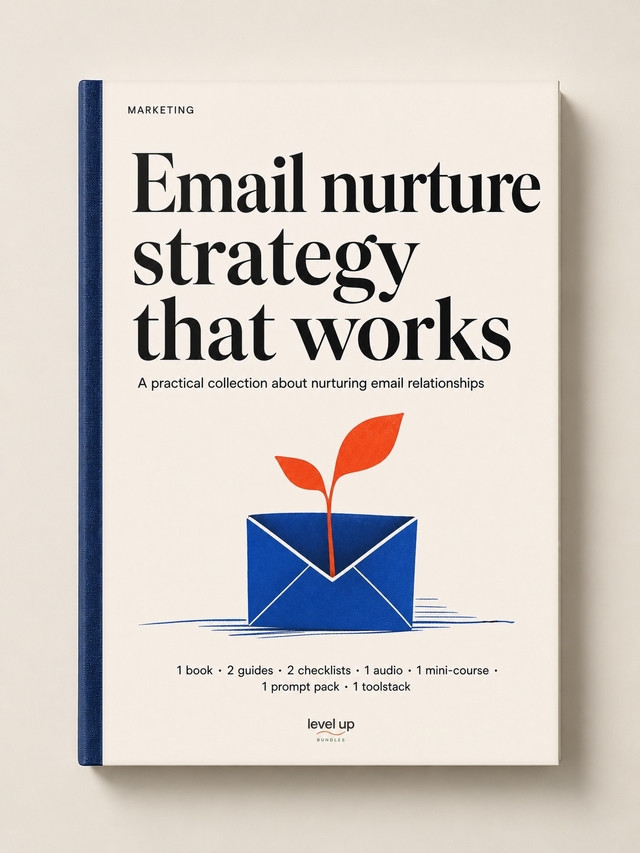
Email Nurture Strategy That Works
Most nurture sequences are written once, plugged into the autoresponder, and forgotten, and the open rates tell the story. Generic welcome flows, bland follow-ups, the same broadcast on Tuesday at 9am for two years. Real nurture is psychology, not automation: the right story at the right moment in the buyer's head.
The kit treats nurture as storyselling. The book lays out the framework, two guides handle the storyselling layer (the framework itself, plus a split-testing workflow that finds what's actually moving subscribers), two checklists cover journey mapping and storyselling implementation, a "don't get ignored in the inbox" mini-course rebuilds the cadence, plus an effective email marketing prompt pack and a nurture sequence builder tool stack handle execution. The audio companion frames inbox-influence thinking.
For the operator running an email program who's tired of low engagement and ready to write nurture that earns the open.
Contents
In this bundle
9 items, in reading order.
 Audio
AudioInbox Influence
Three episodes for the marketer or founder running an email list and noticing the engagement curve declining. Why most nurture sequences fail to nurture (they sell too early, segment too late, and assume the subscriber remembers the previous email, they don't), and what the structural fix looks like. Topics: the welcome sequence that earns the open across all 7 emails, the segmentation that's actually useful, and the long-form storyselling sequence that converts cold subscribers into customers without feeling like a pitch deck. Built for the email lead doing the work and ready to redesign rather than tweak.
 Book
BookEmail Nurture Strategy that Works
Most email nurture sequences are sales emails dressed up as relationships, and the recipient can tell within the first send. The nurture sequences that actually warm cold leads into buyers are structurally different: real value, real timing, real conversation, no manipulation. This ebook is the long-form treatment: the segment-and-personalize work that decides who gets which sequence, the email-by-email craft that builds the relationship instead of pitching, the timing patterns that respect the recipient’s actual journey (versus the marketer’s pace), the subject-line work that earns the open without baiting, the storytelling structure that holds across multi-email arcs, the call-to-action craft that converts without yelling, and the testing-and-iteration loop that improves the sequences across launches. Built for the marketer who’s tired of "nurture sequences" that just feel like spaced-out sales pitches.
 Checklist
Email Journey Mapping
The structured exercise for mapping the actual email journey a subscriber experiences, versus the journey the team thinks they've designed. Walks through the touchpoint inventory (every email a subscriber gets, in what order, triggered by what), the gap analysis (the moments where you're either silent or saying the wrong thing), the over-send check (the segments getting more than the optimal cadence), and the message-consistency audit. Run quarterly or after any major campaign change. Most programs discover at least three structural issues that aren't visible until the journey is mapped.
 Checklist
Storyselling Framework Implementation
The structural check for deploying the storyselling framework on an existing or new email program. Walks through the customer-story identification (which actual customer narratives map to which sales arguments), the email-by-email story arc (what happens in each email, what carries to the next), the proof and objection-handling weave (so the sequence doesn't feel like a sales pitch), and the conversion-step design that lets the close feel earned. Run when designing any nurture sequence longer than three emails.
 Guide
GuideThe Email Split-Testing Workflow
The detailed guide to email split-testing that produces decisions instead of just data. Covers the hypothesis statement that's specific enough to test, the variant design rules that keep tests interpretable (one variable, big enough effect to detect at your list size), the sample size question, and the result-reading framework that distinguishes a real winner from variance. Specific to subject lines, send times, and content variants. Built for the email marketer who's been running tests and noticing they aren't producing the decisions they were supposed to.
 Guide
GuideThe Storyselling Framework
The detailed framework for using customer stories as the spine of an email nurture sequence. Covers the story-selection rubric (which customer narratives actually carry sales arguments), the structural arc across a sequence (so the story builds rather than repeating), the proof and credibility weave that handles objections without becoming defensive, and the close-stage design that makes the buying decision feel earned by the reader. Built for the email marketer ready to move past 'send a value email and a sales email alternately' and into something that actually compounds.
 Mini-Course
Don't Get Ignored in the Inbox
Eight email lessons that walk through redesigning a nurture program from welcome to long-term re-engagement. Sessions one through three install the welcome sequence (the highest-leverage redesign for most programs). Sessions four through six work the long-form nurture and the storyselling sequence. Sessions seven and eight handle the re-engagement and win-back patterns. Built for the email marketer ready to do the structural redesign rather than continue tweaking subject lines on a sequence that has bigger problems.
 Prompt Pack
Effective Email Marketing
Working prompts for the AI-assisted parts of email production: the welcome-email drafter (in your voice, against the offer), the subject-line variant generator, the storyselling sequence outliner from a customer story, the re-engagement campaign drafter for inactive subscribers. Each prompt comes with input/output format. Tested across Claude and ChatGPT. The value is in turning email production from a craft that doesn't scale into a system the small team can sustain at the cadence the program needs.
 Toolstack
Nurture Sequence Builder
The platforms that compose into a working nurture-sequence operation: the ESP choices that handle conditional logic well (Klaviyo, Customer.io, the marketing-automation tier above ConvertKit/Mailchimp), the segmentation infrastructure, the analytics layer for cross-sequence performance, the AI assistance integration. Names specific tools at specific list sizes with the migration breakpoints. Includes the honest take on which automation platforms underdeliver versus the marketing pitch.