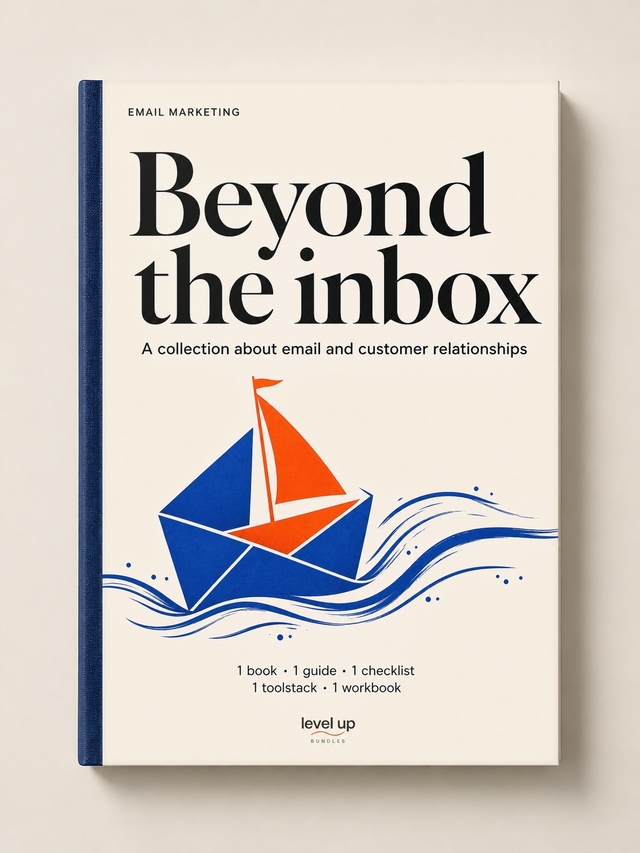
Beyond The Inbox Ebook
Most email programs end where they should begin: send, glance at open rates, repeat. The actual work, list health, segmentation that matches behaviour, retention sequences that survive the unsubscribe wave, transactional touches that double as engagement, lives outside the campaign editor and never makes it onto anyone's roadmap.
The kit takes the email program past the send button. The ebook lays out the post-inbox framework, a guide walks through the operational moves, a checklist covers the sender-reputation hygiene most senders skip, a workbook converts the framework into your own program plan, and a tool stack maps the platforms worth paying for at each list size.
For the operator running the email program who knows opens are vanity and is ready to manage everything that actually compounds.
Contents
In this bundle
5 items, in reading order.
 Book
BookBeyond the Inbox - Ebook
Email marketing has matured past list-and-blast and most operators are still running 2015 playbooks: same email to everyone, occasional sales push, declining open rates that get blamed on the algorithm. The operators whose email actually drives revenue are doing something structurally different. This ebook is the long-form treatment: the segmentation work that turns one big list into action-ready cohorts, the personalization layer that goes past first-name merge fields to actual behavioral relevance, the automation architecture that handles the lifecycle (welcome, engaged, lapsing, won-back) without becoming a robot conversation, the metric stack that distinguishes signal from noise, the optimization loop that improves campaigns across quarters, and the field-tested case studies (Spotify, Airbnb, others) calibrated to what’s actually achievable. Built for the operator who wants email to be an asset, not just a recurring chore.
 Checklist
Beyond the Inbox - Checklist
The pre-send check for any email campaign before it goes to the list. Covers the segmentation question (is this the right list for this message), the personalisation check (are the merge fields actually populated everywhere they appear), the deliverability sanity check, the conversion path verification (does the link actually work in the email client most of your audience uses), and the timing window. Run it on every campaign before scheduling. Most senders skip at least three of these on most sends; the cumulative cost is the engagement decay that nobody catches until quarterly review.
 Guide
GuideBeyond the Inbox - Guide
The structural framework for email marketing past the 'send a newsletter' stage. Covers segmentation that's actually useful (not '10 segments because you can'), the personalisation hierarchy (when first-name personalisation matters and when it's empty noise), automation design that doesn't accidentally double-send, and the analytics framework that measures what matters versus what's easy to measure. Built for the marketer running an email program at 10K-500K list size where the rules change from 'just send' to 'engineer the experience'. Pair with the toolstack for platform-specific implementation.
 Toolstack
Beyond the Inbox - Toolstack
The platforms that actually compose into a working email program at different scales: ESP choices at <10K, 10K-100K, and 100K+ subscriber tiers (with the breakpoints that force migration), CRM integration for the segmentation work, the dedicated tooling for deliverability monitoring, and the analytics layer that catches the things ESP-native reporting misses. Names specific platforms with current pricing and the integration patterns that hold up under volume. Skips the 'top 50 email tools' format that wastes everyone's time. There are 8-10 that matter; the document is honest about that.
 Workbook
Beyond the Inbox - Workbook
Most email marketing books explain the strategy and skip the install, and most readers finish with the same list and the same approach. The workbook format is the install layer: the operator does the actual work alongside the reading, segment by segment, sequence by sequence. This workbook walks the practice: the audience-segmentation exercises that turn the operator’s actual list into named cohorts, the personalization mapping that decides what changes per segment, the automation-design exercises that build the welcome, lifecycle, win-back, and re-engagement sequences for the operator’s specific business, the KPI-and-testing setup that catches what’s working, and the launch-and-iteration prompts that turn the workbook into a working email program by the end. Pair with the ebook for the strategic frame; this workbook is the do-the-work layer.