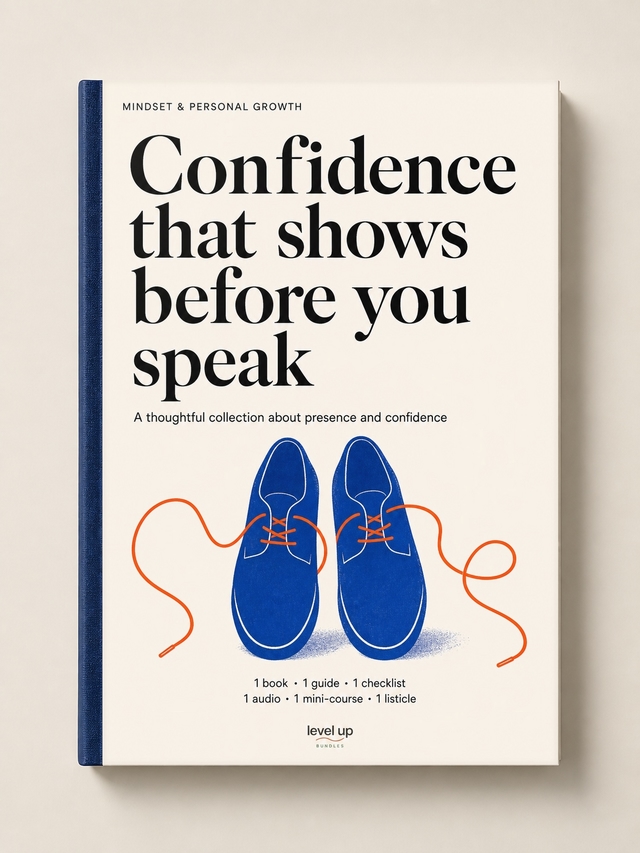
Confidence That Shows Before You Speak
First impressions are formed in milliseconds. Before the handshake, before the introduction, before any words, people have already decided how to read you based on appearance, posture, and the unconscious signals you're broadcasting. Most professional advice ignores this layer entirely; the people who quietly win the room have learned to manage it.
The kit covers the work that happens before you open your mouth. The book sets the framework, a professional wardrobe builder guide walks through the operational decisions, a "looking put-together on rushed days" checklist handles the practical contingencies, a listicle catalogues the seven appearance upgrades that meaningfully shift how others read you, and a mini-course on first impressions makes the whole thing a working skill. The audio companion frames the appearance-advantage mindset.
For the professional who's noticed that the room reads them before they speak, and wants to control what's being read.
Contents
In this bundle
6 items, in reading order.
 Audio
AudioThe Appearance Advantage
Three episodes on dressing as a strategic input rather than a creative expression. Why first impressions are formed in the first three seconds, mostly visually, and why that's not unfair so much as a constraint to work with. The structural moves: the wardrobe baseline that signals competence without requiring fashion expertise, the colour and fit calibration that does most of the work, and the situational adaptation rules. Built for the operator whose appearance has to do real work in client meetings, on stage, or on camera, and ready to treat it deliberately rather than as a daily improvisation.
 Book
BookConfidence That Shows Before You Speak
The book on confidence as a set of structural moves rather than an internal state. Covers the body-language calibration that signals confidence without theatrical posture, the breath and voice work that affects how you're perceived before content registers, the wardrobe and grooming layer that does the work most operators leave to chance, and the mindset moves that prevent the inner monologue from undermining the external presentation. Worked examples for high-stakes contexts: pitches, presentations, difficult conversations, first meetings. Built for the operator whose presence has to perform in moments that matter.
 Checklist
Looking Put Together on Rushed Days
The five-minute protocol for the days when you've got fifteen minutes and need to look like you took an hour. Covers the foundation pieces (the right base layer that handles most of the work), the quick wins (groom, posture check, the one accessory that pulls together a basic outfit), the wardrobe-in-advance moves that make this faster (the night-before laydown, the capsule travel set), and the recovery protocol for when it really has gone sideways and you have a meeting in fifteen minutes. Used regularly, the rushed days stop looking like rushed days.
 Guide
GuideThe Professional Wardrobe Builder
The structured guide to building a wardrobe that does the work without requiring fashion expertise or a large budget. Covers the calibration moves: which pieces actually do the heavy lifting (and how to spot them), the colour palette that simplifies decision-making, the fit principles that matter more than brand or price, the cost-per-wear math that distinguishes investment from indulgence. Worked through with a sample wardrobe build at three budget tiers. Built for the operator who'd rather decide once and execute consistently than think about clothes every morning.
 Listicle
7 Upgrades That Transform How Others See You
Seven specific moves that change how you're perceived in professional contexts: most of them small enough to deploy this week. Posture calibration (the cost of slumping is measured in raises). The voice work that takes vocal fry out of your read. The grooming baseline that signals 'I planned this' without performative effort. The wardrobe edit that drops the three pieces dragging your impression down. The walking pace that signals control. The handshake/greet protocol that calibrates the first ninety seconds. The notebook habit that signals you take the meeting seriously. Each gets a one-paragraph implementation note. Read in twelve minutes. Most operators recognise at least three they could fix immediately.
 Mini-Course
Master the Art of First Impressions
Six email lessons on the structural moves that determine how you're read in the first ninety seconds. Day 1: posture and stance (the version that doesn't read as performative). Day 2: voice and pacing. Day 3: appearance audit (the wardrobe and grooming layer). Day 4: the walk-in protocol for high-stakes meetings. Day 5: the questions and pauses that signal authority. Day 6: integration into daily practice. Built for the operator entering rooms where the first impression actually changes the outcome: pitches, board meetings, first client conversations.