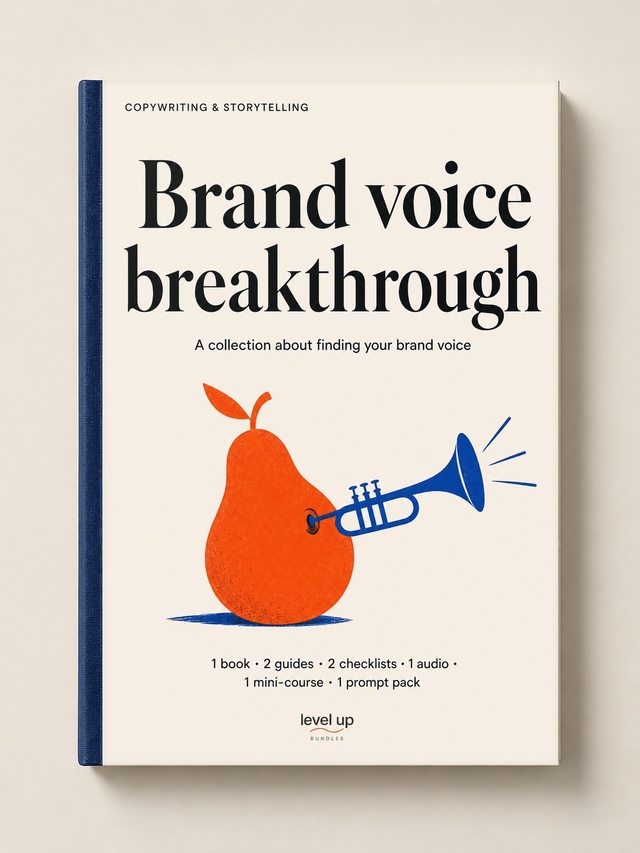
Brand Voice Breakthrough
Most brands have a logo, a colour palette, and a tagline they paid five thousand for. Almost none have a voice anyone could pick out of a lineup. The website sounds professional, the emails sound corporate, the social sounds like a different company entirely, and prospects feel the dissonance before they can name it.
The kit gets the brand voice from "we should work on that" to documented system. The book sets the foundation, a seven-step voice system guide builds the framework, a cross-channel adaptation guide handles how the voice flexes across formats, two checklists cover discovery and platform-consistency audits, a mini-course turns the framework into a six-day intensive, and a prompt pack lets you operationalise the voice across your AI workflow.
Built for the founder or content lead tired of every channel sounding like someone else's company.
Contents
In this bundle
8 items, in reading order.
 Audio
AudioBrand Voice Unlocked
Five episodes for the founder or marketer whose brand 'sounds different on every channel': usually because there isn't actually a defined voice, just whoever wrote each piece bringing their own. Why voice consistency is mostly about decisions, not creativity. The 7-step framework that turns implicit voice into explicit guidelines anyone on the team can use. The cross-channel adaptation move that prevents 'consistency' from becoming 'identical' (which is the wrong target). Written for the small team or solo operator who needs the brand to start sounding like one thing across all the places it shows up.
 Book
BookBrand Voice Breakthrough
The book that treats brand voice as an engineering problem rather than an art-direction problem. Covers the structural moves: voice attribute definition (with the calibration that makes 'we sound friendly' useful instead of meaningless), tone matrix construction for the situations where the same brand needs to sound different (urgent versus casual versus apologetic), word bank development with the do/don't structure that survives team turnover, and the governance system that keeps voice consistent without becoming a bureaucratic check on every piece of copy. Built for the founder or marketing lead writing the company's first real brand voice doc, or rebuilding one that's drifted.
 Checklist
Cross-Platform Brand Voice Consistency
The pre-publish check for any piece of brand content. Walks through the platform-specific calibration (does this version actually fit the platform without breaking voice), the voice-attribute test (does it sound like us, and which specific attributes does it hit), the audience-mindset check (is the framing aligned with how this audience reads this channel), and the tone-matrix verification for situations where the default doesn't fit. Run it on the next ten pieces you publish; you'll catch enough drift to recalibrate the whole content operation.
 Checklist
The Brand Voice Discovery
The structured workshop for extracting an implicit brand voice into something writable. Walks through the source-material audit (the existing content that already sounds 'right'), the attribute extraction process (the four to six adjectives that actually carry the voice, separated from the dozen that sound nice but don't), the do/don't articulation, and the validation step where you re-write existing content using the new guidelines and check that it doesn't lose what was working. Run it as a half-day workshop with the team that does the writing. The output is the voice doc the rest of the bundle assumes you have.
 Guide
GuideThe 7-Step Brand Voice System
The detailed walkthrough of the seven-step process from existing-content audit to working voice guidelines. Step one: content audit (with the rubric that distinguishes 'this is voice' from 'this is just style'). Two: voice attribute discovery. Three: tone matrix construction. Four: word bank development. Five: do/don't writing examples. Six: channel adaptation rules. Seven: governance, how the voice doc actually gets used after the workshop ends. Each step has explicit deliverables. The end product is a working voice doc, not a deck about voice.
 Guide
GuideThe Cross-Channel Voice Adaptation System
The framework for adapting brand voice across channels without it becoming five different voices wearing the same logo. Covers the platform-personality mapping (what each channel structurally rewards versus punishes), the audience-mindset check per channel, the core-wrapper system (which voice attributes stay constant, which adapt), and the consistency scorecard for catching drift early. Built for the team running brand on three or more channels (web, email, social, sales decks, support copy) and noticing that it's started to sound like different teams wrote it, because it did.
 Mini-Course
Build a Voice that Connects
Eight email lessons that walk through building a brand voice from scratch. By session three the recipient has the audit done and the voice attributes drafted. Sessions four through six work through the operational artifacts: tone matrix, word bank, do/don't examples. Sessions seven and eight handle the rollout: getting the voice into the team's actual writing rhythm, not just on a Notion page nobody opens. Built for the founder or marketing lead with a brand that needs voice infrastructure but doesn't have time for a six-month consultant engagement.
 Prompt Pack
Brand Voice Architect
The working prompts for the AI-assisted parts of brand voice work: voice attribute extraction from existing content (paste a sample, get the four-attribute read), tone matrix population for new situations, do/don't example generation grounded in the voice doc, channel-adaptation drafting with the core-wrapper rules built in. Each prompt comes with the input format expected and the output format produced. Tested across Claude and ChatGPT. The value is in turning voice work from a workshop-and-google-doc process into something that fits in the actual rhythm of producing copy.