
Running Meta ads on $200 a month, without guessing
Two hundred dollars a month sounds like too little to learn anything from Meta Ads, and most people spend it like they believe that: one campaign, one audience, no plan for what happens after the first week. Then the results are mediocre, and the conclusion is "Meta doesn't work for us," when the actual problem was that the whole budget went to a single untested bet.
The book in this kit, Meta Ads Made Affordable, opens with some of the genre's usual noise: a promise of agency-level knowledge at a fraction of the cost, a claim that small businesses average 375% ROI, the kind of number that shows up in every ebook like this one and never comes with a source you can check. Skip past that. Underneath it is a budget-splitting method that holds up regardless of whether the headline stat is real.
The 40/50/10 split, and what each third is actually for
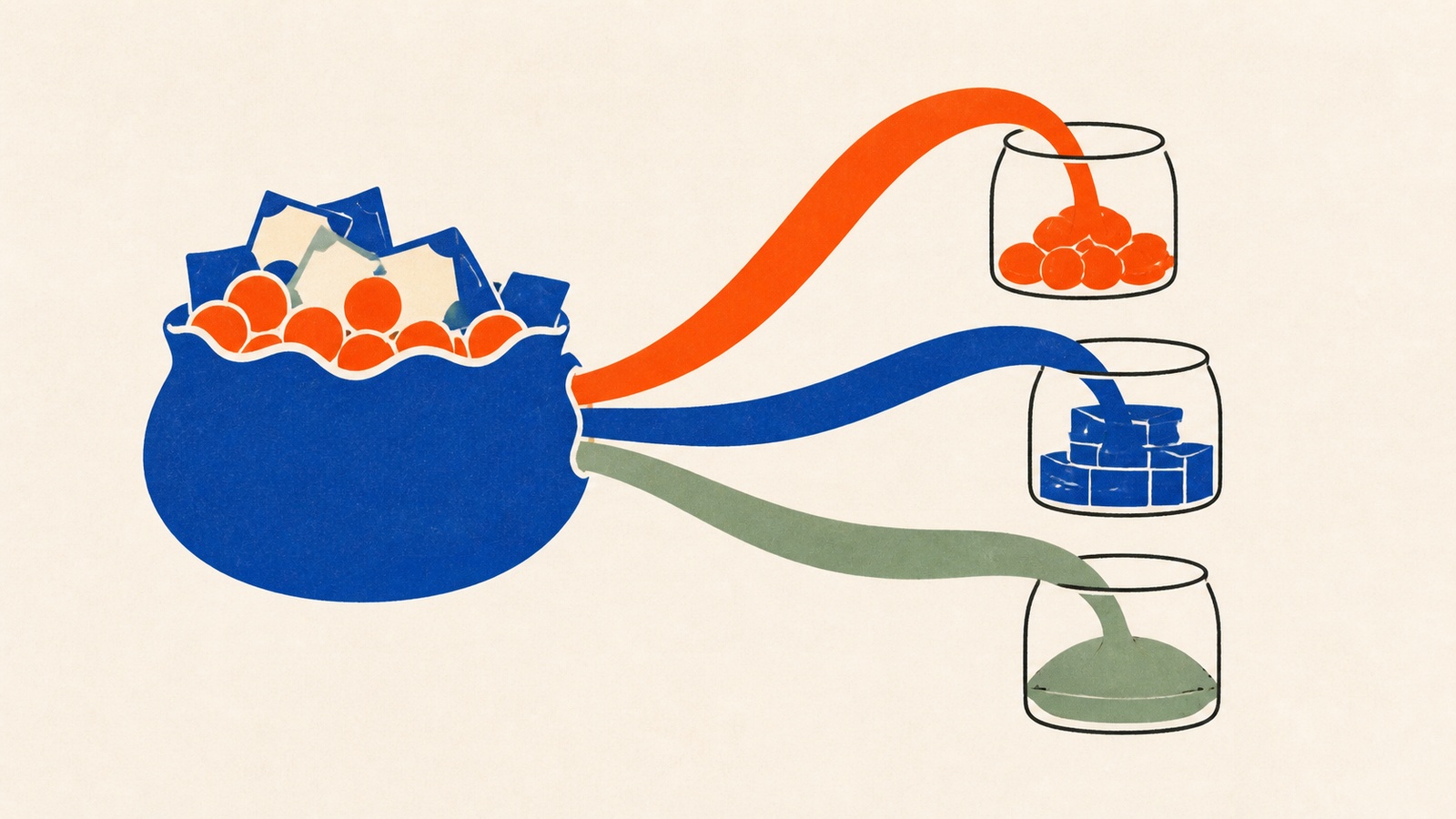
The book's core move is treating a monthly ad budget like three separate jobs rather than one pool of money. Forty percent goes to testing new creative, audiences, and placements. Fifty percent goes to campaigns that have already proven themselves. The remaining ten percent sits in reserve for an unexpected opportunity: a seasonal spike, a competitor stumble, a post that starts working better than planned.
Its worked example is a soap maker running $200 a month: $80 for testing new audiences and formats, $100 for the campaigns already known to convert, $20 held back. Over three months of tracking what actually worked and adjusting from there, the book reports her return on ad spend doubled. The number matters less than the mechanism: she wasn't running one campaign and hoping. She had a fixed slice of the budget whose only job was finding out what worked next, separate from the slice paying the bills.
The reason this beats an even split across campaigns is that testing and proven spend answer different questions. Proven spend tells you whether this month is going well. Testing spend tells you whether next month will be better than this one. Without a dedicated line for it, testing is the first thing that gets cut when a campaign is already working, and then the account stalls the moment that one campaign fatigues.
The book pairs the split with two cost controls worth keeping even if the percentages don't survive contact with your own numbers. Bid caps put a ceiling on what you'll pay per click, per thousand impressions, or per result, so a bad auction day doesn't silently drain the proven-campaign budget. Frequency caps limit how often the same person sees an ad (the book suggests three to four times a week as a starting point) because past that threshold, engagement tends to fall as people start tuning the ad out rather than acting on it.
Its targeting chapter makes a related point about precision: a campaign aimed at "women interested in fitness" and one aimed at "women 25-35, in urban areas, interested in yoga and mindfulness, who shop for organic products" are not the same spend even at identical budgets. The narrower one wastes fewer impressions on people who were never going to convert, which is really the same 40/50/10 logic applied to audience instead of budget: spend where you have reason to believe the money is working, and ring-fence a smaller amount for finding out where else it might.
Where people go wrong
The most common mistake, and the one the book itself names first, is spreading a small budget across too many campaigns and audiences simultaneously. Five audiences at $40 each will not outperform one audience at $200 with a real testing line inside it: each version just accumulates too little data to tell you anything. A related version of the same mistake is testing more than one variable in a single ad at once, which means a winning result can't tell you whether the headline, the image, or the audience did the work.
The second failure mode is reacting to data too early. The book recommends three to five days minimum before judging a test, and that discipline is harder than it sounds when a campaign looks bad on day one. Killing a test before it reaches meaningful volume just means you never learn anything from the money you already spent.
The third is treating platform choice as settled rather than as its own decision. Meta rewards a specific kind of precision targeting, but it isn't automatically the right first platform for every offer. That choice, and what changes once you commit to one, is its own question, covered in the full paid ads guide.
Inside Meta Ads Made Affordable Ebook
Going deeper
- BookMeta Ads Made Affordable - Ebook
- ChecklistMeta Ads Made Affordable - Checklist
- GuideMeta Ads Made Affordable - Guide
- Prompt PackMeta Ads Made Affordable - Prompts
- WorkbookMeta Ads Made Affordable - Workbook
Meta Ads Made Affordable Ebook is one of 13 bundles in The Paid Ads & Landing Pages Pack, or take the whole pack for $29.
Related reading
Paid ads and landing pages: the complete guide for small budgets
How to run paid ads on a small budget: pick one platform, write the ad, fix the landing page, and read the numbers before you spend more.
Read more
The ad funnel diagram everyone draws, and why real customers ignore it
Why a linear ad funnel diagram misreads how people actually buy, and a reusable technique for turning a feature into a reason to care.
Read more
The headline formula behind landing pages that convert
A landing page headline needs clarity, relevance, urgency, uniqueness, and a promise, and most only manage one or two.
Read more