Working Smarter With Virtual Assistants
Hiring a VA is one of the highest-leverage moves a small operator can make and one of the most consistently bungled. Wrong hire, no SOPs, no onboarding, no clear escalation path, and the founder ends up doing the original work plus the VA management. Done well, a VA is genuinely transformative; done badly, it's a tax on the calendar.
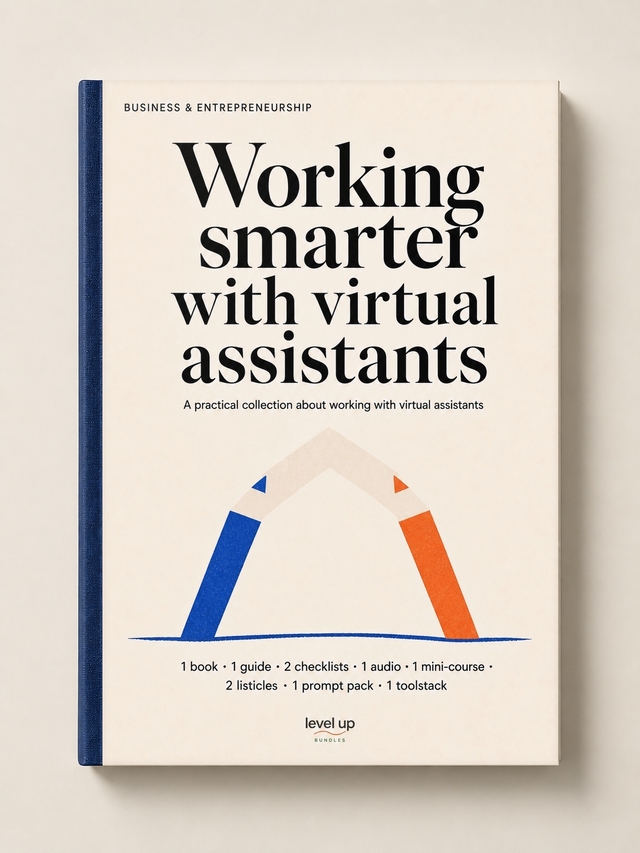
The kit covers VA management end to end. The book lays out the framework, a "preparing your business for VA success" guide handles the upstream work, two checklists cover hiring readiness and onboarding, two listicles surface the seven delegation mistakes stealing your time and the thirteen red flags that your VA system is broken, a "buy back your week with a VA" mini-course turns the framework into a working program, plus a VA management prompt pack and a virtual team management tool stack handle execution. The audio companion frames escape-the-founder-bottleneck thinking.
Aimed at the founder ready to hire a VA, or already has one and is ready to actually delegate properly.
Contents
In this bundle
10 items, in reading order.
 Audio
AudioEscape the Founder Bottleneck
Most founders are the bottleneck in their own business, and the moment they stop touching every decision the operation visibly degrades. The fix isn't more discipline; it's the structural shift that lets virtual assistants actually take work off the founder's plate. The three-episode audio series covers the practice: episode one walks why VAs are one of the fastest paths to operational scale (and why most VA setups quietly fail), episode two installs the systems that let VAs succeed without requiring constant founder oversight, episode three handles the founder-letting-go work that's harder than the operational changes themselves. Each episode includes the moves to test in the next month. Made for commute listening. Pair with the ebook for the long-form treatment; the audio is the briefing version.
 Book
BookWorking Smarter with Virtual Assistants
Most virtual-assistant setups fail because the founder skipped the systems work and expected the VA to figure out how the business runs. The VA partnerships that compound are built on documentation, clear processes, and trust earned through structure. This ebook is the long-form treatment: the task-prep work that decides what's actually delegable (versus what isn't), the role-and-responsibility definition that prevents the scope-drift that kills most VA arrangements, the onboarding system that gets a new VA productive in week one instead of month two, the communication patterns that work without micromanaging, the performance-tracking that measures outcomes instead of hours, and the long-term partnership work that turns a VA into a real operational partner. Built for the founder who's done being the bottleneck and ready to scale operations through delegation that actually works.
 Checklist
The Virtual Assistant Hiring Readiness
Most founders hire a VA before the business is actually ready, then conclude the VA didn't work out when the actual problem was the founder's prep. The readiness checklist catches the prep gaps before the hire. This checklist sequences the readiness pass: the task-inventory work that names what's actually delegable, the documentation pass that turns the founder's tribal knowledge into something a VA can follow, the systems-and-tools setup that the VA needs in place before day one, the role-and-responsibility definition that prevents scope-drift, the communication-and-feedback structure that scales past founder availability, and the success-criteria definition that decides what working-out actually looks like. Pair with the VA ebook for the strategic frame; this checklist is the pre-hire readiness audit.
 Checklist
Virtual Assistant Onboarding
Most VA arrangements stall in the first month because nobody designed the actual onboarding, and the new VA spent week one waiting for clarity that never came. The onboarding sequence that produces a productive VA in seven days is structured. This checklist sequences the practice: the access-and-tools setup that's done before the VA starts (versus reactively), the role-and-expectations conversation that prevents the scope-drift that kills most VA arrangements, the first-week task assignments that build confidence and momentum, the communication-cadence setup that holds without micromanaging, the feedback-and-correction practice that catches issues early, the documentation pass that captures the VA's contributions and improvements, and the 30-day-review structure that calibrates the relationship as both sides learn. Pair with the readiness checklist for the upstream prep; this checklist is the onboarding sequence.
 Guide
GuidePreparing Your Business for Virtual Assistant Success
Most VA hires don't fail because the VA was bad; they fail because the business wasn't ready and nobody walked the founder through the prep. The readiness work is straightforward and pays back across years of leveraged operations. This guide installs the practice: the delegation essentials that name what's actually delegable (versus what isn't yet), the task-identification pass that catches the work eating the founder's hours, the process setup that turns tribal knowledge into something a VA can follow, the tool-and-access preparation that handles the practical layer, the communication standards that scale past the founder's bandwidth, and the ongoing-improvement practice that compounds the VA's contribution across years. Pair with the readiness checklist for the operational pre-flight; this guide is the strategic preparation framework that makes VA hiring actually work.
 Listicle
13 Red Flags Your VA System Is Broken
Most VA arrangements are quietly broken in ways the founder hasn't named because the symptoms look like normal friction. The thirteen specific red flags catch the broken systems before they cost the relationship. This listicle catalogs them: the constant-clarification pattern that signals missing documentation, the work-quality decay that signals broken feedback loops, the founder-touching-everything pattern that signals trust gaps, the deadline-slippage that signals scope-and-prioritization issues, the silent-VA pattern that signals communication breakdown, the rework cycles that signal unclear expectations, the over-dependence on one VA that signals missing systems, and six more. Each red flag has the diagnostic and the structural fix. Made for scanning. Pair with the VA management promptpack for the operational layer; this listicle is the diagnostic that catches what's actually broken.
 Listicle
7 Delegation Mistakes Stealing Your Time With VAs
Most founders hire a VA expecting time savings and discover the delegation is taking more time than the original work, then conclude VAs don't work. The actual cause is usually one of seven specific delegation mistakes. This listicle catalogs them: the delegate-tasks-not-outcomes pattern that produces work that needs constant correction, the no-process-documentation move that requires the VA to ask for every clarification, the perfectionist-correction loop that destroys VA confidence, the expand-scope-without-pay pattern that loses the good VAs to better employers, the inconsistent-feedback approach that prevents skill-building, the no-decision-authority structure that bottlenecks every task back at the founder, and one more that catches even experienced delegators. Each mistake has the diagnostic and the structural fix. Made for scanning. Pair with the VA management promptpack for the practice; this listicle is the failure-mode audit.
 Mini-Course
Buy Back Your Week with VA
Most operators know they should hire a virtual assistant and don’t, because the steps from "I need help" to "the VA is productive" feel mysterious and risky. The drip course installs the actual practice across the working week: lesson one names why doing everything personally is the actual bottleneck (versus the founder’s standard rationalizations), lesson two covers deciding which tasks to delegate first using the right prioritization frame, lesson three names the most-common VA hiring myths and what’s actually true, lesson four installs the task-prep work that makes a new VA productive in week one, lesson five handles hiring the right VA without wasting cycles, lesson six covers the training and onboarding that doesn’t require constant meetings, lesson seven sets the management practice that prevents micromanaging, lesson eight builds the long-term partnership frame. Built for the operator who’s been the bottleneck long enough.
 Prompt Pack
The Virtual Assistant Management
VA management eats time in the structured drafting jobs: the next task brief, the role description, the onboarding plan, the performance feedback, the workflow improvement memo. The pack moves those jobs to AI-assisted starting points: task-identification prompts that surface what's actually delegable from the founder's actual work, role-and-responsibility prompts that produce defensible job descriptions, onboarding prompts that translate tribal knowledge into structured training, performance-and-feedback prompts that produce useful evaluations without becoming awkward, communication-and-workflow prompts that prevent the constant-clarification cycle, troubleshooting prompts for the common VA-relationship issues, and scaling prompts that handle the system as the team grows. Drop them into Claude or ChatGPT alongside the actual VA context. Pair with the VA ebook for the strategic frame; the prompts are the working session.
 Toolstack
Virtual Team Management
Virtual-team tooling sprawls across project management, communication, documentation, hiring, performance, and security, and most operators end up paying for ten platforms when six would do the job. The kit here is the curated short-list, organized by job: the project-management tools matched by team size (ClickUp for serious operations, Asana for mid-size, Trello for small teams), the communication and collaboration picks (Slack, Loom, the alternatives that don't lock the operation in), the documentation and SOP tools (Notion, Tango, the lighter alternatives), the hiring and onboarding platforms, the performance and productivity layer, the security and access tools that handle the basics without becoming a project, and the strategic-framework templates worth using over starting from scratch. Each pick has a one-line reason and a price tier. Pair with the VA ebook for the strategic frame; this list is the buy-list.