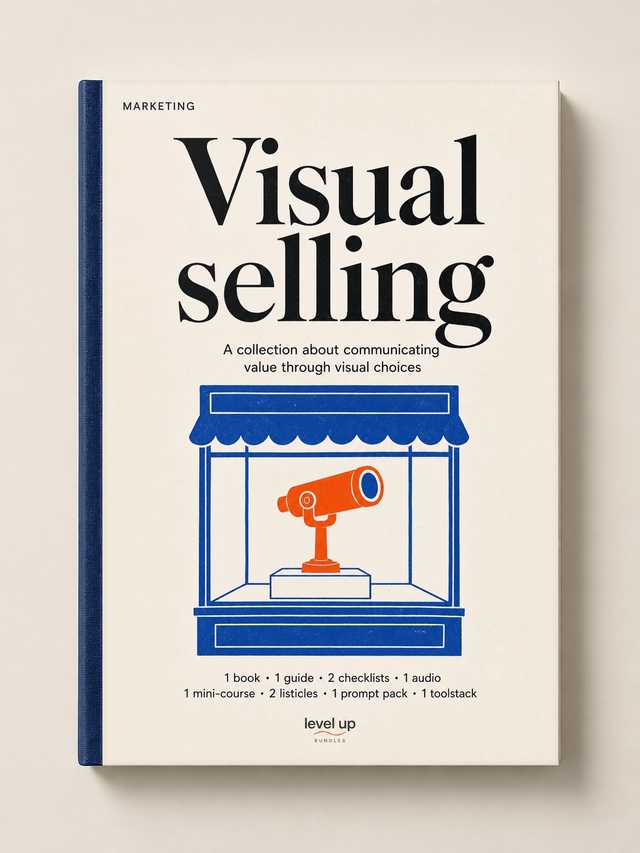
Visual Selling
Visual decisions sell as much as the words do, and most teams optimise the words while leaving the visuals to whoever's free. Colour, hierarchy, the trust signals the eye reads in three seconds, these are decisions that move conversion measurably, and they're learnable without becoming a designer.
The kit covers visual conversion as method. The book lays out the framework, a 3-second trust builder guide handles the highest-leverage layer, two checklists cover colour psychology implementation and 3-second trust elements, two listicles surface the thirteen colour blunders costing sales and the twenty-one visual triggers every marketer needs, a "win customers with design" mini-course turns the framework into a working week, plus a visual marketing excellence prompt pack and a sell-with-design tool stack handle execution. The audio companion frames visual influence thinking.
Aimed at the marketer or founder who's been told "design doesn't matter as much as copy" and ready to find out otherwise.
Contents
In this bundle
10 items, in reading order.
 Audio
AudioVisual Influence
Most online sellers spend their budget on traffic and ignore the visual layer that decides what happens once the visitor arrives. The trust-and-conversion math is mostly visual, and most operators have never been walked through it. The four-episode audio series covers the practice: episode one walks how design choices actually affect customer behavior, episode two breaks the website-visual moves that earn trust in the first three seconds, episode three covers using color psychology that connects with emotion and drives action without manipulating, episode four lands the design improvements that turn visitors into buyers. Each episode includes the moves to test on the next page update. Made for commute listening. Pair with the visual-selling ebook for the long-form treatment; the audio is the briefing version.
 Book
BookVisual Selling
Visual design quietly determines conversion rate at most ecommerce and service sites, and most operators are losing percentage points of conversion to design choices nobody on the team is qualified to evaluate. The visual-selling practice is structured and learnable. This ebook is the long-form treatment: the visual-trust mechanics that explain why visitors decide to trust (or not) in the first three seconds, the color-psychology work that's evidence-based instead of vibes-based, the layout-and-hierarchy moves that guide the eye toward the conversion goal, the product-image patterns that lift purchase rates measurably, the contrast-and-typography decisions that make pages scannable, the field-tested examples of small visual changes producing real conversion lifts, and the testing approach that improves visuals iteratively. Built for the operator who's done leaving conversion gains on the table because the design layer never got the attention.
 Checklist
Color Psychology Implementation
Most brand-color decisions get made by the founder's preference, then defended forever, and most operators have no idea whether their colors are actually working. This checklist runs the color-psychology pass: the audience-emotion mapping that decides what feeling the colors should evoke, the industry-context check that catches colors signaling the wrong category, the primary-and-accent palette structure that prevents the random-color sprawl, the contrast-and-accessibility audit that ensures the palette actually performs across devices and viewers, the call-to-action color decision that drives the conversion moments, the consistency check across web, social, packaging, and print, and the testing structure that catches what's actually moving conversion versus what just looks good. Pair with the trust-builder guide for the broader visual frame; this checklist is the color-decision practice.
 Checklist
The 3-Second Trust Elements Implementation
Visitors decide whether to trust a website in three seconds, and most sites lose that judgment because the trust signals are missing or placed badly. This checklist runs the trust-element implementation pass: the hero-section visual quality that signals professional versus amateur, the social-proof placement above the fold that earns trust before the visitor scrolls, the security-and-credibility badges (SSL, payment, review platforms) at the right moments, the team-and-personality visibility that prevents the brand from reading as faceless corporate, the typography-and-spacing decisions that signal investment in quality, the load-time-and-mobile pass that catches the basic technical fails, and the consistency check across landing page, checkout, and email. Pair with the 3-second trust guide for the strategic frame; this checklist is the per-page implementation pass.
 Guide
GuideThe 3-Second Trust Builder
The first three seconds of a visitor's site experience decide whether they trust the brand enough to keep reading, and most sites quietly fail that test. The trust-builder work is structured. This guide installs the practice: the trust-building basics that explain what visitors are actually evaluating in those three seconds, the trust-triangle frame that maps competence, warmth, and integrity to specific design choices, the header-optimization tips that handle the highest-leverage real estate on the page, the design-that-works principles that earn trust without requiring a designer, the color-psychology work in plain language, the mobile-friendly strategies that handle the half of traffic most operators design poorly for, and the testing-and-improvement loop that catches what's actually moving trust. Pair with the trust-elements checklist for the per-page implementation; this guide is the strategic trust-building frame.
 Listicle
13 Color Blunders Costing You Sales
Most operators are losing real conversion to thirteen specific color mistakes that make the brand look unprofessional, hard-to-trust, or just confusing. The mistakes are knowable and fixable. This listicle catalogs them: the bad-contrast pattern that makes copy unreadable, the call-to-action color that disappears against the page, the brand-palette inconsistency that makes the operation look amateur, the trend-chasing color choice that signals the wrong category, the cultural-context blunder that triggers the wrong emotion in the target market, the too-many-colors sprawl that destroys hierarchy, the wrong-color-for-the-emotion mismatch, and six more. Each mistake has the diagnostic and the specific fix. Made for scanning. Pair with the color-psychology checklist for the structured implementation; this listicle is the failure-mode audit.
 Listicle
21 Visual Triggers Every Marketer Must Know
Most marketing copy gets read but not felt, because nobody used the visual triggers that engage attention at the brain-stem level rather than the cognitive layer. The triggers are knowable and testable. This listicle catalogs twenty-one specific visual triggers: the high-contrast pattern that earns the first eye-stop, the human-face inclusion that lifts attention measurably, the directional-gaze trick that points the visitor's eye where the operator wants it, the white-space discipline that signals quality, the typographic-pairing move that creates hierarchy without effort, the asymmetric-balance pattern that catches attention in the symmetric web, the motion-suggestion through static images, and fourteen more. Each trigger has the mechanism and the application example. Made for desk reference. Pair with the trust-builder guide for the strategic frame; this listicle is the trigger menu.
 Mini-Course
Win Customers with Design
Most "design for conversion" courses are visual theory with no practical install, and most students finish unable to identify the design problems on their own pages. This drip course runs the actual install across the working week: lesson one frames why design is one of the fastest trust-building levers online, lesson two covers the small design fixes that produce big conversion lifts, lesson three lands the layout-and-attention work that guides the eye to the conversion goal, lesson four installs color psychology with the picks for the operator's specific market, lesson five builds the brand consistency that compounds recognition, lesson six handles landing pages, emails, and social posts as a coordinated visual system, lesson seven names the design mistakes that quietly undermine trust, lesson eight sets the testing-and-improvement practice that holds across years. Built for the operator whose product is good and whose conversion rate doesn't reflect it.
 Prompt Pack
Visual Marketing Excellence
Visual-marketing work eats time in the structured drafting jobs: the next ad creative brief, the brand-color decision memo, the social-post visual, the website-redesign brief. The pack moves those jobs to AI-assisted starting points: color-selection prompts that match palette to audience and category instead of founder preference, trust-design prompts that catch the trust-erosion patterns in current pages, brand-consistency prompts that produce style-guide-level decisions across platforms, layout-and-flow prompts that audit pages for visual hierarchy, and testing prompts that frame visual experiments as proper tests. Drop them into Claude or ChatGPT alongside the actual brand context. Pair with the visual-selling course for the strategic frame; the prompts are the working session that produces the next visual asset.
 Toolstack
Sell With Design
Visual-design tooling sprawls across trust-building, conversion design, branding, content creation, and color tools, and most operators end up with overlapping tools that don't quite produce the visual quality they wanted. The kit here is the curated short-list, organized by job: the trust-building tools (testimonial widgets, security badges, social proof platforms), the conversion-design tools (heatmaps, click maps, A/B testing), the visual-branding picks (Brandkit, Frontify, the lighter alternatives for solo operators), the content-creation stack (Canva, Figma, the AI-image generators worth using), and the color-and-layout tools that prevent the random-design problem. Each pick has a one-line reason and a price tier. Pair with the visual-selling course for the strategic frame; this list is the buy-list.