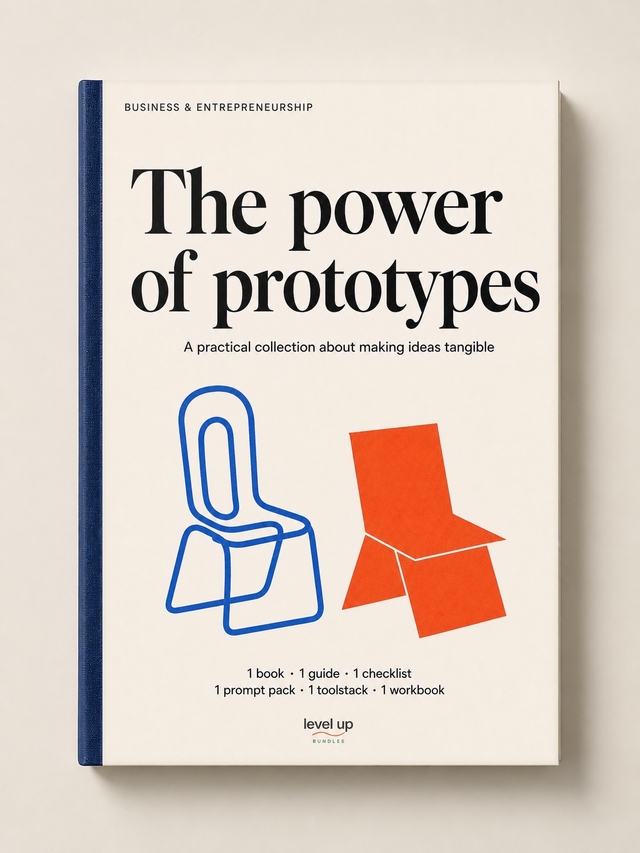
The Power Of Prototypes Ebook
Prototyping is the cheapest way to be wrong fast. Most teams skip it because building feels more productive than testing, and ship products nobody asked for. The operators who prototype well are the ones who treat their assumptions as testable rather than obvious, and who'd rather kill a bad idea on a Tuesday than spend six months building it.
The kit covers prototyping as discipline. The ebook lays out the framework, a guide walks through the practical mechanics (which assumptions to test first, what fidelity is enough), a checklist gates whether the prototype is actually answering a real question, a workbook turns it into your own assumption-test plan, a prompt pack handles the AI-assisted scoping work, and a tool stack maps the no-code and low-fidelity platforms worth using.
Built for the product lead or founder who's done shipping things on hunches and ready to test them while it's still cheap to be wrong.
Contents
In this bundle
6 items, in reading order.
 Book
BookThe Power of Prototypes - Ebook
Most product founders skip prototyping and go straight to build, then waste months and capital on the wrong product. The operators who prototype well consistently ship products that fit the market because they tested the assumptions cheaply before committing. This ebook is the long-form treatment: the prototype-as-test-not-product frame that decides what to actually build, the fidelity-selection logic that picks low, medium, or high based on what's being tested, the user-feedback patterns that pull real signal instead of polite responses, the iteration loop that turns each prototype into the next test instead of the next feature, the pitfalls-and-mistakes pass that catches the failure modes most prototypes hit, and the field-tested examples (Dropbox, Airbnb, others) showing how clean prototyping produced clear answers. Built for the founder who's done betting full builds on untested assumptions.
 Checklist
The Power of Prototypes - Checklist
Most prototypes fail at the questions stage: nobody decided what the prototype was actually testing, so the feedback comes back ambiguous and the next iteration is a guess. This checklist sequences the prototyping pass properly: the test-question definition that names exactly what the prototype is trying to learn, the goal-and-success-criteria pass that decides what counts as a clear answer, the prototype-format pick (sketch, clickable wireframe, smoke test, manual back-end) matched to the question, the user-recruitment that finds the actual target user (not friends), the feedback-collection structure that pulls signal instead of noise, and the iteration-or-pivot decision criteria that handle the results without freezing in analysis. Pair with the prototyping guide for the strategic frame; this checklist is the per-prototype pre-flight.
 Guide
GuideThe Power of Prototypes - Guide
Most founders treat prototyping as a phase to get through quickly so they can start building the real thing. The operators who treat prototyping as the actual product-development discipline ship products that fit the market on the first or second real build, while the rush-to-build founders rebuild three times and still miss. This guide installs the practice: the prototyping essentials that explain what prototypes are actually for, the testing-and-feedback patterns that pull real signal at each fidelity level, the user-centric design work that prevents the founder-bias problem, the iterative development loop that turns each prototype into the next test, and the field-tested case studies of products that became market winners through disciplined prototyping. Pair with the prototyping checklist for the per-prototype pre-flight; this guide is the strategic frame.
 Prompt Pack
The Power of Prototypes - Prompts
Prototyping work eats time in the structured drafting jobs: the test-question definition, the user-interview script, the feedback-synthesis memo, the iteration brief. The pack moves those jobs to AI-assisted starting points: prototype-type-selection prompts that pick the right format for the actual question being asked, functional-test prompts that turn the prototype into a real experiment instead of a demo, user-feedback prompts that produce interview questions and synthesis frameworks, iteration prompts that decide what to change versus keep based on the feedback, and user-experience prompts that catch the design problems before the next prototype round. Drop them into Claude or ChatGPT alongside the actual prototype context. Pair with the prototyping guide for the strategic frame; the prompts are the working session.
 Toolstack
The Power of Prototypes - Toolstack
Prototyping tooling sprawls across concept testing, functional testing, design, physical prototyping, and user feedback, and most operators end up paying for tools they don't use because the wrong tool was picked for the wrong question. The kit here is the curated short-list, organized by job: the concept-testing tools (Maze, UserTesting, the cheaper alternatives for solo founders), the functional-testing platforms matched by complexity, the design-and-visualization picks (Figma, Sketch, the lightweight options), the physical-prototyping tools for the operators building hardware or physical products, and the user-feedback platforms that pull real signal instead of survey noise. Each tool has a one-line reason and a price tier. Pair with the prototyping guide for strategy; this list is the buy-list.
 Workbook
The Power of Prototypes - Workbook
The Power of Prototypes ebook covers the discipline; this workbook is where the operator builds the actual prototype for their specific product idea. The pages walk through structured exercises: the test-question definition that picks what the prototype is actually testing (versus the temptation to test everything), the prototype-format selection matched to that question, the design-and-build planning that ships a real prototype in days, the functional-testing protocol that produces clear data, the iterative-feedback loop that turns each prototype version into the next, and the pivot-or-continue decision frame that handles the data honestly. Each exercise produces a real artifact the operator can ship and learn from. Pair with the prototyping ebook for the strategic frame; this workbook is the build session for the operator ready to ship the next prototype this week.