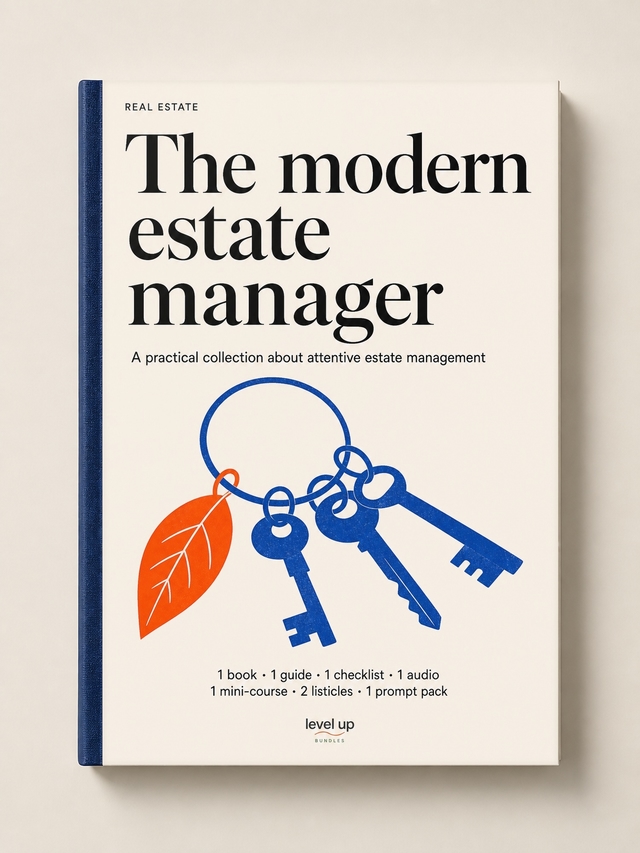
The Modern Estate Manager
Estate management has quietly become one of the most professionalised non-corporate roles in the world. The estates have grown, multiple residences, staff, security, art collections, calendars, and the operators running them have moved from "head housekeeper" to "household chief operating officer." The skill stack is real, the pay reflects it, and almost no one is being trained in it deliberately.
The kit covers the modern estate-management role end to end. The book lays out the framework, a "mastering luxury property and household operations" guide handles the practical work, an estate manager success plan checklist gates the role transition, two listicles surface the thirteen operational systems that separate elite estate managers and the seven silent mistakes that end careers, a "from housekeeper to operations executive" mini-course turns the framework into a working program, and an estate management excellence prompt pack handles documentation. The audio companion frames executive estate management thinking.
Aimed at the estate manager moving into the operator role and ready to run the household like the multi-million-dollar operation it actually is.
Contents
In this bundle
8 items, in reading order.
 Audio
AudioExecutive Estate Management
Most household-staff training treats luxury estate management as glorified housekeeping, and the result is a workforce that can clean but can't actually run a complex household. The estates that operate well are run like small companies, with structure, authority, and clear protocols. The three-episode audio series covers the operator-CEO frame: episode one walks the mindset shift from staff to executive that changes how the household runs, episode two covers the systems setup that lets daily operations run without principal involvement, episode three handles the trust-and-authority work that earns staff and principal cooperation simultaneously. Each episode includes the moves to test in the next month of operations. Made for commute listening. Pair with the ebook for the long-form treatment; the audio is the briefing version.
 Book
BookThe Modern Estate Manager
Modern estate management is a profession that quietly evolved from butler-and-housekeeper roles into something closer to a small-business operator, and most training material still teaches the old version. The estates that operate well are run by managers who think like operators: systems for everything, clear authority, defined protocols. This ebook is the long-form treatment for the operator's version: the leadership frame that earns trust from staff and principals simultaneously, the daily-systems work that handles schedules, vendor management, supply chains, and emergency response without firefighting, the security-and-privacy protocols that protect principals without becoming oppressive, the staff-management practices that prevent turnover at scale, the guest-and-event coordination that handles the unpredictable moments without breaking the routine, and the modern technology stack that runs the household without becoming a surveillance state. Built for the estate manager who's done managing chaos and ready to run the household like a real operation.
 Checklist
The Estate Manager Success Plan
Most estate-manager onboarding is informal and incomplete, and the new manager spends three months figuring out what nobody told them upstream. The result is rocky transitions, principal frustration, and the kind of staff turnover that's expensive everywhere but especially in luxury households. This checklist sequences the onboarding properly: the role-clarity pass that names exactly what the manager is responsible for (and what they're not), the trust-building moves with the principal in the first thirty days, the operational handover from the prior manager (or the founder), the staff-introductions and authority-establishment work, the systems and protocols audit that catches what's actually documented versus what lives in someone's head, and the ninety-day review structure that calibrates the role as the manager learns the household. Pair with the operations guide for the daily work; this checklist is the onboarding pre-flight.
 Guide
GuideMastering Luxury Property and Household Operations
Most luxury-property operations run on the founder's attention and personal relationships, and the moment that attention shifts everything quietly degrades. The estates that operate well treat the household as a small business with structure, leadership, and standards. This guide installs the operator-CEO frame: the estate management basics that explain what the role actually requires (versus the inherited assumptions), the staff leadership work that handles authority without micromanaging, the systems setup that lets the household run without the manager being in every room, the property operations work that handles maintenance, vendors, and supply chains proactively, and the luxury service standards that distinguish good from exceptional in ways principals notice without articulating. Pair with the success-plan checklist for the per-manager onboarding; this guide is the strategic framework for running luxury property operations.
 Listicle
13 Operational Systems That Separate Elite Estate Managers
Most estate managers run on personal capability, then hit a ceiling because they never built the systems that would let them run multiple properties or scale their authority across larger staffs. The thirteen operational systems that elite managers run are knowable and installable. This listicle catalogs them: the daily-briefing system that aligns staff without endless meetings, the vendor-management system that prevents the emergency-vendor scramble, the maintenance-tracking system that catches issues before they become crises, the inventory and supply-chain system that runs without spreadsheets, the security-and-privacy protocols that are written down instead of remembered, the staff-scheduling system that handles the unpredictable demands, the principal-communication cadence that earns trust, and six more. Each system has the diagnostic and the install steps. Made for desk reference. Pair with the operations guide for the strategic frame; this listicle is the system-by-system menu.
 Listicle
7 Silent Mistakes That End Estate Management Careers
Most estate-management careers don't end in dramatic firings; they end in the seven silent mistakes that quietly erode trust until the principal decides to make a change without ever having a hard conversation. This listicle catalogs them: the micromanaging pattern that signals lack of confidence in the staff, the over-promising habit that creates the broken-trust moments, the principal-communication drift that loses connection slowly, the boundary collapse that makes the manager available at all hours and resented for it, the staff-favoritism that destroys team cohesion, the documentation neglect that leaves the manager irreplaceable in the wrong way, and the no-systems pattern that makes the household dependent on the manager's memory. Each mistake has the diagnostic and the specific reset move. Made for scanning. Pair with the operations guide for the strategic work; this listicle is the failure-mode audit.
 Mini-Course
From Housekeeper to Operations Executive
Most household-staff training treats moving up to estate management as a promotion in title, not a fundamental shift in how the work gets done. The mindset gap between service and operations is what most internal promotions don't survive. This drip course runs the actual transition across the working week: lesson one frames the shift from service mindset to executive operations, lesson two installs the staff-leadership moves that don't read as micromanaging, lesson three covers the systems work that lets households run without constant oversight, lesson four lands the vendor-management practices that prevent emergencies, lesson five handles luxury service standards through anticipation rather than reaction, lesson six covers privacy and security protocols, lesson seven sets the daily operations rhythm. Built for the housekeeper, butler, or estate assistant who's been promoted (or wants to be) and needs the practice that holds.
 Prompt Pack
Estate Management Excellence
Estate-management work eats time in the structured drafting jobs: the daily staff briefing, the vendor-evaluation memo, the maintenance schedule, the principal-update report, the budget reconciliation. The pack moves those jobs to AI-assisted starting points: task-organization prompts that turn the day's competing demands into a working sequence, staff-management prompts that handle scheduling, evaluation, and difficult conversations, budget-and-cost-tracking prompts that turn raw expense data into a real financial picture, vendor-and-maintenance prompts that produce the right brief for the right specialist, and service-improvement prompts that translate principal feedback into specific operational changes. Drop them into Claude or ChatGPT alongside the actual household context. Pair with the operations guide for the strategic frame; the prompts are the working session.