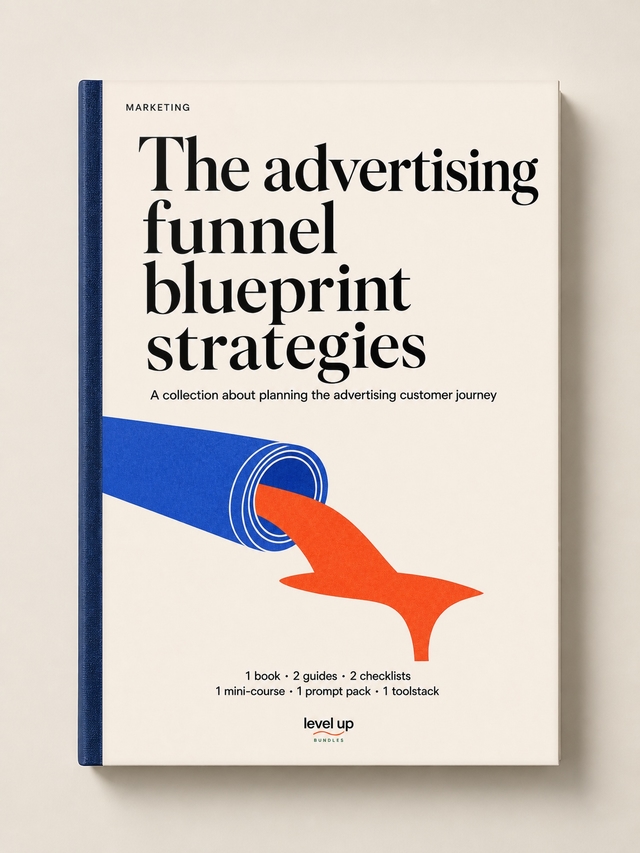
The Advertising Funnel Blueprint Strategies
Most ad funnels are loose collections of campaigns held together by the founder's hope. Top-of-funnel runs to a homepage that doesn't qualify, retargeting hits people who already bought, and the trust-building elements that turn a click into a customer were never built. The funnel that converts is engineered from the prospect's first impression to the purchase confirmation, with friction designed in and out at every stage.
The kit treats the ad funnel as architecture. The book lays out the framework, two guides handle the practical layers (a complete customer journey mapping, a trust signal implementation framework), two checklists cover funnel setup and critical trust-building elements, a "crafting funnel strategies that convert" mini-course rebuilds the cadence, plus an optimise-your-marketing-funnel prompt pack and a funnel growth tool stack handle execution.
For the marketer or founder running paid traffic into a funnel that mostly leaks, and ready to find and seal the gaps.
Contents
In this bundle
8 items, in reading order.
 Book
BookThe Advertising Funnel Blueprint Strategies
Most ad funnels are awareness campaigns dressed up as funnels: the operator runs prospecting ads, sees zero conversions, and concludes the funnel is broken when there was never actually a funnel. The funnels that convert have specific stages, specific creative for each stage, and specific conversion metrics that signal what to fix. This ebook is the long-form treatment: the funnel-architecture frame that decides what each stage is for (awareness, consideration, decision, retention), the audience-build work that picks the right targeting per stage, the creative principles that work at each stage (and the ones that backfire when applied to the wrong stage), the optimization-and-scaling logic that compounds wins instead of fragmenting spend, the budget allocation across stages that lifts overall ROAS, the measurement frame that connects each stage to the next instead of measuring everything in isolation. Built for the operator who's tired of running disconnected campaigns and wants a real funnel.
 Checklist
Advertising Funnel Setup
Most ad funnels launch with the wrong tracking, the wrong audience definitions, and the wrong creative-to-stage assignment, and the operator spends the next quarter trying to figure out which decision is breaking the funnel. This checklist runs the pre-launch pass: the business-goal definition that decides what the funnel is actually optimizing for (versus generic "more sales"), the audience-segmentation pre-build that prevents the funnel from competing with itself, the creative-to-stage mapping that puts the right asset at the right point, the conversion-event configuration that makes the algorithm optimize for the right outcome, the budget-and-bid setup matched to funnel maturity, and the analytics and tracking pre-flight that confirms the funnel is measurable from day one. Pair with the funnel-strategies course for the strategic frame; this checklist is the launch pre-flight.
 Checklist
Critical Trust-Building Elements
Most funnel pages convert below their potential because the trust signals are missing or placed badly, and the operator doesn't know which signals are actually moving the needle. This checklist runs the trust-element audit: the credibility-anchor pass (named clients, named publications, real numbers, real testimonials), the transparency moves (clear pricing, real photos, honest FAQs, refund policy), the social-proof placement at the moments doubt would otherwise spike, the security-and-compliance signals (SSL, payment-processor logos, privacy policy) that handle the implicit objections, the personality and team visibility that prevents the brand from reading as faceless corporate, and the consistency check across landing page, checkout, and post-purchase touchpoints. Pair with the trust-signal framework guide for the strategic placement; this checklist is the trust-element inventory pass.
 Guide
GuideThe Complete Customer Journey Mapping
Most operators have a vague mental model of the customer journey and design marketing as if every touchpoint hits a fresh audience. The journey is actually a sequence of states the buyer moves through, and the marketing that converts knows which state the prospect is in at every interaction. This guide installs the practice: the journey-stage definitions that decide what awareness, consideration, decision, and retention actually mean for this specific business, the touchpoint mapping that catches the gaps where the journey breaks, the emotional-connection work at each stage that earns trust before the next ask, the buying-process optimization that removes friction at the conversion moments, and the tracking-and-improvement system that catches drift before it becomes a quarter of declining conversion rates. Pair with the trust-signal framework for the credibility layer; this guide is the journey architecture.
 Guide
GuideThe Trust Signal Implementation Framework
Trust signals are the most underestimated element of conversion rate optimization, and most operators install them randomly or skip them entirely. The signals that move conversion are placed at specific moments where doubt would otherwise spike, and the placement matters more than the signal itself. This guide installs the practice: the trust-signal fundamentals that explain what each signal type actually does (social proof, authority, security, transparency, consistency), the strategic placement work that puts the right signal at the right decision moment, the social-proof optimization that uses real customers instead of stock testimonials, the security and transparency moves that handle the implicit objections at checkout, the field-tested case studies showing what trust signals actually move conversion, and the testing-and-refinement loop that improves the trust layer over time. Pair with the trust-element checklist for the inventory pass; this guide is the placement strategy.
 Mini-Course
Crafting Funnel Strategies That Convert
Most ad-funnel courses cover the platforms and skip the strategy, and most students finish with the same disconnected campaigns and the same flat ROAS. This drip course runs the actual install across the working week: lesson one walks the funnel-architecture frame that decides what each stage is for, lesson two covers high-converting ad copy, visuals, and targeting matched per stage, lesson three lands the optimization moves at each funnel stage, lesson four installs the funnel-metric tracking that surfaces the actual problems, lesson five covers scaling the funnel without breaking the unit economics, lesson six handles the common funnel mistakes that quietly cap performance. Built for the operator who's running paid ads at real budget and wants the funnel that compounds instead of fragmenting.
 Prompt Pack
Optimize Your Marketing Funnel
Funnel-optimization work eats time in the structured drafting jobs: the persona refresh, the stage-by-stage creative brief, the landing-page copy, the email sequence, the performance-analysis memo. The pack moves those jobs to AI-assisted starting points: persona-and-targeting prompts that turn raw customer data into stage-specific audience definitions, content-creation prompts that produce stage-matched copy and creative briefs, conversion-optimization prompts that audit landing pages, emails, and ads against the actual funnel stage, and performance-analysis prompts that read raw funnel metrics and surface the specific stage that's bleeding conversions. Drop them into Claude or ChatGPT alongside the actual funnel data. Pair with the funnel-strategies course for the strategic frame; the prompts are the working session.
 Toolstack
Funnel Growth Stack
Funnel tooling sprawls across analytics, A/B testing, attribution, communication, and CRM, and most operators end up paying for ten platforms when six would do the job. The kit here is the curated short-list, organized by job: the analytics and measurement tools matched by team size and budget tier (GA4 plus PostHog at the lighter end, Heap and Amplitude as the operation grows), the testing and optimization platforms (VWO, Convert, Optimizely matched by traffic volume), the engagement and communication picks (Intercom, Drift, Crisp), the strategic-framework templates worth using over starting from scratch, and the attribution tools that connect funnel activity to actual revenue. Each pick has a one-line reason and a price tier. Pair with the funnel-strategies course for strategy; this list is the buy-list.