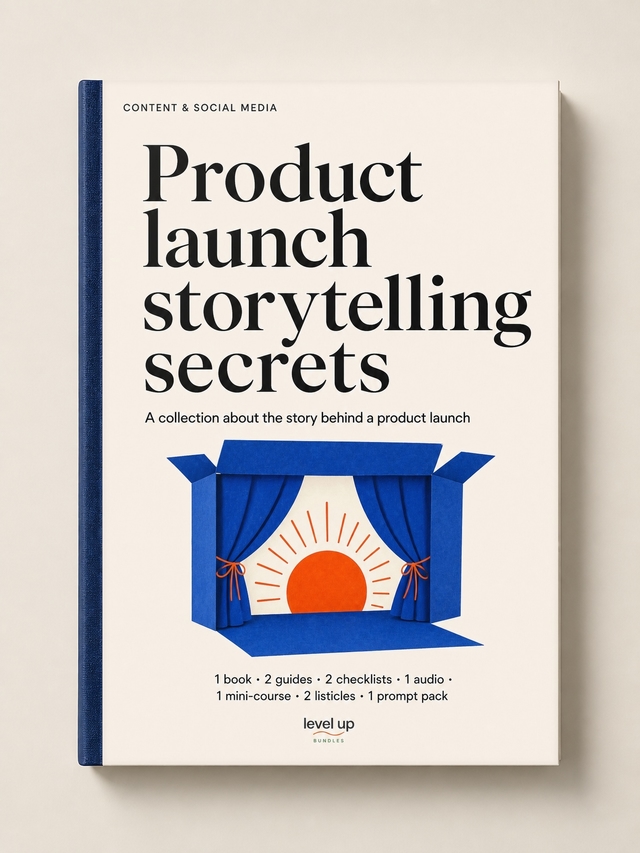
Product Launch Storytelling Secrets
Most product launches fail at the story before they fail at the offer. The product is fine, the email goes out, the sales page is live, and the story the prospect heard was generic enough to bounce off. Launches that sell are launches that tell one specific, well-staged story, told consistently across every touch from the waitlist to the cart-close email.
The kit covers launch-as-narrative. The book lays out the framework, two guides handle the practical mechanics (a 7-day pre-launch waitlist builder, transforming launch assets into evergreen content), two checklists cover the launch email sequence and the storytelling framework itself, two listicles surface the twelve costly content errors that kill launches and the twenty-one psychological hacks that turn launches into sellouts, a 6-day product launch success mini-course rehearses the sequence, and a launch helper prompt pack handles the asset writing. The audio companion frames launch language thinking.
Built for the founder or marketer about to launch and tired of "great product, soft response" being the post-mortem.
Contents
In this bundle
10 items, in reading order.
 Audio
AudioLaunch Language
Most product launches are dump-and-pray events: the product goes live, the founder posts, the audience scrolls past, the launch dies. The launches that compound are stories with structure, and the structure is teachable. The five-episode audio series covers the storytelling layer: episode one walks why launches without narrative quietly underperform regardless of product quality, episode two installs the post-launch momentum moves that prevent the day-two drop-off, episode three covers the pre-launch audience-warming work that turns strangers into pre-purchase fans, episode four lands the email-sequence build that the operator can write in a weekend and run for two weeks, episode five names why every great launch starts with a story (and what story shapes actually work). Made for commute listening. Pair with the ebook for the long-form treatment; the audio is the briefing version.
 Book
BookProduct Launch Storytelling Secrets
Most digital product launches plan the offer, the price, and the email schedule, and skip the part that actually moves units: the story. The product is the answer; the story is the problem the buyer didn’t know how to articulate until the launch named it. This ebook is the long-form treatment: the audience-research pass that surfaces the actual problem language the buyer uses (instead of the marketer’s version), the launch-story architecture that builds tension, conflict, and resolution across the launch sequence, the message-framework that holds the story across email, social, and video without going repetitive, the audience-warming moves that build the list and the trust before launch day, the launch-week communications calendar with the email count and timing that actually convert, and the post-launch evergreen pass that turns the launch content into a sales asset that runs for months. Built for the operator who’s tired of launches that go quiet at the end of week one.
 Checklist
Product Launch Email Sequence
Most launch email sequences land like a series of unrelated pitches because nobody planned them as a story arc, and the open rate decays sharply after the second send. This checklist sequences a launch email series the way it actually converts: the pre-launch warm-up emails (announcement, behind-the-scenes, founder story, value teaser) that build the audience for launch day, the launch-day fire (the open, the social proof drop, the cart-close countdown), the urgency wave (24-hour reminder, last-chance, the final-hour pulse), and the post-launch communications (thank-you for buyers, alternative offer for non-buyers, debrief signal for the next launch). Each email gets a job, not just a slot. Pair with the launch-storytelling framework checklist for the narrative; this checklist is the email-by-email execution.
 Checklist
Product Launch Storytelling Framework
Most launch stories are an origin story, a feature list, and a price page, and the audience never builds the emotional momentum the launch needs. The structure that converts is closer to a three-act story: the problem the buyer didn’t know they had named precisely, the failed attempts that proved the standard solutions don’t work, the new approach that the product embodies. This checklist runs the structure pass: the audience-language audit that surfaces the problem the buyer would actually pay to solve, the message-arc design that builds tension across the launch instead of dumping it on day one, the value-and-proof placement that earns trust at the moments doubt would otherwise spike, the channel-specific format adjustments, and the consistency check that prevents the story from drifting across email and social. Sibling to the email-sequence checklist (the per-email work); this is the story-level frame.
 Guide
GuideA 7-Day Pre-Launch Waitlist Builder
Most launches fail at the start: the product goes live with no audience, no warmed-up list, and the operator wonders why nobody bought. The waitlist work that fixes this is seven days of focused attention, not a six-month brand campaign. This guide installs the seven-day waitlist build: day one designs the lead magnet that earns the first signup (specific to the product, not generic), day two ships the waitlist landing page with the conversion elements that actually move signup rates, day three sets the email sequence that holds the list warm without overcommunicating, day four installs the urgency and scarcity moves that don’t manufacture panic, day five builds the conversion-lifting elements (testimonials, founder note, FAQ), day six runs the traffic plays that fill the list without paid ads, day seven sets the launch-readiness pre-flight. Pair with the launch-sequence guides for what happens after the waitlist; this guide is the upstream demand build.
 Guide
GuideTransform Launch Assets into Evergreen Content
Most operators write a quarter of launch content, run the launch, and let the assets die in a Google Drive folder. The launches that compound are the ones where every asset gets a second and third life as evergreen content. This guide installs the repurposing system: the post-launch content inventory that catalogs what’s worth keeping (versus what was launch-specific), the easy repurposing patterns that turn an email sequence into a blog series, a launch story into a landing page, and a Q&A session into a FAQ resource, the smart publishing strategy that drips the evergreen versions across months, the time-saving templates that handle the rewrite work, the proven-results examples from operators who’ve doubled their launch ROI by extending the content life, and the performance-tracking that proves the evergreen lift. Pair with the email-sequence checklist for the launch itself; this guide is the post-launch extension.
 Listicle
12 Costly Content Errors That Kill Launch Success
Most launches don’t fail because the product was wrong; they fail because the content around the launch made twelve specific mistakes that quietly killed conversions. This listicle catalogs them: the early launch announcement that loses momentum before launch day, the feature-list-as-launch-content that nobody reads, the missing problem statement that leaves the buyer wondering what this is for, the over-promised launch story that creates buyer’s remorse before the purchase, the missing social proof at the decision moment, the buried call-to-action, the launch hook that’s actually a conclusion, the inconsistent voice across email and social, the timezone blunder that confuses the cart-close, and three more, each with a specific fix. Made for scanning before the next launch goes live. Sibling to the psychological-hacks listicle (positive moves); this one is the failure modes to remove first.
 Listicle
21 Psychological Hacks to Turn Product Launches Into Sellouts
Most launch content is generic excitement that doesn’t actually move buyers, when persuasion at launch runs on a small set of named psychological patterns that work when applied with intent. This listicle catalogs twenty-one specific patterns: the loss-aversion frame that names what the buyer loses by not acting, the social-proof drop at the moment doubt spikes, the curiosity gap in the launch story that earns the next email open, the commitment-and-consistency anchor that uses the buyer’s earlier waitlist signup, the scarcity that’s actually scarce, the authority signal that doesn’t need a corner-office headshot, the storytelling-versus-features call, and fourteen more, each with a launch-content example showing the pattern in use. Made for desk reference during launch week. Sibling to the content-errors listicle; this one is the deliberate moves to add.
 Mini-Course
6 Days to Product Launch Success
Most launch courses are eight weeks long and most students never finish, then either skip the launch or run a worse version. This drip course runs the launch system across six working days so the actual launch starts on day seven: day one builds the launch plan and audience definition without the analysis paralysis, day two ships the waitlist and lead magnet, day three writes the launch story and message arc, day four drafts the email sequence with the pre-launch, launch-day, and urgency-wave structure, day five sets the launch-day operations (payment, fulfillment, support readiness), day six covers the post-launch evergreen pass that compounds the work. Built for the operator who has a product ready and is tired of waiting for the perfect moment to launch.
 Prompt Pack
Product Launch Helper
Launch work eats time in the structured drafting jobs: the next launch email, the lead-magnet promise, the social-post launch announcement, the FAQ for the inevitable buyer questions. The pack moves those jobs to AI-assisted starting points: launch-email prompts that produce variants matched to the launch arc (warm-up, launch-day, urgency, post-launch), waitlist-and-lead-magnet prompts that turn product positioning into a real opt-in offer, brand-story prompts that translate founder experience into a launch narrative the audience cares about, launch-task prompts that keep the operator on track without spreadsheet management, and evergreen-conversion prompts that turn launch content into ongoing-traffic assets. Drop them into Claude or ChatGPT alongside the actual product context. Pair with the 6-day course for the strategic frame; the prompts are the working session.