
Breaking a stalled project into tasks you'll actually start
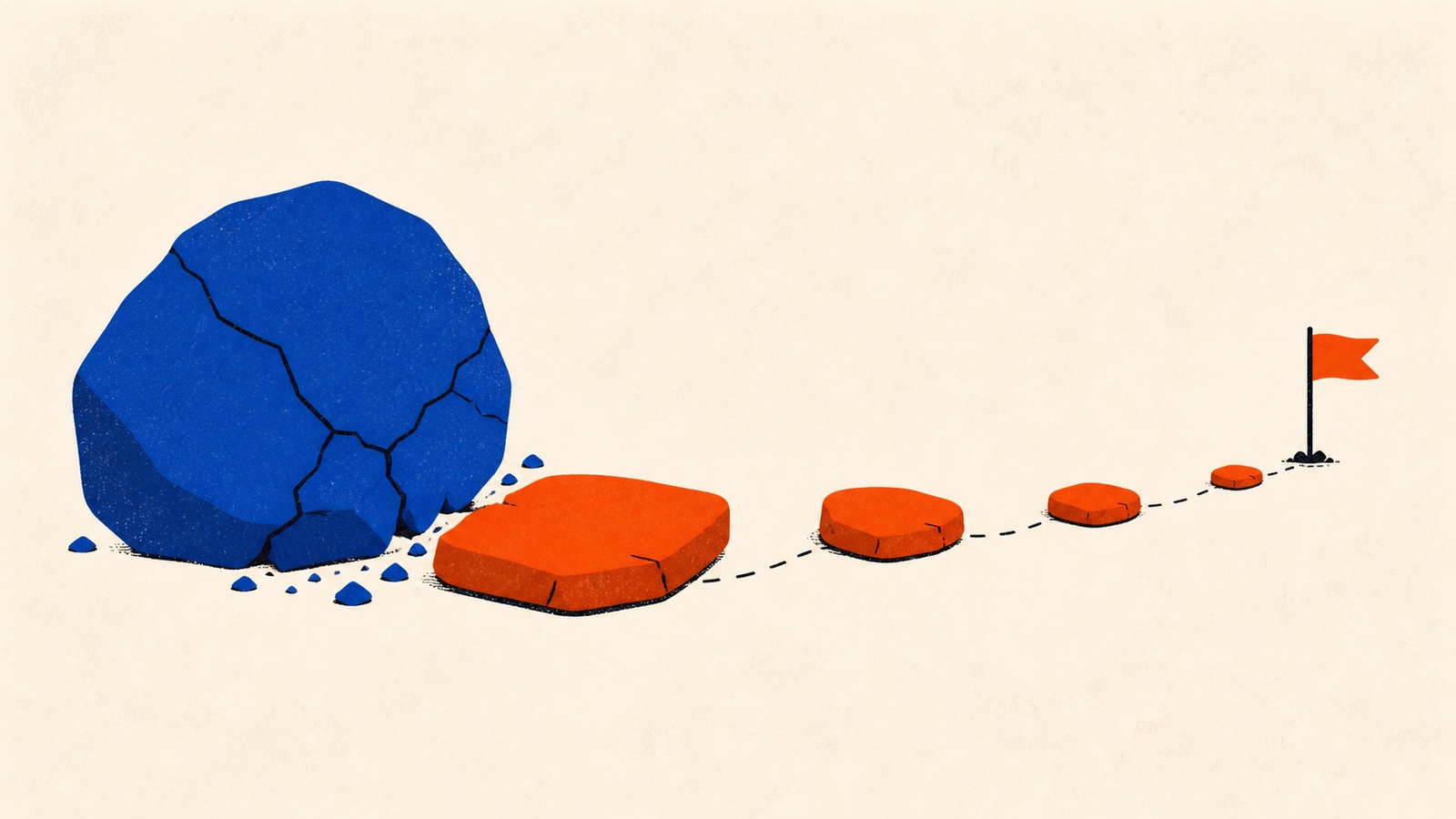
A project can sit on your list for three weeks without being hard. "Write book" is not a difficult task. It is an undefined one, which is worse, because there is no first move to make, and a brain with no first move defaults to no move at all.
Most people read that sentence and blame themselves for lacking discipline. That diagnosis is usually wrong. Resistance to a task tracks its ambiguity far more than its actual difficulty: a five-minute task with a clear verb gets started the same day, while a vague multi-hour task gets pushed to tomorrow for a month. The fix isn't more willpower. It's a smaller, more specific unit of work.
The gap between intending to write the book and actually opening the document is rarely motivation. It's that "write book" hides dozens of decisions inside one phrase, and the brain won't start something it can't picture finishing.
There's a mechanism behind why this specific gap forms. The book points to the Zeigarnik effect: the mental itch of unfinished business, which flares harder the bigger and more open-ended a task looks. A massive, months-long project produces overwhelm and a start delay measured in weeks; a task sized to thirty or sixty minutes produces some hesitation but usually gets started the same day; a task under five minutes produces almost none. The size of the task, not the size of the goal behind it, is what your attention actually reacts to.
The four-level breakdown that produces a five-minute task
Atomic Execution calls this idea fission, and its contribution is a hierarchy specific enough to apply the same afternoon. A vision breaks into four levels, each one narrower than the last:
| Level | What it is | Podcast example |
|---|---|---|
| North Star | One sentence capturing the vision | Launch a weekly podcast interviewing local entrepreneurs |
| Milestone | A major, satisfying checkpoint | Equipment ready |
| Module | A focused packet of work inside a milestone | Microphone setup |
| Micro-task | The final atomic action | Research three microphone options under $100 |
Only the last level is actually startable. Most people's task lists live two levels above it, which is why "launch a podcast" survives on a list for months while nothing underneath it moves.
The book supplies a four-part test for checking whether a task has actually reached that level: it names a single specific verb (draft, call, list; never "work on"), it needs one context or tool, it takes five minutes or less, and it produces something you can see or check off. Run that test against two versions of the same task and the difference is obvious. "Research customer demographics" fails on all four counts: no clear verb, no bounded scope, no visible finish line. "List three competitor websites in the spreadsheet" passes on all four, and it's the version that gets done tonight while the first one gets moved to tomorrow, and the day after that.
The book's own worked example makes the same point at the level of a whole campaign. "Plan social media campaign" can sit untouched for weeks. Split into "Write three Instagram caption templates" and "Schedule a 15-minute call with the designer," both pieces get finished the same afternoon, not because the work changed, but because it became visible.
Breaking a task down has a failure mode of its own: spending more time subdividing than doing. The book's fix is a two-minute timer per milestone: if the fission process runs longer than that, stop and start executing with whatever list you have. Endless subdivision is analysis with better branding.
Where people go wrong
The most common mistake is a vague verb standing in for a real one. "Prepare presentation" looks like a single task but hides roughly thirty of them (research, outline, draft slides, find images, rehearse) which is exactly why it survives untouched on a list while smaller, more specific items around it get done. The fix from the book's own action-verb library is blunt: replace "work on," "prepare," and "handle" with something you could actually observe yourself doing: outline, draft, calculate, contact.
The second is breaking down a task that never belonged on the list in the first place. Fission answers "how do I start this," not "should I be doing this at all": that's a different question, decided before sizing, and it's the one the Focus & Productivity guide walks through in more depth. A perfectly executed micro-task ladder still wastes an afternoon if the milestone at the top of it was never worth doing.
The third is treating the North Star statement as decoration you write once and never revisit. Micro-tasks compound fast, and it's entirely possible to spend a productive week moving efficiently in a direction the North Star no longer points toward. A weekly five-minute check against the original sentence catches this before a month is gone: read the sentence, glance at the last week's finished tasks, and ask whether they actually moved toward it or just kept a list feeling busy.
There's a related trap worth naming even though it isn't a mistake in the sizing itself: a finished micro-task with nothing lined up after it produces a small win and then a dead stop, which is why the book pairs fission with habit molecules: two to four related micro-tasks chained together so finishing one hands off directly into starting the next, instead of requiring a fresh decision every single time.
Inside Atomic Execution
Going deeper
- AudioThe Execution Edge
- BookAtomic Execution
- ChecklistBreaking Down Your Big Ideas
- GuideBreak Down Overwhelming Projects
- GuideBuild Your First Habit Molecule
- Listicle12 Proven Habit Stacking Formulas for Unstoppable Execution
- Listicle7 Execution Killers That Derail Your Best Ideas
- Mini-CourseThe 6-Day Get Things Done Challenge
Atomic Execution is one of 7 bundles in The Focus & Productivity Pack, or take the whole pack for $29.
Related reading
Productivity for people who have already tried the systems: the complete guide
How focus actually works when you already own a task manager: priorities, task size, attention, environment and subtraction, in dependency order.
Read moreBuilding a schedule that survives a brain that doesn't run on rigid time blocks
Anchor points and three-tier habit scaffolding, for when an hour-by-hour schedule breaks the first time something goes off-plan.
Read more
The Eisenhower matrix, for people whose "urgent" column is always full
The two sorting questions everyone already knows, plus the delegation test that decides what actually belongs in the urgent-but-unimportant box.
Read more