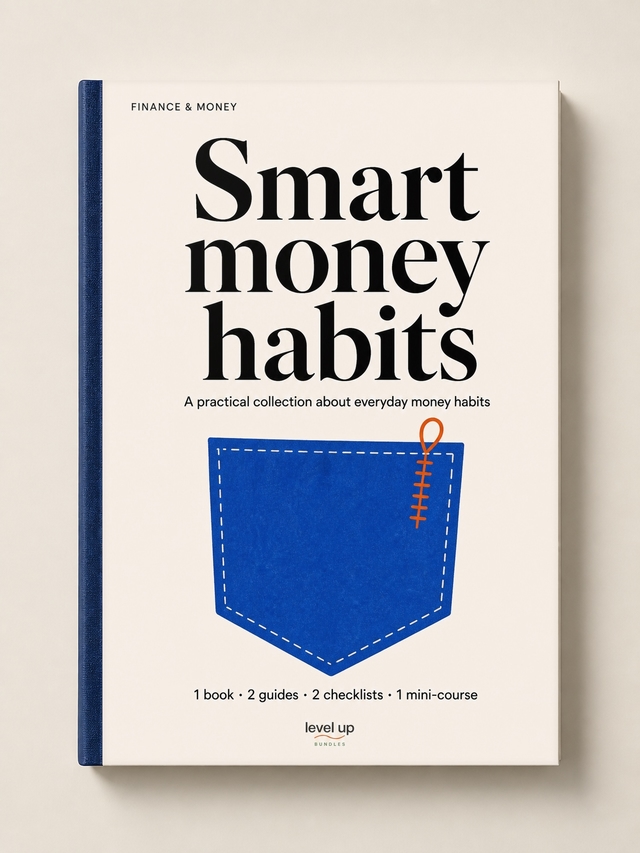
Smart Money Habits
Personal finance isn't complicated; it's just rarely systematised. Most working adults know they should save more, pay debt down, invest something, and instead drift through years of intent without the structure that turns the intent into a balance sheet that's actually moving. The fix is unsexy: a few bucket accounts, a debt-down schedule, an investment cadence on autopilot.
The kit covers the operating habits. The book lays out the framework, two guides handle the heavy lifting (a 90-day debt elimination plan, the multi-bucket savings system), two checklists cover strategic debt elimination and investment portfolio building, and a "smart money moves" mini-course rebuilds the cadence.
Aimed at the working adult who's done meaning to get serious about money and ready to make this the quarter the system actually goes in.
Contents
In this bundle
6 items, in reading order.
 Book
BookSmart Money Habits
Most personal-finance books are either get-rich-quick pitches or austerity guides, and most adults end up with neither financial security nor the patience to stay with the program. This ebook is the long-form treatment for the practice in between: the wealth-building mindset shift that handles the inherited money scripts (without pretending they’re not there), the budgeting practice that supports goals instead of policing every dollar, the saving-and-automation work that compounds without willpower, the investing basics that don’t require becoming an active trader, the debt-elimination playbook that’s strategic instead of just aggressive, and the financial-independence roadmap that’s realistic rather than aspirational. The math is honest about decades-long timelines and the daily practices that make those timelines work. Built for the operator who’s done with both the FIRE-cult intensity and the spending-as-self-care frame, and wants the practice that actually produces stability.
 Checklist
Investment Portfolio Building
Most beginning investors freeze at portfolio construction because the advice swings between "just buy index funds" and "build a sophisticated allocation," and neither helps the person who hasn’t decided what they’re actually optimizing for. This checklist sequences the build: the goals-and-timeline pass that decides what the portfolio is actually for (retirement, near-term purchase, generational wealth), the risk-tolerance assessment that catches the gap between stated comfort and actual comfort under loss, the asset-allocation pick matched to the goal and timeline, the account-tier decisions (tax-advantaged versus taxable, the order to fill them in), the rebalancing rules that prevent emotional decisions, and the cost-and-fee audit that catches what’s quietly eating returns. Pair with the strategic-debt-elimination checklist for the upstream financial work; this checklist is the portfolio build.
 Checklist
Strategic Debt Elimination
Most debt-elimination plans fail because the operator picked the wrong method (avalanche, snowball, or hybrid) for their actual psychology, then ran out of momentum at month four. This checklist sequences the elimination properly: the debt inventory that catches everything (the credit cards, the car loan, the student debt, the medical, the family loan), the debt-classification pass that separates strategic debt from immediate-priority debt, the method pick (avalanche for math optimization, snowball for momentum, hybrid for the operators who need both), the payment-plan structure that handles the income reality without setting up failure, the windfall rules that decide what happens with bonuses or unexpected money, and the progress-tracking that catches the slow weeks before they become slow months. Pair with the 90-day plan guide for the structured rollout; this checklist is the strategic frame.
 Guide
GuideThe 90-Day Debt Elimination Plan
Most debt-elimination advice is open-ended, and the operator wakes up six months in with the same balance and the same shame loop. The 90-day frame is the antidote: it’s short enough to maintain focus, long enough to compound visible progress, and structured enough to surface the patterns that will run the next 90 days. This guide installs the plan: the debt-elimination strategy matched to the operator’s actual situation, the budgeting techniques that free cash flow without slipping into austerity, the income-growth methods that lift the equation from both sides, the debt-payoff approaches with the math behind each, the sustainable financial habits that hold past day 91, and the tracking-and-motivation system that handles the inevitable slow weeks. Pair with the debt-elimination checklist for the strategic frame; this guide is the 90-day execution playbook.
 Guide
GuideThe Multi-Bucket Savings System
Most adults have one savings account that’s everything from emergency fund to vacation fund to "future taxes," and the inevitable result is using the emergency fund for non-emergencies and feeling vaguely guilty about it. The multi-bucket system fixes this by separating savings goals into named accounts the brain treats as different money. This guide installs the practice: the savings-bucket essentials that explain why mental accounting works even when it shouldn’t, the bucket categories worth running for most adults (emergency, near-term goals, taxes for the self-employed, long-term wealth), the account-selection pick (high-yield savings, money market, the right brokerage for each purpose), the automation setup that funds each bucket without manual work, and the optimization moves that lift returns without adding complexity. Pair with the portfolio-building checklist for the investing layer; this guide is the savings architecture underneath.
 Mini-Course
Smart Money Moves
Most personal-finance courses are either too aggressive (the FIRE-bro stuff) or too gentle (the "track your spending" basics), and most students finish with neither system in place. This drip course runs the practical middle across the working week: lesson one reframes the money mindset that’s been quietly running the show, lesson two installs the budgeting method that supports goals instead of policing every dollar, lesson three sets the saving systems that work without willpower, lesson four lands the investing basics that don’t require becoming an active trader, lesson five covers strategic debt elimination matched to the operator’s actual psychology, lesson six builds the action plan for the next 90 days that compounds across years. Built for the operator who’s tired of both the hustle-finance content and the doom-spending content, and wants the practice that actually works.