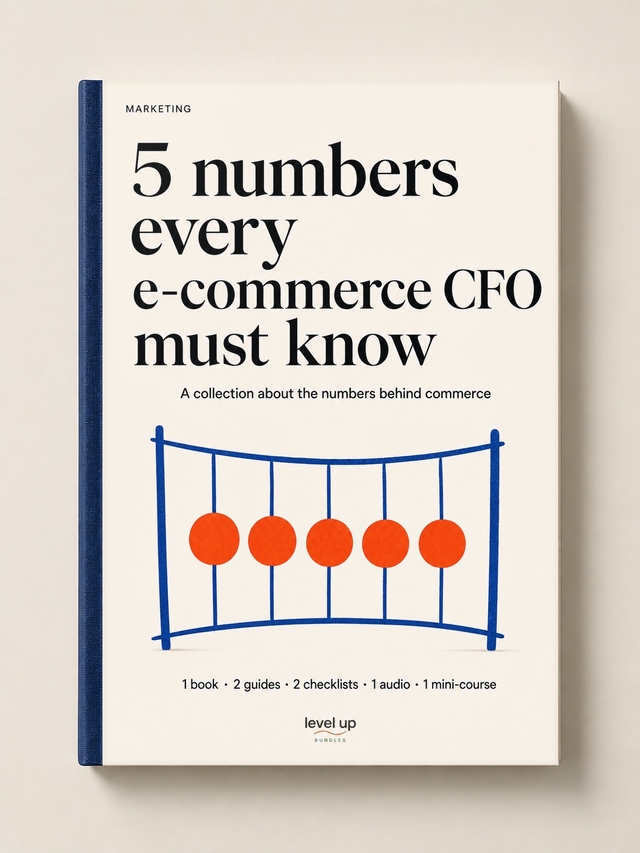
5 Numbers Every E-Commerce CFO Must Know
Five numbers separate an e-commerce operation that scales from one that grows revenue and bleeds cash anyway. Contribution margin per order, inventory turnover, the cash conversion cycle, marketing ROI by channel, and order-level profitability, the metrics every founder eventually wishes they'd been tracking from week one.
The kit covers all five in operator language. The book lays out the framework, two guides walk through the formulas (cash conversion cycle, marketing ROI), two checklists turn the framework into a monthly close (inventory audit, order-level audit), an audio companion summarises the math for a commute, and a mini-course wraps it up for a deeper sit-down review.
Built for the founder who's stopped trusting the dashboard and wants to actually own the model.
Contents
In this bundle
7 items, in reading order.
 Audio
AudioProfit-First Commerce
Most e-commerce founders learn the model on the job, after the cost of learning it has already shown up on the cash flow statement. Five episodes, built for the half-hour walk or commute, that lay out what 'profitable' actually means at the order level: contribution margin, inventory turnover, the cash conversion cycle, ROI by channel, and what to do when one of those numbers is silently bleeding the business. Not theoretical. The presenter assumes the listener already runs a store and wants the operator-tier explanation, not the LinkedIn version. Pair with the book and the order-level audit checklist for the full pass; standalone, it's the version you can absorb without sitting at a desk.
 Book
Book5 Numbers Every E-Commerce CFO Must Know
The book is the spine of the kit. Five numbers, named and worked through end to end: contribution margin per order (so 'gross margin' stops hiding sins), inventory turnover (so you know which SKUs are tying up cash), the cash conversion cycle (so growth doesn't bankrupt you), marketing ROI by channel (real, not blended), and order-level profitability (the one most stores skip and pay for later). Worked examples, not case studies. The section on margin reconstruction is worth the price of the bundle by itself if it stops one underwater Black Friday. Read first. The two checklists, the two guides, and the mini-course all assume you've internalised the framework laid out here.
 Checklist
Inventory Turnover Audit
A monthly close item, not a one-time exercise. Walks through the SKU-level review that surfaces the inventory most stores discover only when the credit line gets tighter: slow movers, dead stock, the products that look profitable until you account for the warehouse space they're occupying for nine months. Run it the first week of the month, alongside the bank reconciliation. The list isn't long; it's the structured version of what most operators eventually do in their head, just inconsistently. After three months you'll have a working sense of which products are earning their shelf space and which are funding themselves out of next quarter's marketing budget.
 Checklist
Order-Level Profitability Audit
The audit most stores never run because it requires admitting how many orders lose money once payment fees, returns, support time, and shipping subsidies are loaded in. Built to be run quarterly across a representative sample, not the whole order book: fifty orders is enough to find the patterns. The structure walks through cost categories most platforms don't surface (returns processing, fraud reserves, cohort-specific support load) and lands at a per-order P&L that can drive real pricing or assortment decisions. Pair with the cash conversion cycle guide for the cash-flow side of the same picture.
 Guide
GuideCash Conversion Cycle Optimization Framework
The cash conversion cycle is the single number that explains why a profitable store can still go broke. Days inventory plus days receivable minus days payable. The guide takes the formula apart, walks through each lever (supplier terms, inventory cadence, payout schedules, customer payment friction), and shows where most stores have thirty or more days of unnecessary cash tied up. Includes the calculation worksheet and a prioritisation framework for which lever to pull first based on your specific cycle. Most operators discover after working through it that their cash problem isn't actually a sales problem. It's a working capital problem hiding in plain sight.
 Guide
GuideMarketing ROI Calculation Protocol
Most marketing dashboards show ROAS, which is approximately useful and often misleading. ROI accounts for full customer cost (returns, support, fulfillment) and full customer value (LTV, not just first order). The guide walks through the channel-by-channel calculation: paid social, search, email, organic, affiliate, with the attribution caveats each channel actually warrants, not the ones the platform's reporting wants you to believe. Includes a working spreadsheet for blended versus per-channel ROI and the trigger thresholds for when to scale, hold, or kill spend. Read alongside the order-level profitability audit; together they tell you which channels are actually paying for themselves.
 Mini-Course
Data-Driven Decisions for E-Commerce CFOs
Eight email sessions that turn the framework into a working monthly rhythm. Not theory; a structured practice that gets the five numbers into a recurring management cadence so the store stops being run on instinct after month one. Each session ends with a specific exercise applied to your actual numbers. By week three the deliverable is a working dashboard tracking the metrics that matter at the cadence they actually move. Designed for founders or fractional CFOs who already understand the principles and need the structure to make them habitual. Self-paced; the structured cadence is what makes the lessons stick.