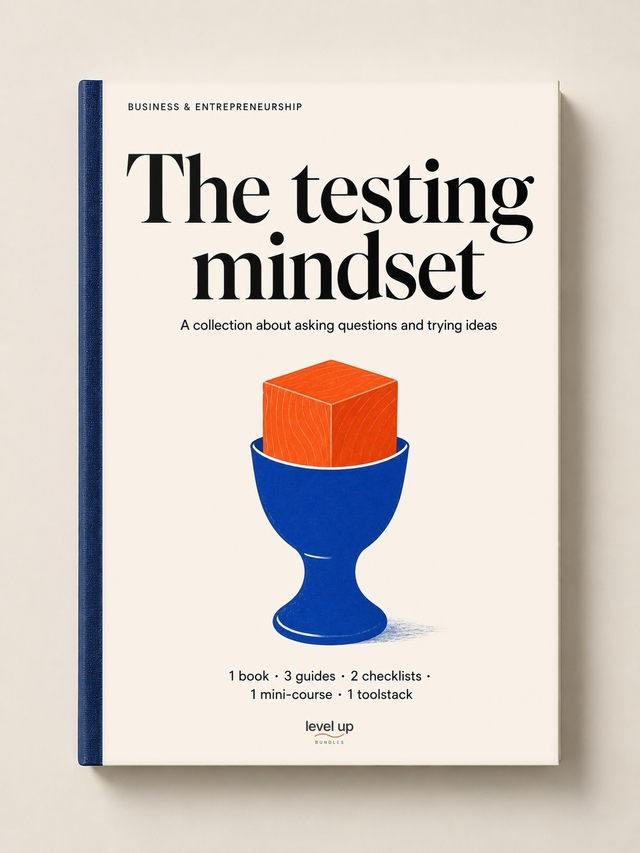
The Testing Mindset
Most ad accounts don't have a testing program; they have a hopes-and-prayers program. New creative goes live, runs for a week, gets killed because "the numbers were bad", without ever defining what bad meant or whether the test was even powered to produce a real result. The testing mindset is what separates accounts that compound from accounts that flatten out at year two.
The kit treats testing as discipline. The book lays out the framework, three guides handle the practical mechanics (the first-time ad test setup, multivariate testing implementation, the testing data analysis framework), two checklists cover building a testing culture and pre-test launch preparation, a "make every ad count" mini-course rebuilds the cadence, and a "test smarter, scale faster" tool stack maps the experimentation platforms.
Built for the marketer or growth operator who's done killing tests early and ready to run experiments that actually produce decisions.
Contents
In this bundle
8 items, in reading order.
 Book
BookThe Testing Mindset
Most ad accounts run on opinion and gut, and most operators argue about creative direction in meetings instead of letting the data settle the question. The testing-as-discipline approach is the alternative: most strategic decisions become testable hypotheses, and most "we should try this" arguments become "let’s run the test." This ebook is the long-form treatment: the testing-mindset frame that decides what’s worth testing (versus what’s just curiosity), the test-design discipline that produces clear results instead of ambiguous ones, the headline-image-offer-audience prioritization that picks the right variable to test first, the data-interpretation work that translates raw numbers into specific decisions, the testing-system architecture that makes testing routine instead of effortful, the field-tested examples of brands that scaled by treating testing as the core discipline, and the long-term frame that compounds learning across years. Built for the operator who’s tired of running ads on guesswork.
 Checklist
Building a Testing Culture
Most marketing teams talk about "data-driven" and run on opinions, because nobody installed the actual testing culture that would produce real data. The culture isn't a process document; it's a daily practice. This checklist installs the testing-culture build: the team-readiness assessment that catches who's actually willing to be wrong, the tool-and-tracking infrastructure that prevents tests from being measurable in theory only, the testing-cadence rhythm that holds without burning out the team, the hypothesis-and-documentation practice that prevents test re-runs and lost institutional knowledge, the leadership behaviors that signal "test-and-learn" actually beats "be right the first time," and the metrics-and-celebration patterns that reinforce the right outcomes. Pair with the testing-mindset minicourse for the strategic frame; this checklist is the operational culture install.
 Checklist
Pre-Test Launch Preparation
Most ad tests fail before they launch because nobody designed them properly: the variants are too similar, the sample size is too small, the tracking is wrong, the team isn't aligned on what success looks like. This checklist sequences the pre-launch pass: the hypothesis definition that names exactly what's being tested (not "let's try this and see"), the variant design that produces actual differences worth measuring, the sample-size math that confirms the test can produce statistical significance, the tracking-and-attribution setup that captures the right data, the launch-week monitoring plan that catches early problems, and the success-criteria pre-commitment that prevents the team from rationalizing inconclusive results. Pair with the first-time ad-test guide for the deeper structure; this checklist is the per-test pre-flight.
 Guide
GuideMultivariate Testing Implementation Playbook
Most marketers run A/B tests one variable at a time and miss the interaction effects that explain most of the actual lift. Multivariate testing handles those interactions but requires more discipline to run correctly. This guide installs the practice: the multivariate-testing basics that explain what's actually different from sequential A/B (and when MVT actually beats it), the test-planning steps that decide which variables are worth combining, the test-matrix creation that handles the variant explosion without burning the entire budget, the tracking setup that captures the right data per cell, the monitoring-and-management routine that catches problems mid-test, the analysis pass that interprets results without over-claiming, and the long-term strategy that turns multivariate findings into compounding campaign improvements. Pair with the first-time ad-test guide for the upstream basics; this guide is the multivariate-specific playbook.
 Guide
GuideThe First-Time Ad Test Setup
Most operators set up their first ad test wrong and spend the next month confused about what the data means. The first-time setup is more disciplined than people expect. This guide installs the practice: the goal-setting work that decides what the test is actually for, the hypothesis-building pass that turns "let's test this" into a real prediction, the test-setup basics for the major platforms (Meta, Google, LinkedIn) without the platform-specific surprises, the sample-size and statistics work that prevents calling winners on three conversions, the tool-setup walkthrough for tracking and analysis, the success-measurement pass that distinguishes signal from noise, and the avoiding-mistakes section that catches the most common first-time errors. Pair with the testing-culture checklist for the upstream practice; this guide is the per-test build for operators new to structured testing.
 Guide
GuideThe Testing Data Analysis Framework
Most ad-test data sits in the dashboard while the team argues about what it means, because nobody installed the analysis framework that turns numbers into decisions. The framework is teachable. This guide installs the analysis practice: the metrics-framework setup that decides what’s worth tracking versus what’s noise, the dashboard creation that surfaces the right data without overwhelming, the statistical-testing process that prevents calling winners on insufficient evidence, the pattern-recognition techniques that catch the second-order effects most analysis misses, the insight-generation pass that turns observations into specific conclusions, the action-planning step that translates insight into the next test or scaling decision, and the knowledge-management practice that prevents the team from re-running tests it already ran. Pair with the multivariate guide for the upstream test design; this guide is the analysis layer.
 Mini-Course
Make Every Ad Count
Most "test more" advice is correct in principle and useless in practice because nobody installed the actual testing discipline. This drip course runs the install across the working week: lesson one frames why testing is the difference between top-performing campaigns and average ones, lesson two installs the testing framework that survives across platforms and team changes, lesson three covers the methods beyond basic A/B (sequential, multivariate, multi-armed bandit), lesson four lands turning test data into business insights, lesson five sets the team-and-organizational practice that scales testing past one analyst, lesson six covers the long-term strategy that holds against algorithm changes and platform shifts. Built for the marketer who knows testing matters and is tired of running ad-hoc experiments without a real system.
 Toolstack
Test Smarter, Scale Faster
Testing tooling sprawls across testing platforms, analytics, statistics, and frameworks, and most operators end up paying for tools that overlap or skip the categories that actually matter. The kit here is the curated short-list, organized by job: the testing platforms matched by team scale (VWO, Optimizely, Convert, Google Optimize alternatives), the analytics-and-measurement layer that captures the right data without dashboard sprawl, the statistical tools that handle significance and power calculations without requiring a stats degree, and the framework-and-methodology templates worth using over starting from scratch. Each pick has a one-line reason and a price tier. Pair with the testing-mindset course for the strategic frame; this list is the buy-list.