The Neuroscience Of Peak Productivity
Most productivity advice is built on folk wisdom; some of it works, most of it doesn't, and almost none is grounded in what the actual neuroscience says about attention, flow, and recovery. The principles that survive the lab, the trigger conditions for flow, the focus-killer patterns the brain can't override, the recovery cycles that rebuild capacity, are the levers worth pulling.
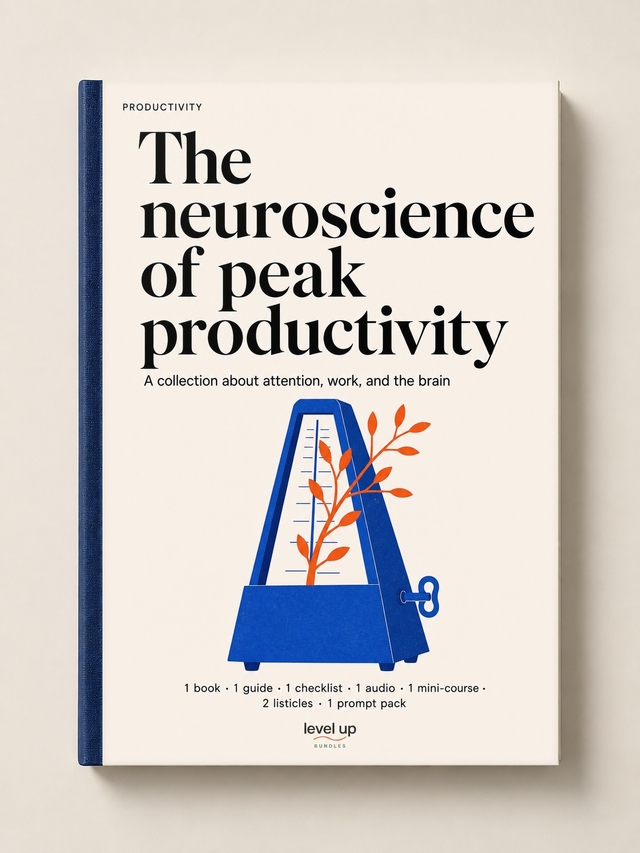
The kit treats productivity as applied neuroscience. The book lays out the framework, a remote worker's flow blueprint guide handles the practical environment-design layer, a focus-killer elimination audit checklist gates the inputs, two listicles surface the seven neuroscience-backed triggers that unlock flow and the thirteen invisible focus killers blocking it, a "flow state mastery" mini-course turns the framework into a working week, and a personal flow operating system prompt pack handles the AI-assisted planning. The audio companion runs the flow operating system framing.
For the operator who's done collecting productivity tactics and ready to operate on what the brain will actually do.
Contents
In this bundle
8 items, in reading order.
 Audio
AudioThe Flow Operating System
Flow state is the most-romanticized cognitive condition in productivity content and the least-engineered. Most people wait for it like weather. The three-episode audio series treats flow as a buildable system: episode one walks how flow actually works in the brain (versus the metaphor), episode two covers the hidden distractions that quietly drain attention before flow can start, episode three breaks down the environment-and-state work that produces flow on demand instead of by accident. Each episode includes the moves to test in the next workday. Made for commute listening. Pair with the focus-killer audit checklist for the operational layer; the audio is the briefing version that makes the next deep-work session start cleaner.
 Book
BookThe Neuroscience of Peak Productivity
Most productivity advice is folk wisdom dressed in productivity-bro language, and most adults end up with the same scattered focus and the same recurring fatigue. The neuroscience of peak performance is more practical than the popular literature suggests, and the working adult who installs the right practices outperforms the one running on willpower. This ebook is the long-form treatment: the attention-and-focus mechanics that explain how the brain actually allocates cognitive resources (versus the metaphors), the flow-state architecture with the specific conditions that make flow reliable rather than accidental, the energy-and-recovery work that determines what’s actually available for cognitive output, the distraction-and-context-switching cost analysis that prevents the productivity-theater of being busy without producing, and the long-term cognitive-fitness frame that compounds across decades. Built for the operator who wants the actual mechanism behind productivity, not just another lifehack stack.
 Checklist
The Focus Killer Elimination Audit
Most operators have heard "minimize distractions" and stopped there, never running the actual audit that surfaces which distractions are actually costing the most. This checklist runs the focus-killer elimination pass: the notification audit (every app, every channel, every alert that fires during work hours), the workspace-distraction inventory (visual, auditory, the second monitor showing Slack), the meeting-load review that catches the calendar reactive-mode, the digital-tab graveyard that fragments attention, the noise-and-environment factors most people don't recognize as distracting, and the colleague-and-team patterns that interrupt deep work without anyone meaning to. Each item gets a fix and a test-this-week assignment. Pair with the remote-worker flow blueprint guide for the broader environment work; this checklist is the elimination pass that frees the conditions flow needs.
 Guide
GuideThe Remote Worker's Flow Blueprint
Remote work made deep focus harder for almost everyone and the standard advice ("set up a dedicated workspace") doesn't begin to address why. The actual fix is structural: the environment, the routines, and the boundaries that office work used to provide automatically have to be installed deliberately. This guide installs the practice: the focus foundations that explain why remote work breaks attention by default, the workspace optimization that goes beyond a clean desk, the daily flow routines that bracket deep work with the right warm-up and cool-down, the distraction-control work for the home environment specifically, and the energy-management practices that prevent the late-day collapse most remote workers know intimately. Pair with the focus-killer checklist for the elimination pass; this guide is the architectural rebuild for remote-worker flow.
 Listicle
13 Invisible Focus Killers Blocking Your Flow States
Most operators blame willpower for their focus problems, when the actual cause is one of thirteen specific patterns that quietly degrade attention before deep work can start. This listicle catalogs them: the morning email check that anchors the brain to reactive mode, the always-open Slack that fragments attention every nine minutes, the multi-tab browser that splits cognitive load across forty contexts, the mid-morning sugar crash, the dehydration that nobody recognizes as a focus issue, the noise-without-cancellation that the brain keeps processing, the bad-posture fatigue that drains attention through the body, the sleep debt that makes everything harder, and five more. Each killer has the diagnostic and the specific intervention. Made for sequential install. Pair with the focus-killer checklist for the structured audit; this listicle is the diagnostic menu.
 Listicle
7 Neuroscience-Backed Triggers That Unlock Flow States
Flow state isn't mystical; it has specific neurochemical triggers that researchers have identified, and operators who know them can engineer the conditions instead of waiting for them. This listicle catalogs the seven most-validated triggers: the clear-goal-and-immediate-feedback condition that the activity itself has to provide, the challenge-skill balance that picks the right difficulty for the operator's current capability, the elimination of self-consciousness via the right environment, the deep concentration enabled by single-tasking and notification blocks, the autotelic experience where the activity is rewarding in itself, the action-and-awareness merger that requires committed attention, and the distortion-of-time signal that the previous six are working. Each trigger has the practical move that activates it. Made for desk reference before the next deep-work block. Pair with the focus-killers listicle for the removal work; this one is the activation menu.
 Mini-Course
Flow State Mastery
Most flow-state courses are research summaries with no practical install, and most students finish knowing more about dopamine and the same scattered focus they started with. This drip course runs the actual install across the working week: lesson one walks what flow actually is and what it produces, lesson two covers the science of attention and motivation in usable terms, lesson three lands the four stages of flow without burnout, lesson four installs the simple triggers that get the operator into flow faster, lesson five handles the environment design that supports distraction-free work, lesson six covers the techniques that protect attention from phones, noise, and interruptions, lesson seven builds the daily focus muscle, lesson eight sets the personal flow operating system that holds across years. Built for the operator who's done waiting for flow and ready to engineer it.
 Prompt Pack
The Personal Flow Operating System
Flow-engineering work eats time in the structured drafting jobs: the focus-blocker inventory, the workday redesign brief, the energy-management routine, the focus review. The pack moves those jobs to AI-assisted starting points: focus-blocker prompts that surface the personal patterns the operator can't see in themselves, daily-routine prompts that build deep-work blocks into a real schedule (versus an aspirational one), workspace-design prompts that translate the operator's actual constraints into a focus-supporting setup, energy-management prompts that schedule recovery as deliberately as work, and progress-review prompts that catch focus drift before it becomes weeks of scattered output. Drop them into Claude or ChatGPT alongside the actual constraints. Pair with the flow-state course for the strategic frame; the prompts are the working session that produces the next focus-block plan.