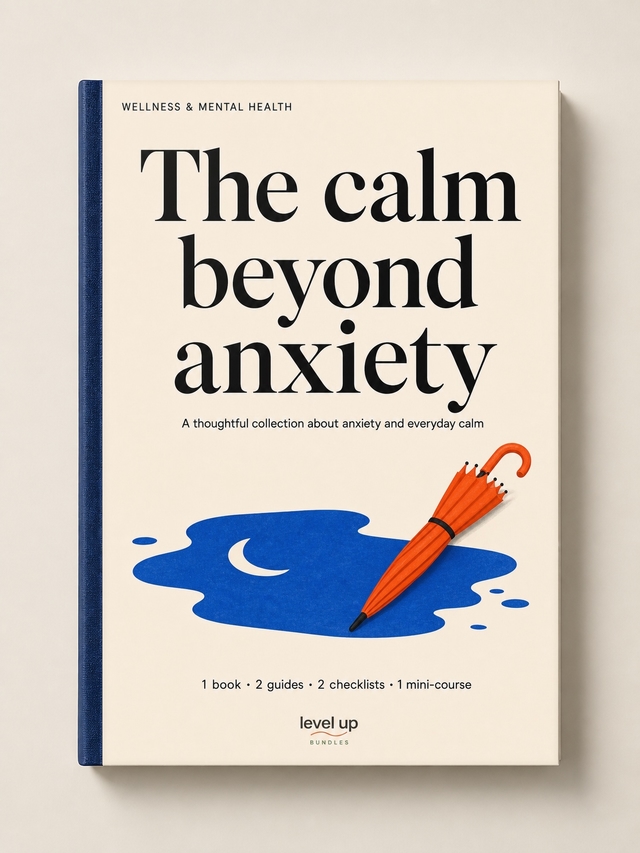
The Calm Beyond Anxiety
Most anxiety advice splits between "talk to a professional" (good, often necessary, but slow) and "try mindfulness" (helpful, but not a working protocol). The middle path, the daily mechanics that keep anxiety from compounding into a bad week, is what most people actually need and rarely find. The work is structured, learnable, and almost never requires waiting for a referral.
The kit covers daily anxiety management. The book lays out the framework, two guides handle the practical layers (think-clearly with the ABCD method, boundaries that work at work), two checklists cover a daily anxiety management routine and a personal boundary builder, and a "your daily calm practice" mini-course turns the framework into a sustainable habit.
For the operator whose anxiety isn't a crisis and isn't going away on its own, and ready for the daily practice that keeps it manageable.
Contents
In this bundle
6 items, in reading order.
 Book
BookThe Calm Beyond Anxiety
Most anxiety content is either pop-psychology platitudes or graduate-level neuroscience, and the working adult dealing with actual chronic anxiety gets neither a usable practice nor a clear understanding of what’s actually happening. The honest middle is structured. This ebook is the long-form treatment: the anxiety-physiology basics in plain language that makes the experience less mysterious, the trigger-identification work that catches the patterns the operator can’t see in real time, the cognitive-restructuring practice that interrupts anxious thought spirals (without pretending the underlying problems aren’t real), the boundary-setting work that prevents the anxiety triggers from accumulating, the breathing and nervous-system regulation moves that work in real time, the daily-routine and lifestyle work (sleep, nutrition, movement) that makes the anxiety system more resilient, and the long-term frame that makes recovery a sustainable practice rather than a temporary fix. Built for the working adult ready to address the anxiety honestly rather than just manage the symptoms.
 Checklist
Daily Anxiety Management Routine
Most anxiety-management advice is one-shot interventions ("try meditation") that nobody maintains, and the operator stays anxious despite trying every recommendation in turn. The fix is a daily routine, not a tool collection. This checklist installs the routine: the morning grounding moves that set the nervous-system tone before the inbox opens, the mid-morning check-in that catches escalation before it spirals, the lunch-and-recovery practices that prevent the post-meal crash, the afternoon stress-reset moves that handle the actual high-arousal moments, the evening wind-down that protects sleep, and the weekly review that catches the patterns before they become permanent. Each item is two minutes or less. Pair with the ABCD-method guide for the in-the-moment thought work; this checklist is the daily nervous-system practice.
 Checklist
Personal Boundary Builder
Most boundaries fail because the operator named them once and never installed the actual practice that holds them. The boundaries that work are protected by structure, not willpower. This checklist installs the practice: the digital-communication boundaries (the notification settings, the response-time expectations, the non-work-hours rules) that prevent the workday from absorbing every loose minute, the time-management boundaries that handle the meeting and request load, the workspace-organization moves that signal "in focus" versus "available," the communication-clarity practices that make the boundary visible to the people who would otherwise cross it, the progress-tracking that catches when boundaries quietly erode, and the support-system work that prevents the operator from being the only enforcer. Pair with the work-boundaries guide for the strategic frame; this checklist is the operational practice.
 Guide
GuideBoundaries that Work at Work
Workplace boundaries collapse because the operator tried to enforce them with willpower instead of structure, and the next urgent request burned through the boundary in five minutes. The boundaries that hold are designed in, not announced. This guide installs the practice: the boundary-essentials frame that explains why boundaries are protective infrastructure rather than rejection, the time-and-energy-management work that decides what gets defended, the digital-communication limits that handle the always-on culture, the protocol creation that gives colleagues clear expectations, the ready-to-use templates for the difficult conversations (saying no, declining a meeting, pushing back on an ask), and the ongoing-refinement practice that updates the boundaries as the role changes. Pair with the boundary-builder checklist for the daily install; this guide is the strategic boundary architecture for working life.
 Guide
GuideThink Clearly with ABCD Method
Most workplace anxiety advice is "try mindfulness" and stops there, and the operator stays anxious because the actual cognitive patterns don't change. The ABCD method (Activating event, Beliefs, Consequences, Disputation) is the structured cognitive-behavioral approach that interrupts the pattern at the thought layer. This guide installs the practice: the anxiety-awareness tools that name the trigger before the spiral, the thought-pattern breakdown that catches the unhelpful belief running underneath the reaction, the emotional-and-behavioral tracking that surfaces the patterns over weeks, the daily-practice plans that build the muscle before the high-stakes moment, the quick-response techniques for in-the-meeting moments, and the advanced applications for the recurring high-anxiety situations. Pair with the daily-anxiety routine checklist for the nervous-system layer; this guide is the cognitive-restructuring practice.
 Mini-Course
Your Daily Calm Practice
Most anxiety-management courses are scary research summaries and abstract advice, and most students finish more anxious than they started. This drip course runs a different path across six working days: day one explains the brain's actual anxiety mechanism in plain language (which makes it less mysterious and less scary), day two installs the cognitive-restructuring moves that interrupt anxious thought patterns, day three lands the boundary-setting practice that prevents anxiety triggers from accumulating, day four covers fast stress-relief techniques for the in-the-moment moments, day five sets the daily routines and environment design that support emotional balance, day six builds the personalized anxiety-management plan from the practices that fit the operator's specific patterns. Built for the working adult who's tired of generic anxiety advice and wants the practice that actually fits their life.