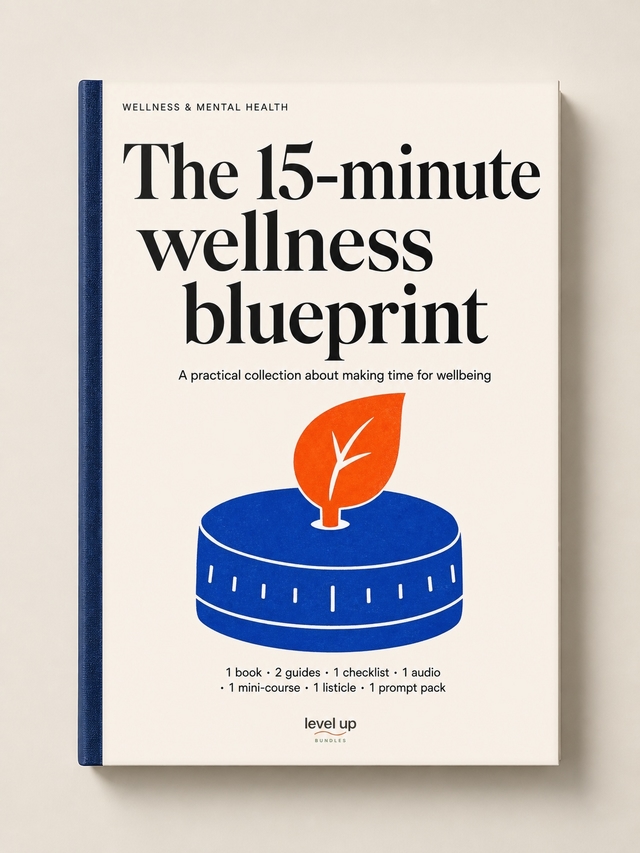
The 15 Minute Wellness Blueprint
Wellness advice is built for people with two hours a day. That's not most people. The honest truth is that the difference between healthy and unhealthy at the operator scale isn't an hour at the gym, it's whether the small habits (movement, fuel, sleep cues) are happening at all. Fifteen minutes done daily beats two hours done monthly, and most "wellness" programs fail by getting that math wrong.
The kit covers wellness on a real schedule. The book lays out the framework, two guides handle the practical mechanics (a 15-minute HIIT workout plan, building wellness habits that stick), a smart weekly meal-prep checklist gates the food layer, a listicle catalogues the fifteen micro-habits that transform health fast, a 5-day "healthier you" mini-course turns the framework into a working week, and a wellness revolution prompt pack handles the planning layer. The audio companion frames wellness-in-motion thinking.
Aimed at the busy professional who's done waiting for a free hour and ready to use the fifteen minutes that already exist.
Contents
In this bundle
8 items, in reading order.
 Audio
AudioWellness in Motion
Most wellness advice for busy professionals assumes either an hour at the gym or zero time at all, and most professionals end up doing nothing. The four-episode audio series treats wellness as something that fits in fifteen-minute windows: episode one breaks the wellness habits that compound versus the ones that decay, episode two covers fitness, nutrition, and balance in the time the operator actually has, episode three handles meal prep and stress management without requiring a meal-prep Sunday, episode four lands the consistency-and-motivation work that holds the practice past week two. Each episode includes the moves to test in the next working day. Made for commute listening. Pair with the ebook for the long-form treatment; the audio is the briefing version that makes the practice start tomorrow.
 Book
BookThe 15-Minute Wellness Blueprint
The wellness industry pretends the only path to health is hours at the gym, organic meal plans, and meditation retreats, and the working professional with eight meetings and a kid quietly opts out. The fifteen-minute frame is the antidote: the practices that compound across years run in fifteen-minute windows, not weekend retreats. This ebook is the long-form treatment: the fifteen-minute fitness routines that move actual cardiovascular and strength markers (versus the ones that don't), the nutrition basics that handle eighty percent of the gain without a meal-plan subscription, the mindset work that prevents the all-or-nothing collapse most wellness attempts hit, the consistency moves that hold the practice past week two, the tracking system that catches drift, and the realistic plan-design for the working adult with actual constraints. Built for the operator who's done choosing between health and work and wants the practice that fits both.
 Checklist
Smart Weekly Meal Preparation
Meal prep collapses for most adults because the standard advice is "spend Sunday cooking ten meals," and Sunday already has things in it. The fifteen-minute meal-prep frame is the alternative: the assemble-don't-cook pattern that produces a week of meals from a Sunday afternoon. This checklist sequences the practice: the protein-carb-fat formula that prevents the bowl-of-leftover-rice problem, the shopping list that maps to the formula instead of recipes, the batch-cooking routines that handle the 20% of food that needs actual cooking, the assembly system that lets the operator build five days of lunches in fifteen minutes, the portioning containers and storage decisions that prevent waste, and the variation rules that prevent boredom by week three. Pair with the wellness habits guide for the broader practice; this checklist is the meal-prep operations.
 Guide
GuideBuilding Wellness Habits That Stick
Most wellness habits collapse in week two because the operator picked too big a habit and relied on willpower to sustain it. The micro-habit frame is the antidote: small enough to start regardless of motivation, structured enough to compound across years. This guide installs the practice: the micro-habit system that builds change one two-minute commitment at a time, the science of habit formation translated into actually-applicable steps, the two-minute rule that handles the activation problem most adults lose to, the environment design that puts the right defaults in place so willpower isn’t the load-bearing system, the habit-stacking patterns that attach new habits to existing routines, the obstacle-handling moves for the inevitable disruptions, and the tracking tools that make the habits visible without becoming surveillance. Pair with the meal-prep checklist for the food-side practice; this guide is the habit-build architecture.
 Guide
GuideThe 15-Minute HIIT Workout Plan
Most workout plans assume a 45-minute window at a gym, and most adults don't have either. The 15-minute HIIT frame is the practical alternative: short enough to actually fit in the day, intense enough to move cardiovascular and strength markers that walking won't. This guide installs the practice: the HIIT foundations that explain what makes the format work (versus the watered-down versions that don't), the 15-minute routines structured by goal (fat loss, conditioning, strength endurance), the no-equipment versions that work in a hotel room or apartment, the weekly blueprints that mix routines without overtraining, the realistic-results examples that calibrate expectations honestly, and the adaptation patterns for the operator with specific constraints (bad knees, limited space, recovery from inactivity). Pair with the wellness habits guide for the broader practice; this guide is the workout layer.
 Listicle
15 Micro-Habits That Transform Your Health Fast
Most wellness changes fail because the operator tried to install too many at once. The micro-habit frame solves this by picking habits small enough to start regardless of motivation. This listicle catalogs fifteen specific micro-habits worth installing: the two-minute morning hydration before caffeine, the fifteen-minute walk after lunch instead of doomscrolling, the protein-first-meal rule that handles afternoon energy, the breathing-pattern reset for the high-stress moment, the screen-cutoff time that protects sleep without requiring a wellness retreat, the two-minute strength move during a meeting break, and nine more. Each habit has the install time and the compound effect. Made for sequential install, not for committing to all fifteen at once. Pair with the wellness-habits guide for the framework; this listicle is the menu of micro-habits to pick from.
 Mini-Course
5 Days to a Healthier You
Most wellness courses are either lifestyle-overhaul programs that nobody completes or individual-tip newsletters that don't add up to anything. The five-day frame is the working middle: long enough to install the basics, short enough to maintain focus through. This drip course runs the install: day one frames why small daily actions beat occasional bursts of effort, day two covers building balanced fifteen-minute meals without becoming a meal prepper, day three lands the science-backed workout routines that fit any schedule, day four installs the habit-formation patterns that hold without willpower, day five sets the personalized fifteen-minute health roadmap that the operator can actually maintain past day six. Built for the working adult who's tired of either ignoring their health or feeling guilty about ignoring their health.
 Prompt Pack
Wellness Revolution for Busy Professionals
Wellness work eats time in the structured drafting jobs: the next meal plan, the workout brief, the habit-tracker setup, the stress-management plan. The pack moves those jobs to AI-assisted starting points: meal-planning prompts that produce a week of fifteen-minute meals from the operator's actual constraints, workout-design prompts that fit available equipment and time windows, habit-formation prompts that translate vague intentions into specific micro-habits, time-management prompts that find the wellness windows in an already-full schedule, and stress-and-recovery prompts that match interventions to the actual stress shape. Drop them into Claude or ChatGPT alongside the actual constraints. Pair with the wellness habits guide for the framework; the prompts are the personalization session that makes the framework fit the operator's actual life.