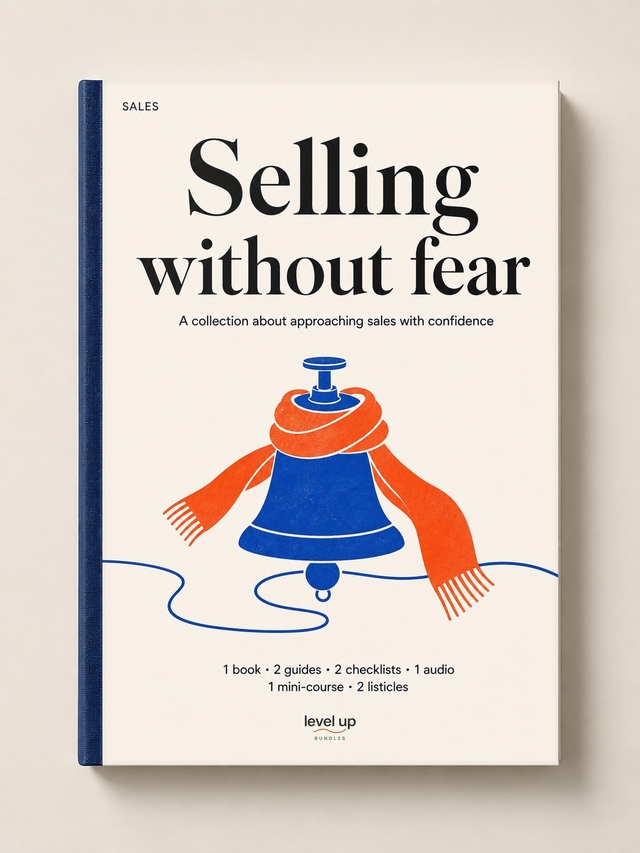
Selling Without Fear
Most non-salespeople hate selling because they've internalised the wrong model of it. The pushy ABC-be-closing template makes anyone feel grimy; the alternative isn't "soft selling," it's a different game entirely, service-led, question-driven, comfortable enough to leave money on the table when the fit isn't there. The fear is mostly about being the wrong kind of salesperson.
The kit covers the gentle-sales playbook. The book lays out the framework, two guides handle the conversational layer (a 3-step warm-up system, client-centred sales conversations), two checklists cover follow-up that feels good and value-based proposal creation, two listicles catalogue the seven psychological blocks sabotaging sales and the twelve trust-building skills that close, and a 6-day "from sales-shy to sold out" mini-course rehearses the moves end to end. The audio companion frames the gentle sales method.
For the consultant, freelancer, or founder who's good at the work and uncomfortable with the asking, and ready to make the asking feel like service.
Contents
In this bundle
9 items, in reading order.
 Audio
AudioThe Gentle Sales Method
Most sales advice teaches volume and pressure, then wonders why most service-providers and small-business operators avoid selling at all. The honest read is that the high-pressure playbook works for one type of operator and burns the rest. The five-episode audio series covers the alternative: episode one walks the 3-touch warm-up system that opens doors without becoming the salesperson the operator hates, episode two covers the 60/40 listening rule that turns sales calls into conversations the buyer wants to be in, episode three handles the proposal mistakes most service-providers make and the structural fixes that close more deals, episode four lands the follow-up cadence buyers actually welcome, episode five reframes selling as care rather than pressure. Made for commute listening. Pair with the ebook for the long-form treatment; the audio is the briefing version.
 Book
BookSelling Without Fear
Sales for service-providers and small-business operators is a strange category: the standard playbook is built for hard-charging closers, and the actual buyer is now allergic to it. The operators who close consistently in 2026 are doing something different, and the difference is teachable. This ebook is the long-form treatment: the trust-building frame that earns the conversation before the pitch, the discovery-call structure that asks the right questions instead of running through a script, the empathy-and-curiosity practice that pulls real information instead of polite answers, the proposal craft that doesn't read as overpriced consulting, the objection-handling that addresses concerns instead of dismissing them, and the lead-pipeline approach that doesn't require cold calling or chasing. Built for the operator whose work is good and whose closing rate doesn't reflect it because they hate the standard sales playbook.
 Checklist
Follow-Up That Feels Good
Most follow-up advice is "send a check-in email" and stops there, and the operator either nags or vanishes. The follow-up that actually works is structured, useful to the recipient, and respectful of the relationship. This checklist installs the follow-up sequence: the immediate post-meeting note (within 24 hours, summarizes the discussion, names the next step), the value-adding mid-week touch that earns the relationship instead of just maintaining it, the longer-arc check-in for prospects that need time, the relationship-warming moves between formal asks (the article share, the introduction, the milestone acknowledgment), the polite-close move for the prospects who've gone silent, and the long-term-relationship cadence that keeps doors open without being a pest. Pair with the warm-up system guide for the upstream work; this checklist is the in-flight follow-up practice.
 Checklist
Value-Based Proposal Creation
Most service-business proposals are price documents pretending to be value documents, and the prospect either picks the cheapest one or doesn't pick at all. The proposals that actually win frame outcome before scope, scope before deliverables, deliverables before price. This checklist runs the value-based proposal pass: the client-needs translation that mirrors the buyer's actual problem language back to them, the outcome statement that names what's different after the work versus before, the scope-and-approach section that earns trust instead of bloating with deliverables, the social-proof placement at the moment doubt would otherwise spike, the price presentation that anchors against value instead of leading with cost, the FAQ section that handles the predictable objections, and the next-step clarity that makes saying yes the easy path. Pair with the client-centered conversations guide for the upstream sales call; this checklist is the post-call asset.
 Guide
GuideClient-Centered Sales Conversations
Most sales calls fail because the salesperson talks too much, asks the wrong questions, and walks out without understanding what the prospect actually needs. The fix isn’t more charisma; it’s a structured approach that puts the client at the center of the conversation. This guide installs the practice: the client-centered conversation framework that organizes the call around the buyer instead of the script, the 60/40 listening rule that catches the operator who defaults to talking, the permission-based dialogue moves that earn the harder questions, the high-leverage question templates that pull real information instead of polite answers, the visual note-taking system that demonstrates active listening without breaking flow, the common-challenge solutions for the moments calls go sideways, and the action-plan close that turns the conversation into a clear next step. Pair with the warm-up guide for the upstream pipeline work; this guide is the actual call.
 Guide
GuideThe 3-Step Warm-Up System
Cold outreach is broken: response rates are at all-time lows, prospects are tired of the templated openers, and the operators sending the cold emails know it. The 3-step warm-up system is the alternative that actually fits how decision-makers buy in 2026. This guide installs the practice: the recognition step that puts the operator on the prospect’s radar through real engagement (not the LinkedIn comment that says "Great post!"), the relevance step that earns the prospect’s attention by demonstrating real understanding of their work, the resonance step that opens the conversation when there’s something genuinely worth talking about, the templates for each step that don’t read as templated, the tracking system that shows where prospects are in the warm-up arc, and the common-mistake fixes that catch the over-enthusiasm that turns warm-up into stalking. Pair with the client-centered conversations guide for the actual sales call; this guide is the upstream pipeline build.
 Listicle
12 Sales Skills That Build Trust and Close Deals
Most sales advice catalogs tactics; the operators who actually close consistently have a smaller set of trust-building skills they run reliably. This listicle catalogs twelve: the active-listening practice that beats waiting-to-talk, the question-stacking that pulls real information instead of polite answers, the assumption-naming move that surfaces the unstated objection, the pace-matching that meets the buyer where they are, the follow-up promise that gets kept exactly when it was promised, the honest-pricing conversation that doesn't dodge the number, the option-narrowing that helps the prospect actually decide, the silence-tolerance during pricing discussions, the post-decision gratitude that earns the referral, and three more, each with a specific application example. Made for desk reference. Sibling to the psychological-blocks listicle; this one is the skills layer that the blocks-list helps the operator have headspace to actually use.
 Listicle
7 Psychological Blocks That Are Sabotaging Your Sales
Most sales advice teaches tactics and ignores the seven psychological blocks that prevent the operator from using any tactic well. This listicle catalogs them: the worth-projection problem that under-prices the work, the rejection sensitivity that makes follow-ups feel like begging, the perfectionism that delays sending the proposal until the window closes, the inherited belief that "real businesses don't need to sell," the attachment to the outcome that pollutes every conversation with neediness, the conflict-avoidance that lets prospects ghost without a clarifying question, and the comparison spiral that watches competitors' wins instead of running the operator's own play. Each entry has the diagnostic and the specific reframe. Sibling to the twelve-skills listicle; this one is the upstream block-removal that lets the skills land.
 Mini-Course
From Sales-Shy to Sold Out in 6 Days
Most "overcome your sales fear" courses are positivity sessions that produce no behavior change, and most students finish with the same hesitation and the same empty pipeline. This drip course runs the actual install across six working days: day one reframes the operator’s discomfort with selling as a strategic asset rather than a liability, day two installs the trust-building conversations that beat scripted pitches, day three lands the framework for asking for the sale without manipulating, day four covers follow-up moves that the prospect actually welcomes, day five sets the content-and-attraction work that brings ideal clients without cold outreach, day six handles the mindset patterns that quietly sabotage every sales effort and the daily exercises that rewire them. Built for the operator whose work is good and who’s been told they need to "be more aggressive" to close. They don’t.