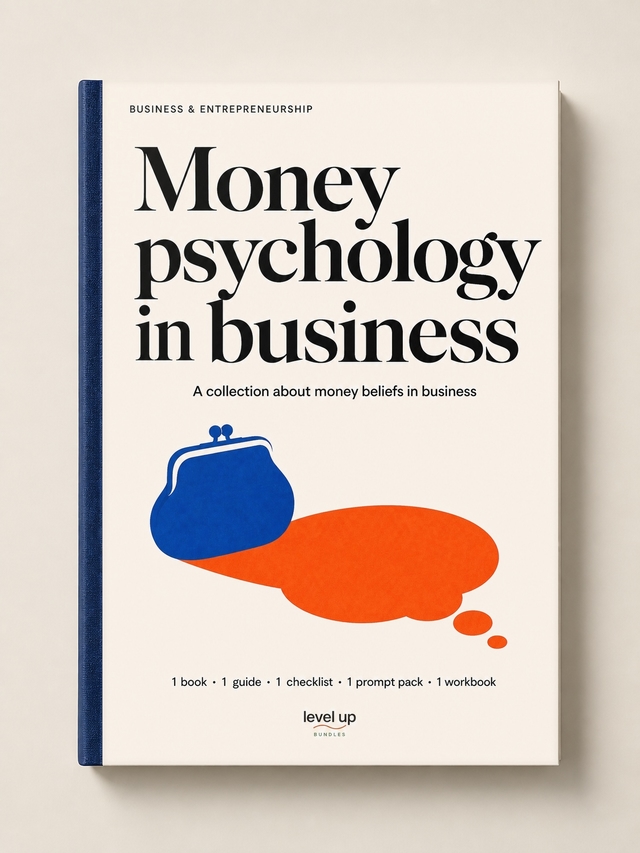
Money Psychology In Business Ebook
Most founders' financial decisions are made by their childhood, not by the spreadsheet. Pricing too low because charging more feels presumptuous. Refusing to invest in growth because debt feels like failure. Saving cash for an emergency that never comes while the competitor with the looser money psychology eats market share. Money operates on trauma and pattern long before it operates on logic, and that's a skill, like any other, that can be unlearned.
The kit handles the money-psychology layer. The ebook lays out the framework, a guide walks through the practical exercises that surface and rewrite the inherited patterns, a checklist gates whether your current pricing and spending decisions are aligned with the business or with old fears, a workbook turns the framework into your own money-relationship map, and a prompt pack covers the journaling and reflection prompts AI is genuinely useful for here.
Aimed at the founder whose pricing, hiring, or investing decisions feel right and aren't, and is ready to find out why.
Contents
In this bundle
5 items, in reading order.
 Book
BookMoney Psychology in Business - Ebook
Most business books treat money as a math problem and ignore the part where the operator sabotages the math because of a thirty-year-old story they don’t even remember inheriting. The math is solvable; the psychology is the bottleneck. This ebook is the long-form treatment: the inherited money scripts that quietly run pricing decisions (under-pricing because "I shouldn’t charge that much," over-saving because "money runs out"), the cognitive biases that wreck financial decisions (sunk-cost in the failing project, recency bias after one good month, anchoring on the first revenue number ever seen), the emotional patterns that trigger spending or hoarding cycles, the daily money-management practice that builds financial muscle instead of avoidance, and the wealth-building mindset that survives the first big setback. Built for the operator who’s done blaming the spreadsheet for problems that started in childhood.
 Checklist
Money Psychology in Business - Checklist
Most financial-decision audits skip the psychological layer and miss the actual reason decisions go sideways. This checklist runs the psychology audit in parallel with the math: the money-script identification (the inherited beliefs about money showing up in current decisions), the bias-check pass for the next three pending decisions (anchoring, sunk-cost, loss aversion, confirmation), the emotional-state check (which money decisions are getting made when tired or activated), the daily-money-touch routine that prevents avoidance from compounding, the risk-tolerance recalibration that catches drift between stated and revealed preferences, and the monthly review that names the patterns before they become permanent. Pair with the guide for the strategic frame; this is the audit pass.
 Guide
GuideMoney Psychology in Business - Guide
Financial decisions in business aren’t really financial; they’re psychological events that happen to involve money, and most operators are losing percentage points of margin to patterns they could change in a quarter if anyone named them. This guide is the build sequence: the financial-decision-making framework that separates evidence from emotional pull, the daily money-management practice that prevents avoidance from accumulating, the bias-resistant decision protocol for the high-stakes calls (pricing, hiring, investment), the structured risk-assessment that handles risk without paralysis, and the recovery moves for the inevitable loss that fires every old script. Pair with the checklist for the audit pass; this guide is the system that makes the next financial decision better than the last one.
 Prompt Pack
Money Psychology in Business - Prompts
Money decisions get harder when the operator is alone with them, and most financial drift happens in the silence between when a decision is needed and when it actually gets made. The pack handles that silence by generating useful pressure: financial-pattern prompts that surface the recurring scripts running pricing and spending decisions, bias-detection prompts that surface the cognitive distortions in a current decision before committing, risk-assessment prompts that pressure-test a decision against multiple scenarios, emotional-intelligence prompts that name the feeling-state behind a money pull, and growth-mindset prompts that handle the post-loss recovery without spiraling into either denial or shame. Drop them into Claude or ChatGPT alongside the actual decision context. Pair with the guide for the strategic frame; the prompts are the working session.
 Workbook
Money Psychology in Business - Workbook
The Money Psychology in Business ebook covers the underlying patterns; this workbook is where the operator does the actual work on their own decisions and habits. The pages walk through structured exercises: the money-script identification that surfaces what the operator inherited about money, the bias-detection practice on actual recent decisions (the ones that didn’t go well), the financial-decision-frameworks application to specific situations the operator is facing, the daily money-management routine setup, and the long-term mindset work that compounds across years. Each exercise is grounded in the operator’s actual financial reality. Pair with the money-psychology ebook for the strategic frame; this workbook is the practice layer that turns understanding into changed behavior.