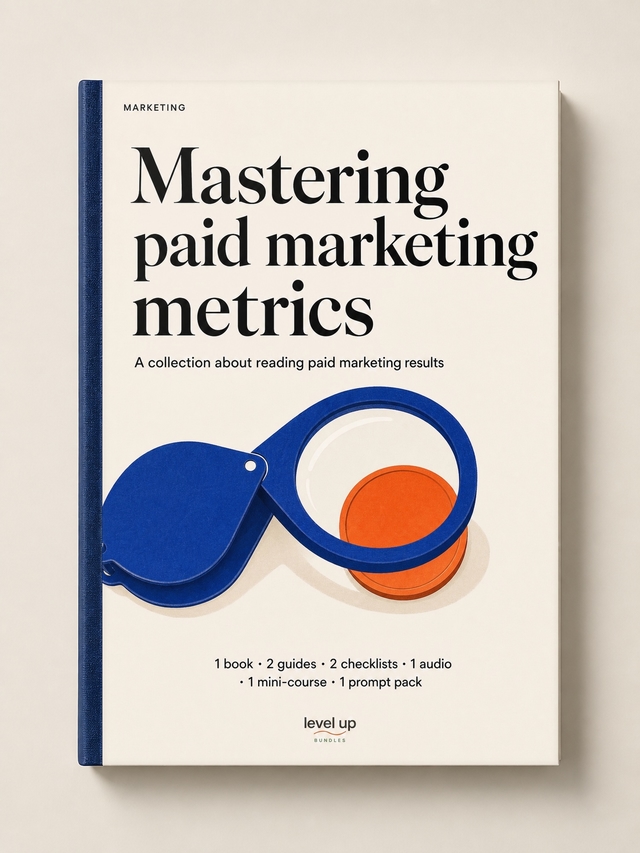
Mastering Paid Marketing Metrics
ROAS is the most-discussed and least-understood metric in paid media. Calculated three different ways across four platforms, attributed by whichever model the team chose two years ago, and reported up the chain as if it's a standard. Most paid programs are flying on metrics that look precise and aren't. The fix is upstream: a measurement framework that survives last-touch nostalgia and produces actual decisions.
The kit treats paid metrics as a discipline. The book lays out the framework, two guides handle the heavy lifting (benchmarking for better ads, ROAS that actually pays), two checklists cover performance-tracking infrastructure and ROI-focused optimisation, a "measure what matters most" mini-course rebuilds the reporting cadence, and a paid advertising optimisation prompt pack handles the AI-assisted analysis. The audio companion runs the from-clicks-to-cashflow framing.
Built for the performance marketer who's done arguing about attribution and ready to report on the numbers the CFO can sign off.
Contents
In this bundle
8 items, in reading order.
 Audio
AudioFrom Clicks to Cashflow
Most paid-media post-mortems blame the platform, the budget, or the creative, when the actual problem is that nobody knew which numbers to read in real time. The five-episode audio series fixes the reading layer: episode one walks the metrics that actually predict revenue (and the vanity metrics that don’t), episode two builds the benchmarks that turn "is this campaign working" from a guess into a measurement, episode three covers ROAS as a CFO would track it (with the LTV and margin context most marketers skip), episode four installs the weekly optimization rhythm that compounds gains instead of swinging them, episode five hardens the tracking infrastructure so the data is trustworthy. Made for commute listening. Pair with the ebook for the long-form treatment; the audio is the briefing version.
 Book
BookMastering Paid Marketing Metrics
In-depth ebook on mastering paid marketing metrics. Checklist
Performance Tracking Infrastructure
Most ad accounts launch campaigns before the tracking is right, then spend the next quarter making decisions on numbers that aren’t real. This checklist is the pre-flight: the conversion-pixel verification (is it firing on the right event, on the right page, with the right value), the UTM tagging convention that survives a team change and connects ad-platform clicks to analytics, the server-side tracking call (when iOS-14 changes mean client-side alone undercounts), the data-deduplication setup that prevents double-counting between platforms, the consent-mode configuration that keeps the operation defensible without strangling the data, and the smoke-test routine before any campaign goes live with real budget. Run it once per platform and twice per quarter. Sibling to the optimization checklist; this one is the upstream foundation.
 Checklist
ROI-Focused Advertising Optimization
Weekly ad reviews are the difference between a campaign that compounds and one that quietly drifts toward CPM-burn. Most operators run the review badly: they look at the dashboard, feel either good or bad about the numbers, and change something at random. This checklist sequences the review properly: the metric pass (CPC, CPA, ROAS, CTR, conversion rate, in that order, against the benchmark), the segment cut that catches a specific audience or placement that’s dragging the average, the creative-fatigue check (impressions per user, frequency, CTR decay), the budget-reallocation rules that move spend toward winners without starving learners, the hypothesis log that prevents the team from re-running the same test, and the action-list with owners. Sibling to the tracking checklist; this one is the weekly operating rhythm.
 Guide
GuideBenchmarking for Better Ads
Without benchmarks, "is this campaign performing" is a feelings question, and feelings are a bad way to allocate ad spend. This guide is the benchmark-build pass: the internal benchmarks pulled from the account’s own historical data (the only benchmarks that actually fit the business), the platform and industry benchmarks worth referencing (and the ones the vendors fudge), the metric stack worth tracking versus the ones that look impressive in slides but don’t predict outcomes, the seasonal and regional adjustments that prevent over-reacting to a quiet Tuesday, the daily-versus-weekly cadence that catches problems without creating noise, and the quarterly recalibration that prevents stale benchmarks from misleading the team. Pair with the ROAS guide for revenue-side framing; this one is the upstream measurement system that makes every other decision defensible.
 Guide
GuideROAS that Actually Pays
ROAS is the most quoted and most miscalculated number in paid media. The operator who treats ROAS as revenue divided by ad spend and stops there is consistently overpaying for unprofitable campaigns and starving the ones that actually compound. This guide is the honest version: the calculation that includes COGS, fulfillment, and the platform fees most marketers forget, the attribution call between last-click, multi-touch, and the LTV-weighted view that matches the actual purchase cycle, the hidden costs (return rate, payment fees, support load) that a margin-aware ROAS exposes, the LTV-based ROAS that turns a "losing" first-purchase campaign into a clear winner, the industry benchmarks worth using for sanity checks, and the scaling logic that survives the move from $5K to $50K monthly. For the operator who wants ROAS to mean something.
 Mini-Course
Measure What Matters Most
Marketing metrics get taught as either intimidating spreadsheet work or motivational poster ("focus on what matters"), and most marketers end up doing the work badly with confidence. This drip course runs the actual system: lesson one decodes the metrics vocabulary so the marketer reads dashboards in real time, lesson two installs the tracking infrastructure that makes the data trustworthy, lesson three lands ROAS and CAC with the LTV and margin context most operators skip, lesson four maps the funnel and connects each metric to a specific decision, lesson five covers attribution beyond last-click without falling into measurement paralysis, lesson six runs the weekly optimization rhythm, lesson seven scales the winners without breaking them. Lessons drip across a working week. Built for the marketer who’s done pretending the dashboard is too complicated to actually use.
 Prompt Pack
Paid Advertising Optimization
Paid-media optimization eats hours in the small drafting jobs: the next test hypothesis, the budget-reallocation memo, the audience-refresh brief, the creative-fatigue analysis. The pack moves those jobs to AI-assisted starting points: campaign-diagnosis prompts that read raw performance data and surface the actual problems, attribution-modeling prompts that frame the right question for the team’s data, budget-reallocation prompts that turn weekly metrics into a defensible spend shift, creative-test prompts that frame variants as proper experiments instead of vibes, audience-segmentation prompts that produce action-ready cohort definitions, and predictive prompts that use historical performance to forecast the next quarter. Drop them into Claude or ChatGPT alongside the actual ad-account data. Pair with the optimization checklist for the rhythm; the prompts are the working session.