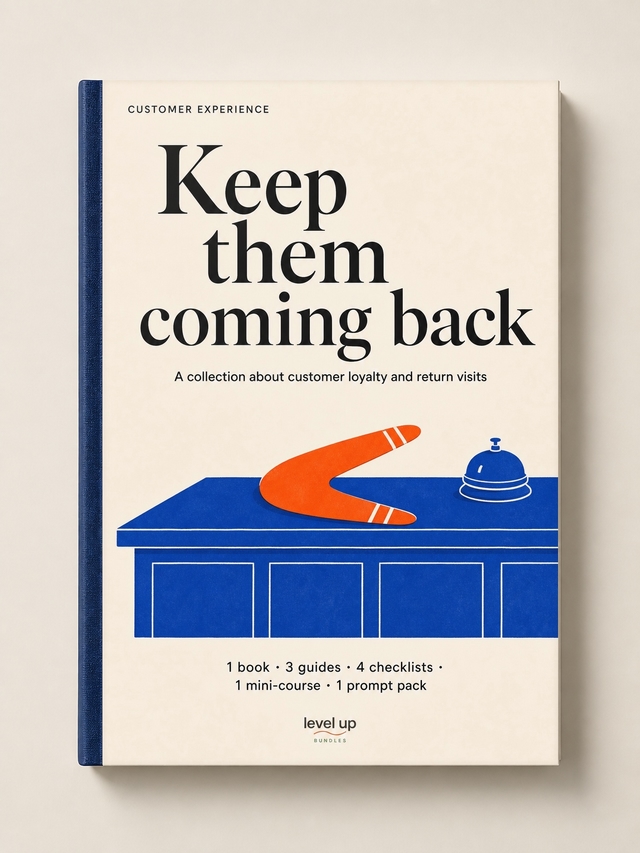
Keep Them Coming Back
Acquisition is loud. Retention is quiet, expensive to ignore, and where the actual margin lives. Most operators know retained customers are worth multiples of new ones; almost none have built the operating system that turns the principle into a churn rate that trends down. The work isn't a "loyalty program", it's the boring infrastructure of customer data, predictive churn signals, and the proactive moves that happen before the cancel button.
The kit lays out the retention operating system. The book covers the framework, three guides handle the heavy lifting (a customer data foundation blueprint, preventing churn before it happens, the loyalty program launch playbook), four checklists turn each into a recurring routine (community building, data collection, loyalty launch, proactive service), a retention formula mini-course rebuilds the cadence, and a customer retention prompt pack handles the AI-assisted segmentation and outreach work.
For the operator who's done playing the acquisition treadmill and ready to compound on the customers already in the door.
Contents
In this bundle
10 items, in reading order.
 Book
BookKeep Them Coming Back
Acquisition cost has been climbing for a decade and most operators are still solving for the wrong problem. The math says the customer who buys twice is worth four times the customer who buys once, and almost nothing in the typical funnel is built for the second purchase. This ebook is the long-form treatment: the loyalty math that determines what a retention point is actually worth, the loyalty-program designs that earn repeat behavior versus the ones that get gamed, the personalization moves that work without an enterprise data stack, the proactive-service playbook that catches churn before it shows up in the cancellation form, and the community-as-retention-channel work that turns customers into the marketing. The frame is operator-economic, not feel-good. Built for the founder who’s already paying for ads and wants to stop renting customers.
 Checklist
Building Thriving Communities
Most brand "communities" are a Slack with sixteen people in it and three messages from last March. The community that actually drives retention has structure, ritual, and a reason to show up that isn’t a coupon. This checklist is the build-and-run sequence: the purpose statement that filters out drive-by joiners, the platform pick (Discord, Circle, Slack, Facebook Group, branded forum) matched to the audience instead of the founder’s preference, the first-week posting cadence that prevents dead-channel syndrome, the moderator system that scales past the founder’s attention, and the engagement metrics that catch decay before it’s terminal. Use it when launching a community from scratch or fixing one that went quiet. Pair with the loyalty-program work for the full retention motion, not just the social layer.
 Checklist
Customer Data Collection and Analysis
Most retention programs fail at the data layer, not the strategy. The operator collects email and order history, calls it a CRM, then wonders why personalization keeps reading like a mail merge. This checklist is the data-foundation pass: the inventory of what’s already being collected (and where it’s siloed), the seven data points that actually predict repeat behavior, the consent and tagging structure that keeps the operation GDPR-clean without strangling the marketer, the dedupe and hygiene routine that runs monthly instead of yearly, and the analysis cadence that turns the dashboard into decisions. Pair it with the data-foundation guide for the strategy and the loyalty-launch checklist for the activation. This one is the audit before any of that gets built.
 Checklist
Loyalty Program Launch
Loyalty programs fail in the first ninety days, almost always for the same three reasons: the rewards are boring, the enrollment friction is too high, or nobody told the customers it exists. This checklist sequences the launch so none of those happens: the reward economics that make the program profitable instead of a margin leak, the tier structure that creates real progression instead of vanity badges, the integration list (POS, email, SMS, app) that has to be live before opening day, the launch-week communications across every channel the brand owns, and the early-signal metrics that flag problems before the program calcifies. Pair it with the loyalty-program playbook guide for the strategic frame; this is the operational checklist for the launch itself.
 Checklist
Proactive Customer Service Implementation
Reactive support waits for the ticket. Proactive support spots the problem in the data before the customer types it, and the difference shows up in retention numbers within a quarter. This checklist installs the proactive layer on top of whatever support stack already exists: the trigger events worth monitoring (failed payment, unused feature, support tickets per cohort, login decay), the outreach templates that don’t read as creepy or panicked, the routing rules that send the right kind of contact for each trigger, the measurement frame that proves the work is actually preventing churn, and the staffing math for who runs it without breaking the existing queue. Pair with the churn-prevention guide for the diagnostic playbook; this is the implementation checklist that turns the strategy into a running system.
 Guide
GuideCustomer Data Foundation Blueprint
Personalization, churn prediction, lifecycle marketing, all of it sits on top of customer data that most operations don’t actually have. This guide is the architectural pass: the data model that underwrites every retention move (identity, behavior, preference, transaction, support history, all keyed to one customer ID), the collection points that fill it without adding friction at checkout, the storage call between a CDP, a CRM, and a warehouse depending on volume and team, the privacy and consent layer that keeps the operation defensible, and the feedback loop that flags decay in the data quality before the marketing team builds on top of dirty inputs. Pair this blueprint with the operational checklist for the audit; this guide is the architecture, not the to-do list. Built for the operator who’s tired of running personalization on guesswork.
 Guide
GuidePreventing Customer Churn Before It Happens
Churn shows up in the cancellation form, but it started six weeks earlier in the usage data. By the time a customer hits the cancel button, the operator has already lost them; the work is at the early-signal layer. This guide builds the churn-prevention system: the leading indicators that predict cancellation across SaaS, ecom, and subscription models, the cohort views that separate normal disengagement from terminal drift, the intervention playbooks tiered by severity (light nudge, human reach-out, retention offer, win-back), the math that decides when a save is profitable versus when it’s negative-margin, and the post-mortem routine that turns the churns that did happen into product input. Pair with the proactive-service checklist for the operational layer. This one is the diagnostic and decision frame.
 Guide
GuideThe Loyalty Program Launch Playbook
Most loyalty programs are points-for-purchase with a different logo, and they perform like points-for-purchase with a different logo. The programs that move the retention number have a structural reason customers care, and that reason is designed in, not bolted on. This playbook covers the design work: the choice between transactional, tiered, paid, and hybrid models matched to margin and purchase frequency, the reward menu that actually changes behavior (and the discount-only menu that erodes margin), the gamification layer that earns engagement without manipulating it, the partnership and coalition plays that extend perceived value without raising cost, and the iteration cadence that keeps the program from going stale at month nine. Pair with the launch checklist for the operational rollout; this is the strategic frame.
 Mini-Course
Retention Formula
Acquisition is the noisy metric; retention is the one that compounds. Most operators run a single retention play, see modest results, and move on, missing that retention is a system of overlapping motions where each one lifts the others. This drip course assembles the full system: the unit economics that quantify what a one-percent retention lift is worth in this specific business, the loyalty-program layer that earns repeat behavior, the personalization layer that makes communications feel chosen instead of blasted, the proactive-service layer that intervenes before churn, and the community layer that turns customers into the marketing channel. Each lesson lands one motion; the final lesson sequences them into a cadence the team can run. Built for the operator who’s done with point-fixes and ready to install the engine.
 Prompt Pack
Customer Retention Excellence
Most retention work stalls because the operator doesn’t have time to draft the third version of the win-back email or run the cohort analysis from scratch. The pack collapses that drafting overhead: the segmentation prompts that turn raw customer data into named cohorts a marketer can act on, the loyalty-tier-design prompts that test reward economics before launch, the personalization prompts that produce variant copy across email, SMS, and in-app without losing voice, the churn-signal analysis prompts that read usage data and flag at-risk accounts, and the win-back sequence prompts that don’t read as desperate. Drop them into Claude or ChatGPT alongside the actual customer data and skip the cold-start. Pair with the retention course for the strategic frame; the prompts are the working layer.